I hope it works out but I find it hard to believe that they’ll be able to knock three birds with one stone (better sculpting, texturing and now a mobile branch).
2 Likes
oh no…
Why?
3 Likes
It probably won’t be as time consuming as you’d think. It’s already been ported to the Mac, so all the truly labor intensive work of getting it running on Apple hardware using their frameworks and APIs has already been done. It’s primarily going to be interface work, both in terms of layout and actual literal interfacing with your fingers or a pen.
3 Likes
I understand their need to enter this market and widen the audience but at what cost?
if it’s just a side project then it would be fine but if takes the time and resources from the main project then that’s a big problem.
They should have kept Pablo Dobarro around ,he already have done so much and I believe he now has developed two 3D apps that tailored directly for IPad.
How are they going to compete with such in terms of UI/UX and Performance?
3 Likes
I’ve got them both. CozyBlanket is an excellent retopology tool. Uniform? Well, it performs well, and is surprisingly feature rich. Actually using these features simply and easily is another matter altogether.
Not just “at what cost”, but “for what gain”?
Kept him? How? He wasn’t fired. He left because the community rejected him and his ideas
3 Likes
So naturally, as someone who has been using mobile apps (Valence3D and/or Nomad these days) for making characters, backgrounds and props to then animate on Blender on my laptop, this is an interesting development for me.
Not sure how successful this could be beyond maybe making desktop Blender less reliant on keyboard shortcuts, or maybe putting in some much-needed work on the sculpting and texture paint tools, though–we already have a good selection of 3D modeling, sculpting and texturing tools just from the iOS App Store alone, like the two I mentioned above. Perhaps Blender should focus on the “all-in-one” aspect of a theoretical Blender iPad app, as opposed to the current standard of buying and using like a dozen specialized apps just for 3D pre-production and STILL needing to eventually move on to a proper desktop or laptop for things like animation, lighting, and especially rendering. Perhaps they could focus more on making animating in Blender on a tablet far more intuitive at first, because (at least on the App Store) there seems to be a lot less competition for remotely-passable 3D animation apps, and the ones I do find are prohibitively expensive for some. The best 3D animation app I’ve been able to find for my iPhone so far is Morphin, which I believe set me back $40 (at least it was a one-time purchase) and I find it mostly useless beyond basic practice and maybe making low-poly YouTube Shorts loops and GIFs with a little jiggery-pokery.
As long as it doesn’t take too much resources away from desktop Blender, this could be a good way of learning ways to make Blender a bit more approachable than it already is to the more tablet/mobile-obsessed Gen Z and Gen Alpha generations. And I’ve stretched myself thin before with multiple simultaneous projects, heck I’m doing it now these past few months, I think the comments suggesting it’s completely impossible for Blender devs to work on this side project while still keeping desktop Blender in tip-top shape are underestimating their individual work ethics…
I don’t know how much I can share, but let’s just say that the foundation is not going to put a team of developers on this.
I’m super excited about this project ! Don’t know how many times people have asked about animating with Grease Pencil on the go. Or having a version that’s optimized for big wacom screen tablets.
And I’m also a big fan of making it an application template. That means that Blender itself won’t have to change or “know” about the device it runs on and what input requirements it has. So that means that as a dev, I won’t have to develop for multiple input targets. And if I want to see how the ipad version looks while on my working computer (linux) I can just check the app template  nice
nice
13 Likes
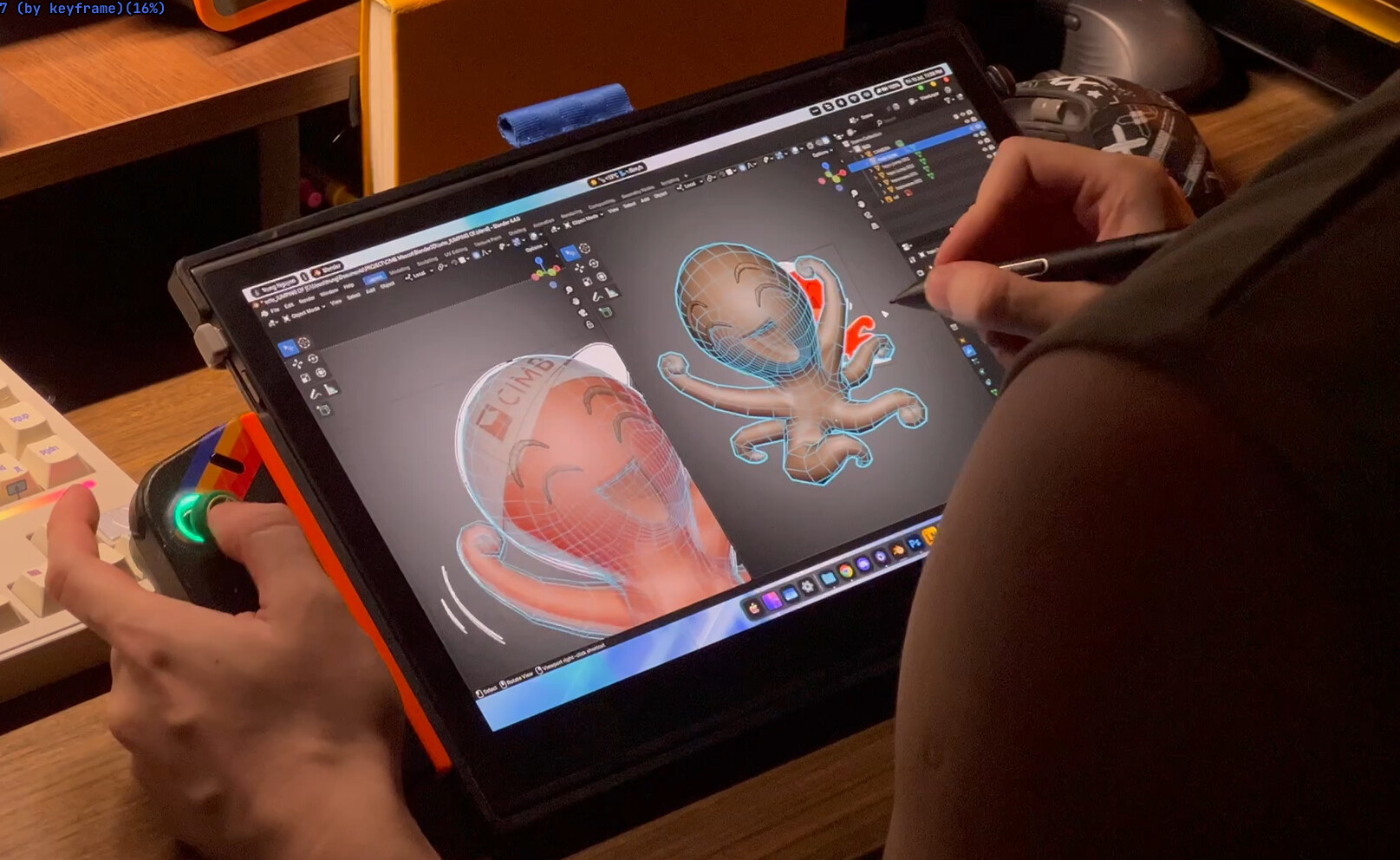
I have a DIY windows tablet version.
Depends on whether windows will finish thin and light tablets first or ARM tablets will finish software first.
1 Like
If you keep a keyboard around ; that looks slower that maximizing/minimizing the editor.
The mock-up implies that user is constantly clicking to open one panel/one editor at a time.
That is a mock-up for small screens, unable to display several editors, panels or gizmos, at once.
That is a mock-up where menus are collapsed, because header is wider and its icons are bigger.
That is a mock-up where last operator region is hidden.
That is a mock-up where asset shelf takes the whole wide of the screen.
That is again a mock-up for left handed people.
That is a mock-up very close to what 2.8 UI mock-ups were.
That does not solve our issues.
That does not help people to arrange a lot of small UI elements, a maximum of info, a maximum of settings frequently tweaked, on a big screen, efficiently.
Because the paradigm is still to hide a maximum of things behind popovers and big icons.
Nobody can work quickly, with an hiding UI.
This is great news! I have always wanted blender to be able to run on any OS. Ipad already uses the same chip as MacBook so it’s a logical step forward for the future. Also Android is already confirmed to be merged with Chrome OS, so in a few years, android can actually be your next desktop.
6 Likes
I can see this may be useful for getting more people into 3d modelling since most people already own a tablet, however for a lot of users I think an external graphics tablet would be better. The issue would be with using Blender on a tablet is rendering, even if the IOS app has rendering support it would be very slow, meaning that even if you get into Blender on a tablet you would likely need a PC to render on unless maybe you just use Eevee
Or, it could leave it all in a more half unfinished/broken state.
To me the far more logical thing to do would be to really focus on and get Texturing/Sculpting highly working and polished and then consider porting all of Blender to iPad, etc.
At the end of the day, any tablet use is more likely to be used for texturing and sculpting (with 2D drawing/animation and storyboarding a fair second option).
However, even on desktop, most texturing and sculpting is done using some sort of tablet. So overall, not only are the toolset and features of those greatly improved, but all of the UI considerations and polish is also done from a tablet point of view.
Then, with all of that insight and user feedback, a much more complete whole of Blender tablet UI can be developed.
Otherwise, we just get current Blender on a tablet and for texturing/sculpting, I already know what that is like and no amount of iPad UI with no mouse or keyboard or buttons is going to fix or change any of the base issues.
7 Likes
I don’t think the community rejected his ideas, He was doing great for Sculpting & Painting.
I think it might be an internal conflict with the Devs, who knows!!
His ideas were almost a direct copy of “Zbrush features” which might cause legal problems to them, but this is another discussion for another topic.
1 Like
There are currently 11 projects for 2025 that are incomplete or not started:
I think it’s fair to be concerned that adding a new giant project will impede the progress on these other projects, most of which are not on track to be met by the end of the year. Can you clarify what the plan is to get these 12 projects finished and how this additional project won’t affect the other 11?
I’m also somewhat concerned by the status here- there’s a partially functional prototype that’s been worked on for a long time, however, it doesn’t appear on the 2025 project list or any other public facing roadmap until now. How does secret development fit into the paradigm of openness that Blender traditionally values?
6 Likes
I think “the grateful community” was going around saying something along the lines: “oh no, this guy is only interested in making anime girlz, so he won’t do anything good / will make sculpting unusable for us, real sculptors” 
2 Likes
None of the developers assigned to existing projects that are listed in the update will work on this. That post is also pretty outdated by now, I think the Q3 update should probably coming soon.
All the project development that is done by the foundation is openly documented. There’s no secrets there. But there are developments happening outside the foundation. Like the XR Grease Pencil project. Obviously the foundation can’t decide how they choose to communicate, if at all.
6 Likes
Out of those 12, as of today 4 are completed (UV sync just final review remaining, but is considered complete), 3 are in daily development, 2 are being designed, and I do expect remaining three to go into next year (all because priorities changed when projects started, and some things became more clear).
I also don’t know why you’re spreading information that this is a project that was being worked on for a long time? All the work done so far is mock-ups by Dalai, exploration PR by Harley, and initial build for iOS that Sergey did just couple days ago. Rest of the work was planning done by non-developers, and after it was done information was published.
One day without spreading conspiracies would be a nice change.
7 Likes
Which are those 4?
Vulcan is marked Complete, but doesn’t seem to actually be complete. (Maybe my definition of “complete” is different than the post author’s.) What are the other 3?
One day without spreading conspiracies would be a nice change.
Asking questions ≠ spreading conspiracies.
4 Likes