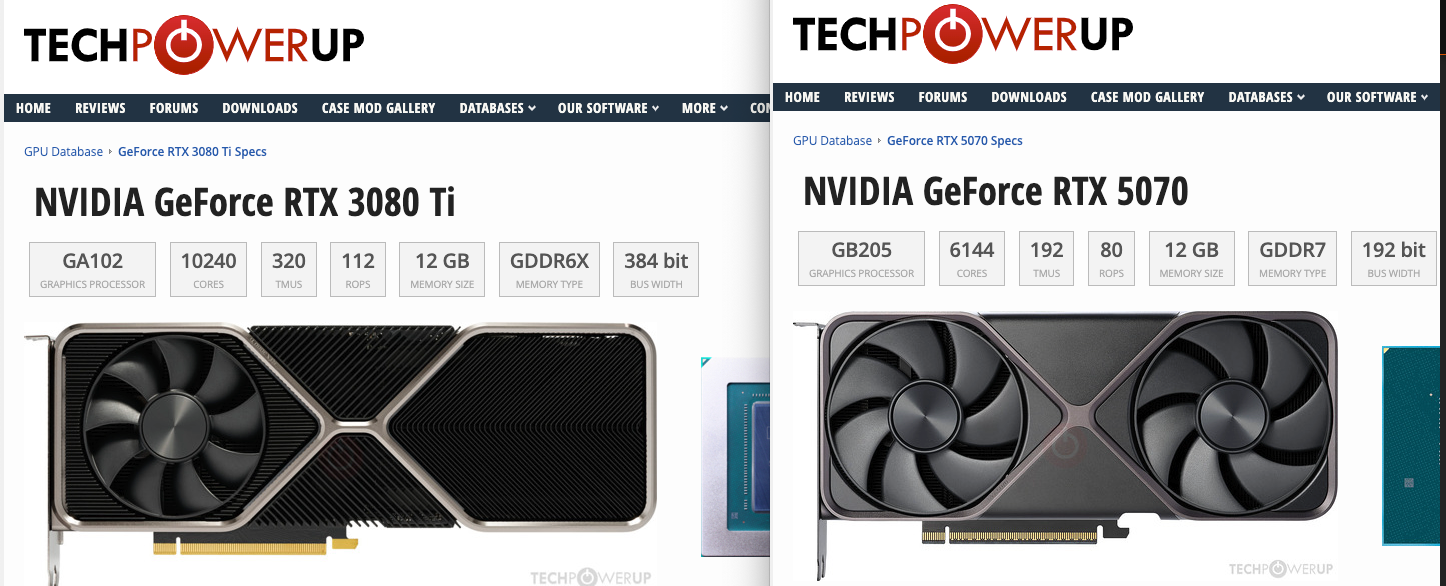
Thank you for responding with the link! I had read it, but reading it again raises my interpretation: that the GPU benchmark score is independent of VRAM. The only mention of GPU memory following the ‘path tracing samples’ hyperlink is under the ‘Denoising’ header, below the ‘Use GPU’ sub-header, where the manual states, “large scenes need[ing] more GPU memory” (noting users can denoise using the CPU if needing to preserve GPU memory for a large scene). This being the only mention of GPU memory on the page, I interpret the GPU benchmark value to be a ranking of each GPUs computational render performance independent of scene size, being, the GPU’s power to compute path tracing samples alone. Still though, I am confused. Comparing the 3080 Ti to the 5070, each with 12 GB of VRAM, there isn’t a single spec that the 5070 surpasses the 3080 Ti, yet the 5070 has a higher GPU benchmark value.
Perhaps, considering the @thorn analogy to HP above, the 5070’s use of AI processing amongst other engineering synergies produces superior render performance, despite its lower specifications across the board in comparison to the 3080 Ti (the GPU benchmark value delta is marginal).
I have not tried to do so, but perhaps those who run the Benchmark Launcher locally on their computer, providing the data the Blender Foundation leverages to compute the GPU benchmark tier list, are able to gain an insight into the data they collect and can provide this thread with any learned insights.
In any case, my main interest is/was whether or not VRAM is a variable used in computing this “GPU Median Score”, that perhaps a weighted average equation is used to benchmark GPU performance factoring in a GPUs VRAM. But, at least from reading through the manual again without any additional information, this does not seem to be the case. This may be more a testament to my fundamental understanding (or lack thereof) of how Blender works. In that, if VRAM has nothing to do with rendering path tracing samples (render performance) in a vacuum, than perhaps the foundation, in so communicating the GPU benchmark data to its users, does so to relate their findings of a GPUs render performance independent of the size of a scene.