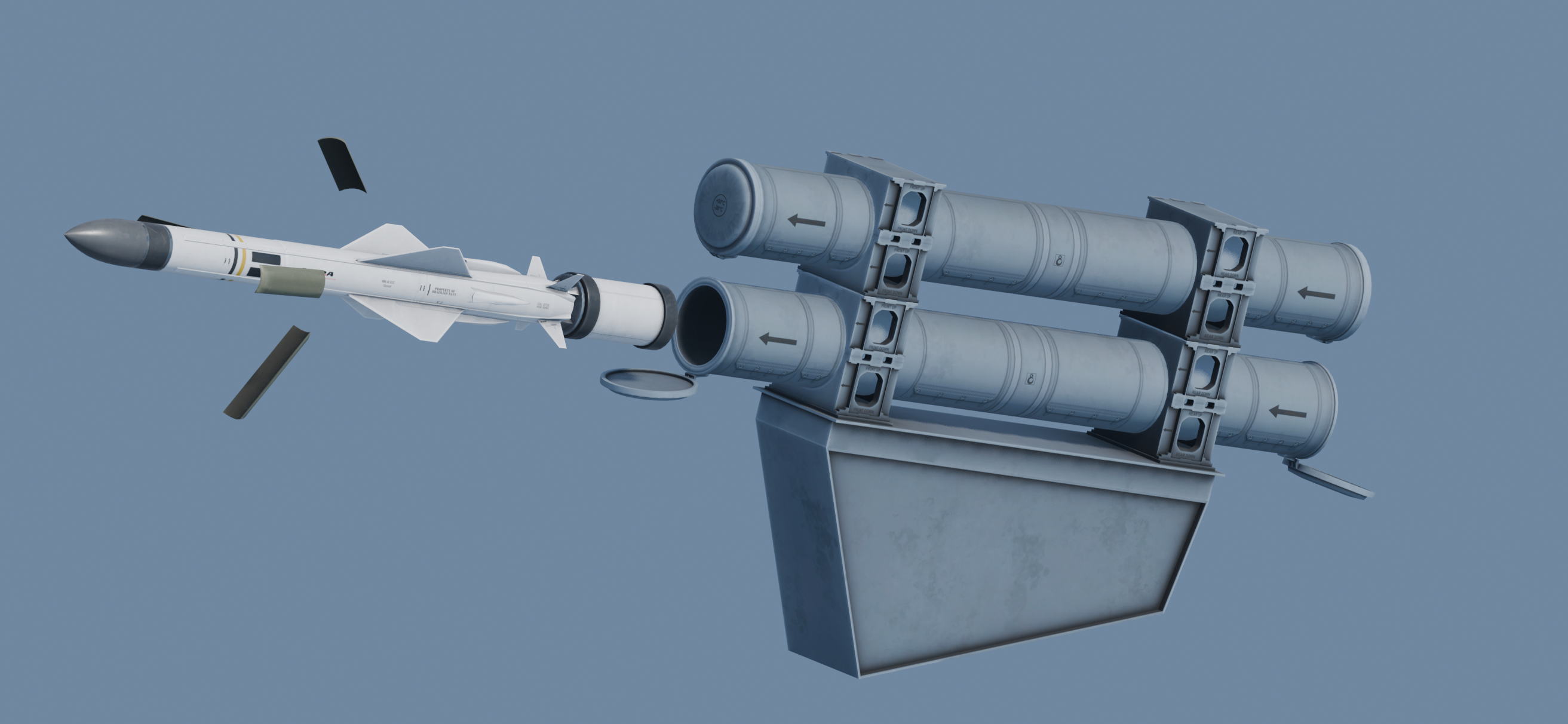
Real-time 3D asset of the Exocet MM40 Block 3C anti-ship missile and canister launcher assembly, developed for integration into the Brazilian Navy’s Tamandaré-class frigate model for naval simulation.
Modeled in Blender and textured in Substance 3D Painter, the asset is optimized for military simulation, depicting an active launch sequence complete with deploying sabot centering shoes and the booster stage.
Technical Specifications:
-
Total Polycount: 17,488 triangles
-
Missile Assembly (Missile, booster & centering shoes): 5,498 triangles
-
Launcher Assembly (Canisters & pedestal mount): 11,990 triangles
-
-
Materials: 2 independent material sets (Missile & Launcher)
-
Texture Resolution: 4K PBR textures
-
Software: Blender, Substance 3D Painter
-
Application: Real-time naval simulator made in Unity (Brazilian Navy)
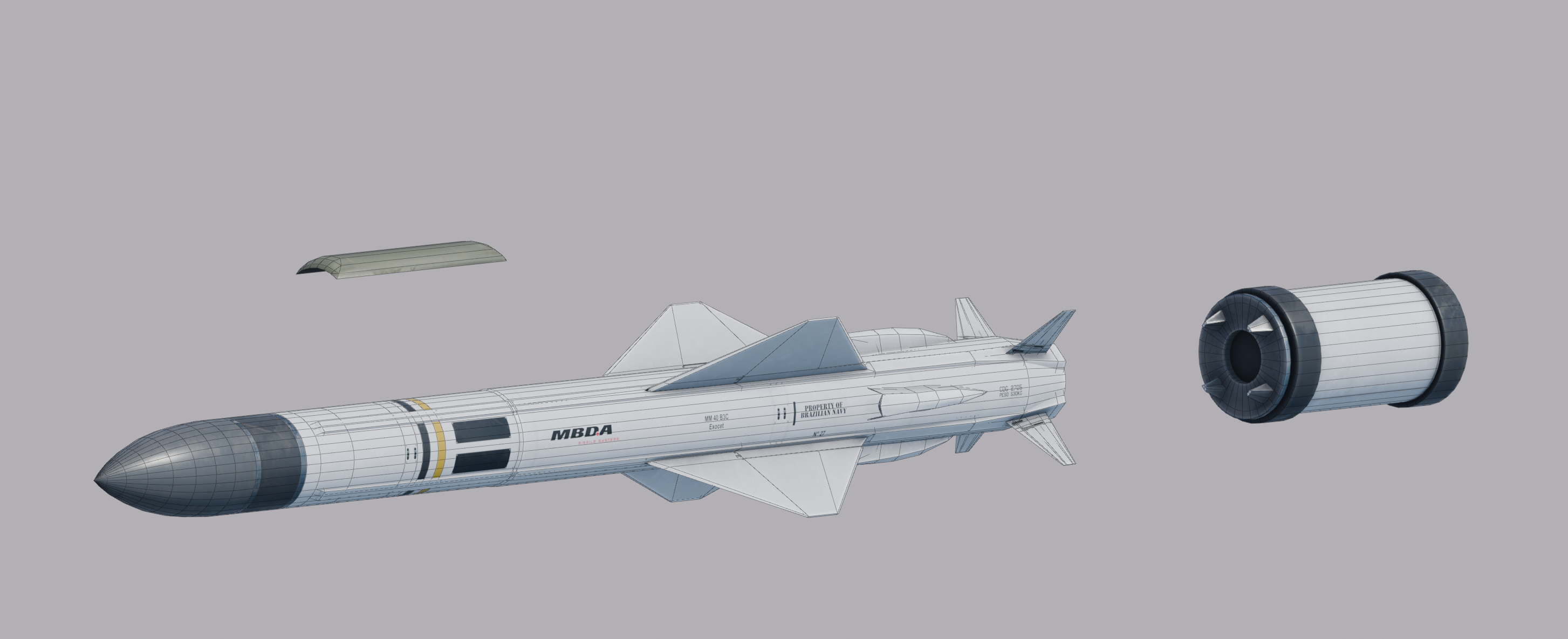
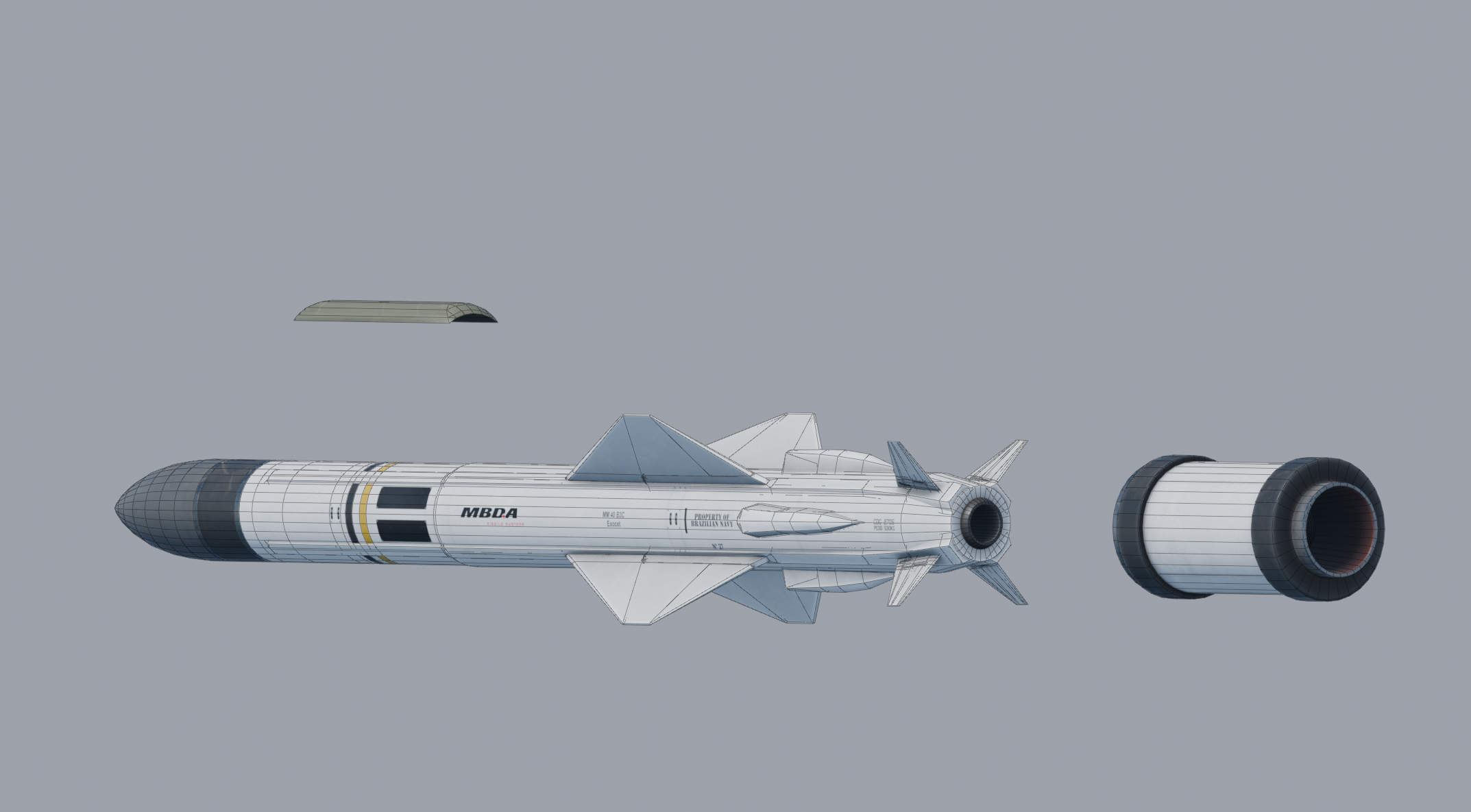
Here is a closer look at the Exocet MM40 Block 3C missile itself, along with how the assembly was broken down to support in-engine visual scripting and physics for the simulator.
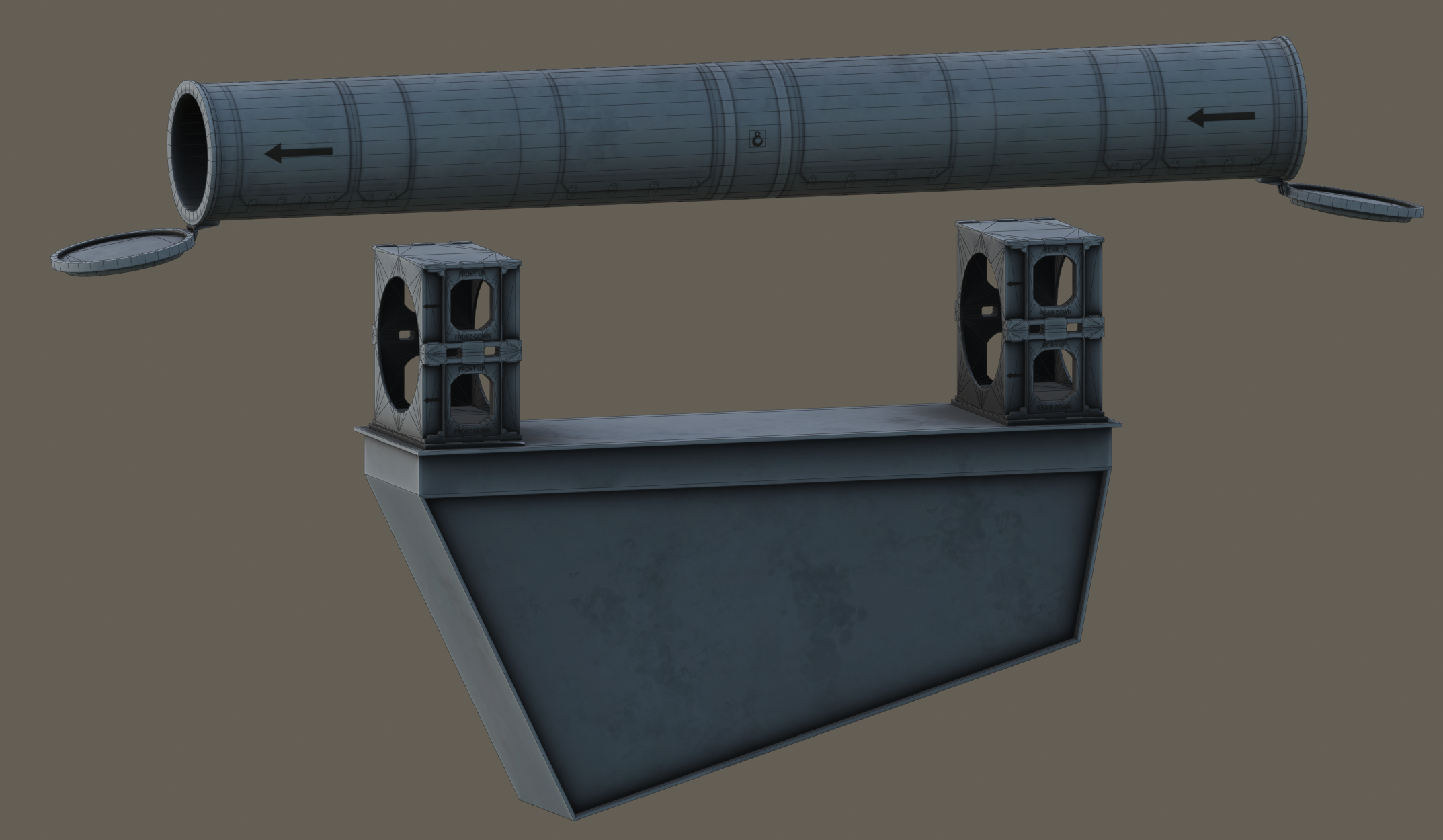
Here is a closer look at the Exocet Launcher itself with only one tube and both doors opened.
Modeling & Optimization:
- Aerodynamics & Control Surfaces: The main cruciform mid-body wings and rear steering control fins were modeled with clean silhouette management in Blender, keeping bevels efficient while maintaining aerodynamic fidelity.
- Modular Separation: For simulator deployment, the model couldn’t just be a static mesh. The solid propellant rocket booster is an independent sub-mesh that cleanly detaches post-burnout, fully exposing the sustainer turbojet engine nozzle beneath it.
- Canister Exit & Sabots: The launch shoe guides/sabots are also discrete pieces, allowing the sim’s visual fx logic to eject them dynamically as the missile clears the launch tube muzzle.
- Articulated Blast Covers: Both the fore and aft protective caps are modeled with dedicated hinge pivots, allowing full operational animation, swinging open prior to ignition to clear the missile trajectory and vent booster exhaust gases safely overboard.
- Cylindrical Tube & Guide Rails: The container geometry balances silhouette smoothness with low-poly optimization, keeping circular cross-sections clean while preserving polygonal budget for mechanical connection points and internal rail guides.
- Structural Saddles & Cutouts: The dual clamping frames feature realistic weight-reduction cutouts and gusset reinforcement details. The topology was kept clean with strategic quad/tri distribution to hold sharp industrial bevels under real-time lighting without baking artifacts.
- Angled Deck Mount: The lower pedestal was designed to match the specific deck installation footprint on the Tamandaré-class frigate, preserving the authentic elevation angle required for naval surface-to-surface missile launch envelopes.
Texturing & Stencils:
- Identification & Markings: Recreated accurate live-ordnance hazard bands, maintenance access hatches, factory MBDA markings, and custom *“PROPERTY OF BRAZILIAN NAVY”* operational stencils.
- Surface Detail & PBR Values: Subtle surface variations—radar-absorbent coating feel on the nose radome, slight thermal discoloration around exhaust areas, and restrained metallic wear along panels and canister rail contact points.
- Missile Launcher Features heavy-duty naval grey paintwork with localized salt-spray buildup, operational directional stencils, subtle fastener grime, and friction wear along the clamping brackets and hinge pins.
Thanks for checking out the project!
Any feedback on the topology, rigging setup, or texturing workflow is greatly appreciated.