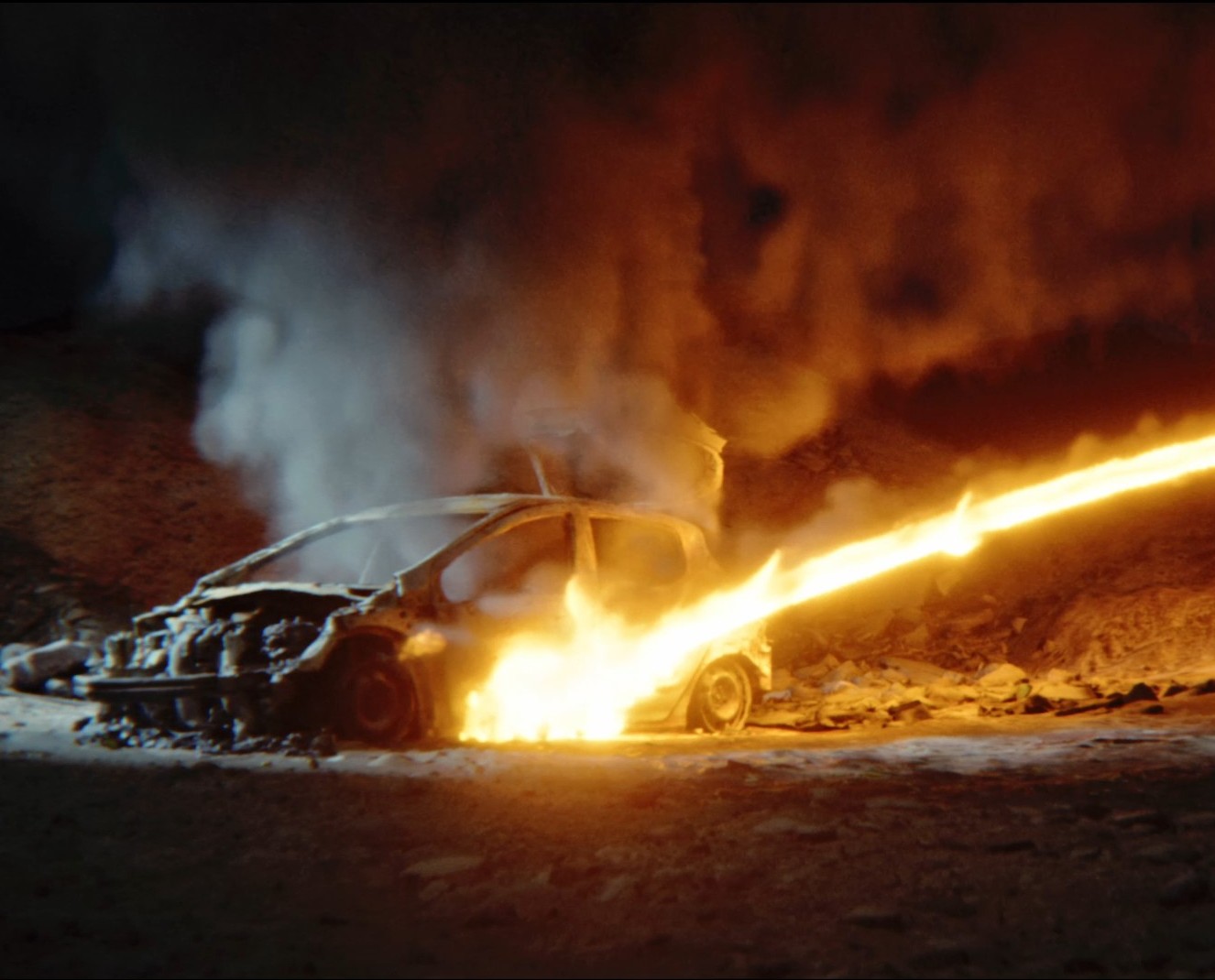
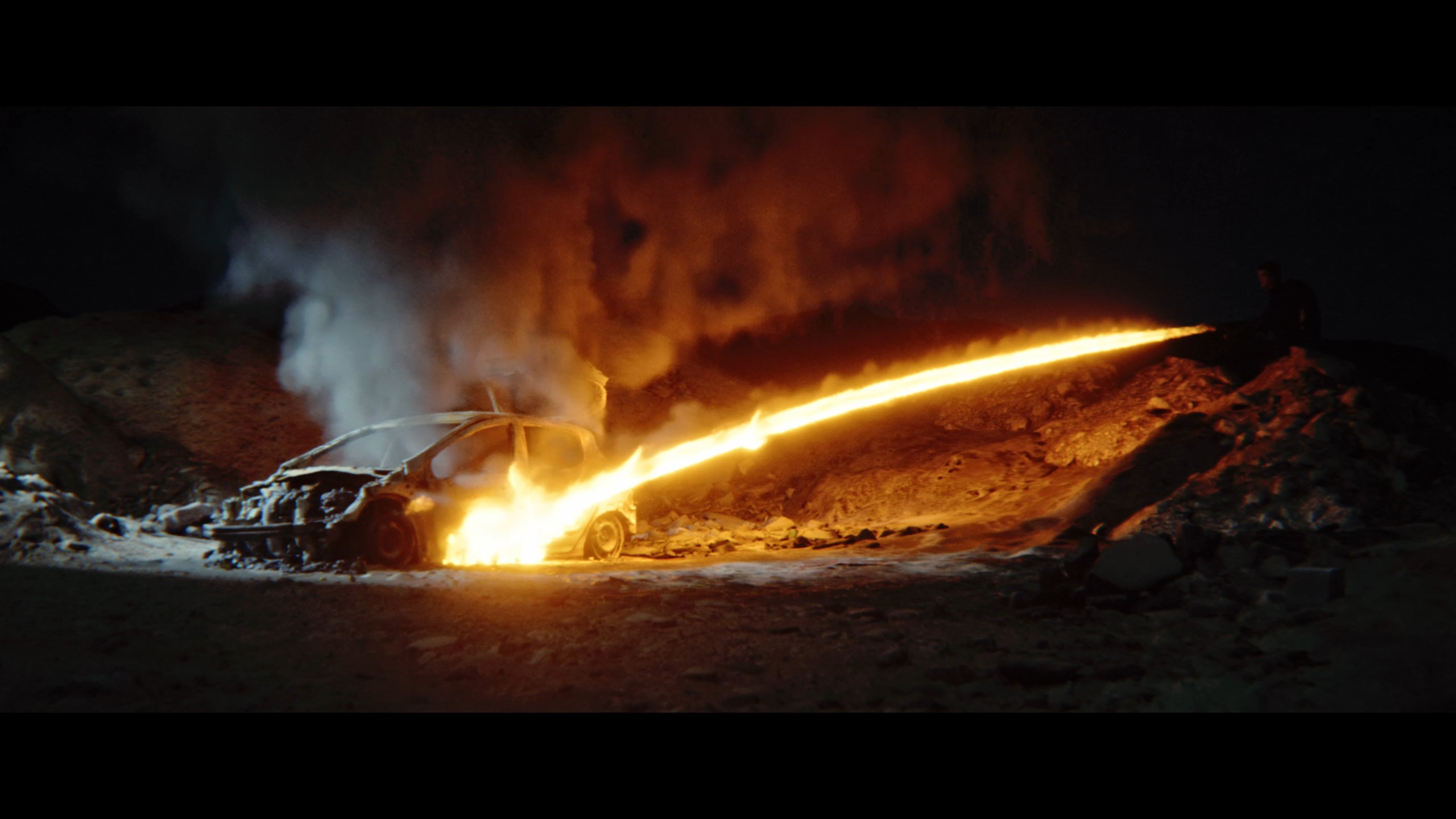
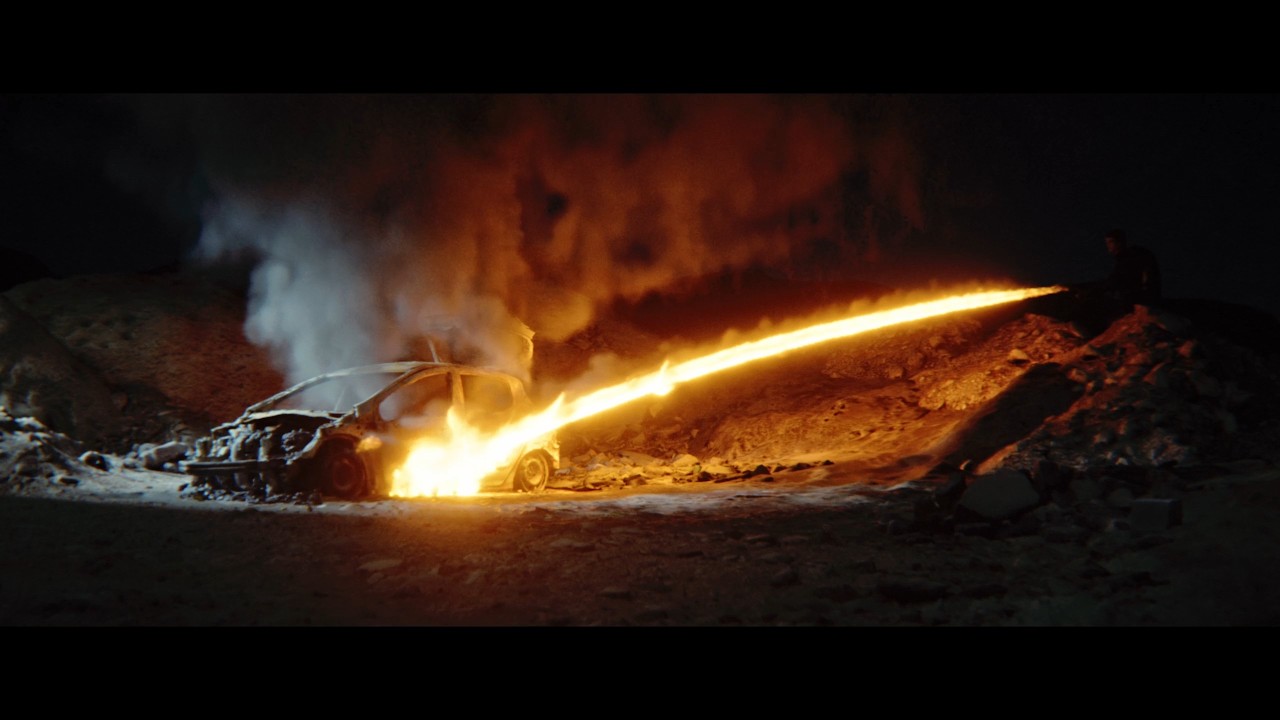
The fire and smoke simulation was done with my own free and open source addon Continuum Flow. It can simulate flow on the GPU (Nvidia only) and is significantly faster than Blenders current implementation MantaFlow. If you are interested you can download it here:
There is also some more information and history in this post:
The simulation is based on a simple particle stream emitted by the flame thrower. This particle system acts as a source for the simulation. The car is an obstacle for the particles and for the flow simulation.
That still frame is unreal — the flame core reads so hot and dense, and the smoke rolling over the burned car has real weight to it. Fire sims usually fall apart for me in the turbulence: too smooth and it looks like a video-game effect, too noisy and it turns to mush. Yours sits right in that sweet middle — the way the smoke keeps its structure as it lifts off the hood sells the whole illusion.
The fact that this runs on your own GPU solver (Continuum Flow, right?) makes it even better. I just finished my first animated short and simulation work was the one thing I was too scared to touch, so watching someone ship their own flow solver AND a film out of it is properly inspiring.
One thing I’m genuinely curious about: the flame stream hugs the ground for a surprisingly long time before it lifts — was that tuned through the particle stream’s emission angle, or does the solver handle the buoyancy transition on its own? Would love to know what you’d tweak if you had one more week with it.
Hey thanks a lot for such a nice reply !
I am not completly sure what you mean by the later part. The particles emit smoke and fire for as long as they live in the simulation. They die shortly after hitting the car. The buoancy simply depends on the temperature which is very hot close to the particles. Does this help? For the last question. If i had more time with it i think i would probably just run a more high res case. There are for sure things that could be tuned which i do not see right know. Maybe that the places where there was burning a color change in the car?
It looks good overall, but there is one little detail that appears uncanny and not like realistic fire behaviour and that is how some of the flames dissolve/disappear (the ones rising from the car).
Flames don’t show this particle behaviour when they die off, I am assuming your particle system source is driving this. You can (and should) use particles to source velocity into the sim, but you need to be careful with the temperature/fuel especially after it was “thrown” by the flammenwerfer.
In reality, the fuel sticks to the surface and drips down or goes through combustion.

 !