In any case I believe proper hair sim to be about the most tricky thing among the types of numerical simulation usually used in CG.
That is to say, other than cloth, hair is as anisotropic as it gets (quite sure hair hardly stretches, and it’s so thin, it has to be basically modeled as a one-dimensional string).
Add to that there’s probably little room for optimization via a combination of sparse sampling and interpolation (hairstrands rooted next to one another might easily be exposed to wildly different forces in real life), as well as the fact the number of strands you’d typically need per scalp are a six digit number and you have yourself a nasty thing to numerically solve.
That’s at least my layman understanding. In that sense, I assume full, proper hair simulation is actually a tall order.
I haven’t seen tests from the developers in that regard. Some time ago a few physics tests with geometry nodes, just when they started to work on simulation nodes.
It appears to me, they actually want to do it, but going into such a production without having something that actually works would be incredibly naive. The bare minimum is to have something that kind of works and they feel very comfortable to getting it ready.
It is more likely in my view, we are going to see some more basic physics functionality in geometry nodes at one point and later on this might be extended to cloth simulations and hair.
Yeah, I have little doubt that the current simulation limits and the work involved in getting it ‘production ready’ is somewhat driving the art design. Been plenty of examples, Spring, Ellie, there’s a reason the Charged dude has a cap.
Now I know they have it planned, but I fear by the time they get around to it, it will just be done enough to say its there and pretty much left half finished for the next decade, much like current hair/cloth.
Leaving simulation nodes to be something that just looks great for motion graphics. As long as the Blender Studio ‘avoid’ it, I’m not sure that’s going to change.
On ocean waves: I saw a liquid sim addon (Cell Fluids, video) using simulation nodes in real-time, looked awesome. It’s early days, but nice rolling waves and foam. I expect the Blender devs to come up with a better version for this movie, given their experience with sim zones and the Ocean modifier.
On story: the concept art makes me think of that young Dutch girl (Laura Dekker) who sailed around the world alone.
At the time they worked on those, they had very limited resources as far as I remember.
Looking at how much they have been following through with geometry nodes and continued with simulation nodes, I have no reason to believe they are not going to continue with it.
In my view, they are working out a solid basis for simulation nodes at the moment. That solid basis is apparently already very useful for motion graphics.
True, however and I maybe wrong on this, since I can’t code to save my life, I’m concerned that simulation for motion graphics and simulation for cloth/hair are very different things. Even more so when one then considers the type of controls/adjustments/editability that one would likely want/need for hair and cloth.
Hence, my fear is that unless such a simulation system is built from the ground up with cloth/hair as its goal, then significant roadblocks may well stop it from being much more then very good for motion graphics.
But like I said, I could be wrong. It’s just that Project Gold looks to be another in a long list of Open Movies to avoid simulation and if the Blender Studio doesn’t push for it, then the devs are way less likely to spend much time on it.
In the case of motion graphics or in the current state of simulation nodes, you sort of have to manually specify how things move/change over time. When it comes to cloth and hair, you want the changes to be mostly driven by physics. What I imagine is that there might be physics nodes, which drive the whole thing (of course there are many open questions how exactly this should be done).
Conceptually, this would be very similar to how it is done in game engines. I don’t see a reason, why this should not work.
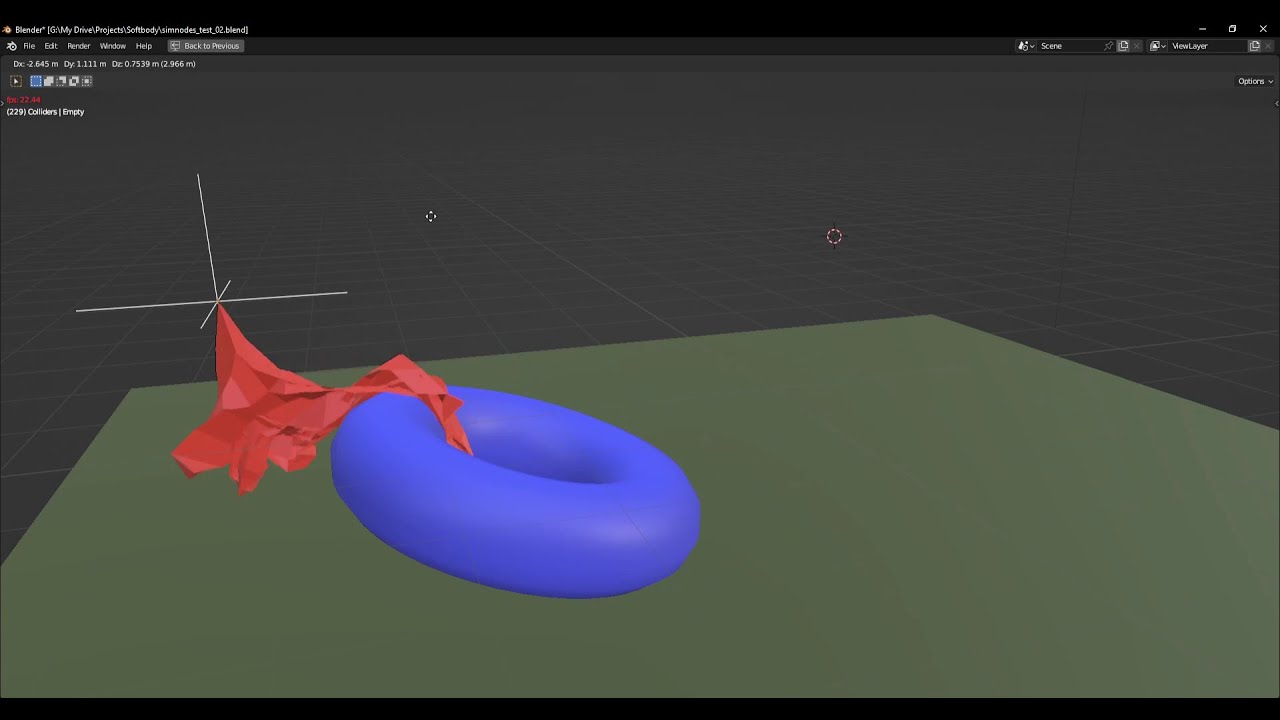
Edit: I knew there was a video with an experiment somewhere, now I found it:
Sure, it is not ground breaking, but it shows that conceptually, it should work.
Yes you do, but at the end of the day, it usually isn’t all correct and some manual adjustments or art direction, etc is wanted/needed. And that’s just for simple stuff, let alone say running a hand through the hair, etc.
Yes, in theory, but just because a basic tech demo works on simple stuff, doesn’t mean it holds up for full character animation. Guess time will tell.
Do you see anything in the current development, which would make this kind of functionality more difficult to have later on?
I understand the need for hair and cloth simulation. But everything starts like that. It shows they are thinking what it is going to take to get the physics working. And I am confident they though how this can be integrated properly to work with geometry nodes too.
In theory no, but I’m no coder and really can’t understand the ins and outs of it all. But just look at how GeoNodes has developed so far, with the couple of wrong turns and then total rigs of it, likely how it was first designed and made to just cover the Studio requirement at the time, which was mostly scattering.
Yeah, at this stage I’m sort of not, since last I looked or found any info, there was yet to be any actual firm plan or design, etc for hair and cloth simulation, only that it will be added to GeoNodes in the future. Which brings me back to Project Gold, if that avoids the need, then the likely best future is after this current movie, ie may have something in a years time.
You are literally arguing based on (incorrect) assumptions. Contrary to other applications, there is a lot of information available. It doesn’t take much to figure out that Geometry Nodes is the successor of the addon named Animation Nodes.
And yes, at one point they focused about scattering because it was actively used by the studio, but that doesn’t mean it was built around this idea (which can easily be shown to be wrong) and they likely just took the opportunity to push this one feature and learn from it.
If you look closely, you won’t find firm plans or designs for simulation nodes either (at least I am not aware of them).
So which is it, is there a lot of information available, unless I look closely, in which case when it comes to updating the simulation system via GeoNodes (which is what this whole discussion has been about), there’s no firm plans or designs? Even tho GeoNodes is what, 2 years old now and based on Animation Nodes, which is even older.
Changing the system to use fields isn’t an incorrect assumption, its fact, as in the first plan and design, while fine for scattering, didn’t work so well going forward. How can we be so sure that the current design and plan will work for hair/cloth if they haven’t yet worked out how hair/cloth simulation is going to function as part of GeoNodes.
So if Project Gold continues the long tradition of avoiding simulation, how much more work gets done on GeoNodes without any plan/design for hair/cloth to make sure it will all work going forward.
Feel free to misrepresent what I am writing and taking quotes out of context to give them a different meaning. Not interested in this kind of discussion at all.
I read your previous post a number of times, and no matter how I read it, I was confused by the fact it seemed to totally contradict itself in the subject of using GeoNodes for hair and cloth simulation.
There was no provided basis as to why my assumptions (if indeed they are) are incorrect. Then a reference to other applications (not sure why that has anything to do with GeoNodes), but then stated a lot of information is available (one assumes about GeoNodes, as that is the subject at hand, which in turn means Hair/Cloth simulation, which is also the subject at hand).
But then right after, you state if one looks closely, there is no firm plans or designs (ie information) for said GeoNodes and how it will replace the simulation of Hair/Cloth (ie the subject at hand).
So sorry, but I currently fail at seeing/reading that any other way.
Fields was chosen because it was a lot more artist friendly and it made the creation of trees feel a lot like shading and compositor nodes.
For node systems to really be intuitive and worth it, they should be designed in a way that does not feel exactly like programming (ie. it should not be the Python API with graphics instead of text). On the todo list are preset simulation effects in the form of assets much like with hair nodes (particles ect…), so the use of simulation for those who do not want to figure out the simulation zone will become much easier.
You find a lot of information about geometry nodes is absolutely correct. You won’t find firm plans or designs for simulation nodes does not contradict it. There is still a lot of information about geometry nodes available. Enough to figure out it wasn’t sort of designed around scattering. You can understand scattering as the first kind of use case where they pushed it to make it usable in a production case. That’s incredibly useful to test whether the system as a whole actually works in practice.
Which will be a good thing, as the current included hair nodes makes it more a plug and play with some tweak to settings as need be, rather then having to dive deep into the whole nodes setup, where one can get lost very fast.
OK, well that’s a good thing then. But given there are no firm plans or designs for simulation, then wouldn’t it stand that GeoNodes wasn’t designed with that in mind, especially when it comes to hair/cloth simulation, which I think we agree (unless we don’t…) that the overall requirements for hair/cloth simulation is very different compared to motion graphics ‘simulation’.
Frankly even between hair and cloth the requirements and hence design are different, as both react differently to forces and movement.
At the end of the day, it still all comes back to my initial post, the basically final hair design for Mikassa is aimed at avoiding simulation and I fear that till the devs are ‘forced’ to tackle it, this will remain a low priority for GeoNodes.
I mean it seems we are getting GeoNode tools in Blender 4, something we never knew we needed, but we are getting it anyway. Which is partly funny I feel, given that its use breaks the whole non-destructive workflow that I thought was the point of GeoNodes in the first place.
If you are looking at how physics is implemented and used pretty much everywhere, simulation nodes can be seen as the node like counterpart for geometry nodes. Simulation nodes are the logical succession of geometry nodes towards simulations.
Skipping that step would be incredibly naive, even if you would like to see it happening that way.
Just because you haven’t seen design documents or what not, does not mean they don’t know how they are proceeding. I even posted a YouTube video with some sort of proof of concept for that. And you still claim whatever you want, because they are not working on the thing you want?
The way they are integrated into a physics simulation are identical. Sure, there are different properties to modify and they require different simulators. But what they are doing right now is literally the whole framework around it, before physics simulators can be added. They are even working on baking and the like, which will also be useful if physics simulators are integrated.
It was not a target. You wanted it to be a target.
And seeing the state of the development of simulation nodes, I don’t think they are ready to tackle hair or cloth simulation for an actual production. The critical parts for that are the cloth or hair simulators. Getting them stable is incredibly difficult. Good luck tackling that, while not having sorted out the basics where those simulators are integrated in geometry/simulation nodes.
Again, it is a logical in between step. And it is incredibly useful for many people. While others complain they didn’t get what they wanted…