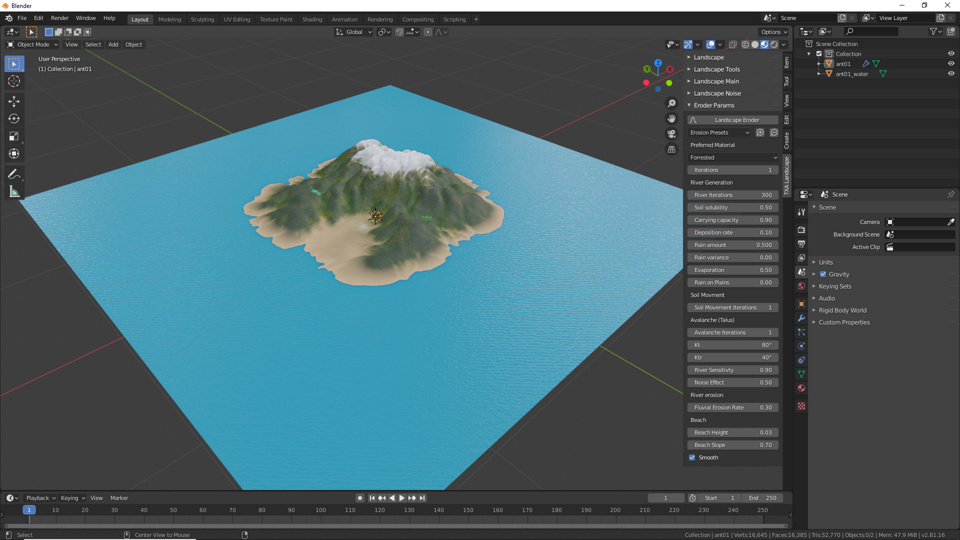
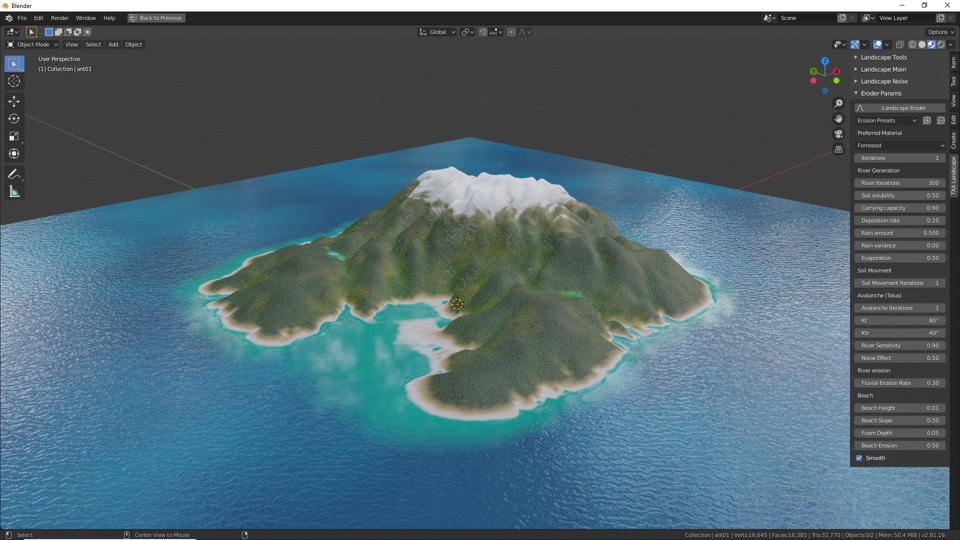
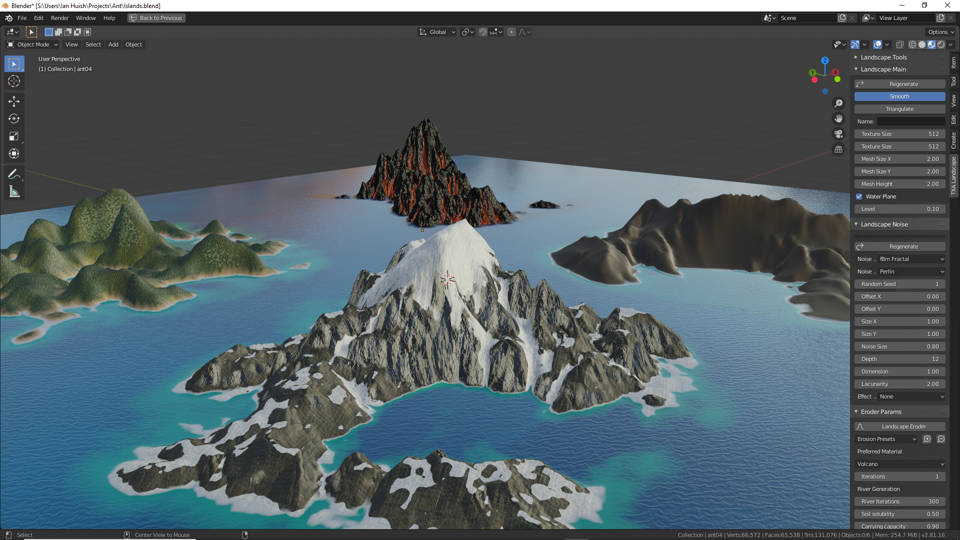
I’m a big fan of the A.N.T. Landscape add-on. Written by @Jimmy_Haze, it’s been shipped with Blender for what seems like forever! I’ve used it quite a bit (and there’s even a little of my code in the current version), but I often think it would be good if instead of creating geometry and vertex weights, it produced a height map, normal map and texture masks. It would be more flexible and save fiddling with high density meshes and baking.
I’ve had a go at doing this. With Jimmy’s permission, I’ve made a version called TXA Landscape (TeXtured Ant). It’s at an alpha stage in that not all of the original ANT functions are supported, but I think it’s at a stage where it’s useful.
I also thought it would be handy if it provided sample procedural materials using the erosion masks generated by the add-on. It’s quite a lot of work to do this, so I asked the author of the NodeCustomBuilder add-on - @HaiKalle - if I could use the import part of his add-on, and he generously agreed. This allows materials to be supplied with the add-on in JSon format, which is very neat! There are a few materials supplied with this alpha version, and I’ve tried to structure them a little, but there’s lots of scope for improvement. Please feel free to post better ones!
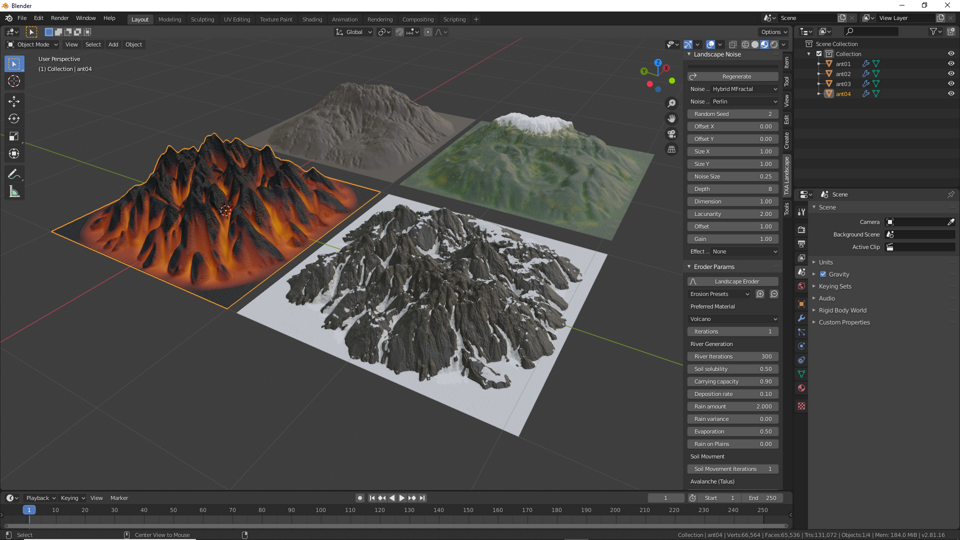
The add-on is suitable for Blender Version 4.0, with versions available for 2.81, 2.82, 2.83, 2.9 and 3.0 upward.
The GitHub page for the the add-on is
https://github.com/nerk987/txa_ant
The zip file can be downloaded there, or the direct link is:
txa_ant_4_00_0.zip
This is for Blender 4.0 and higher only! (Versions that work for earlier blender versions are available on the github site)
For a quick start introduction:
- Install the addon
- 3D View ‣ Add ‣ Mesh menu ‣ TXA Landscape
- Note that the landscape is a simple plane with subdivision and displace modifiers
- Set Viewport Shading to Material Preview mode
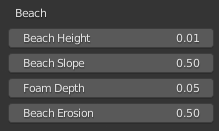
- Locate the Eroder Params panel in the TXA Landscape Sidebar tab
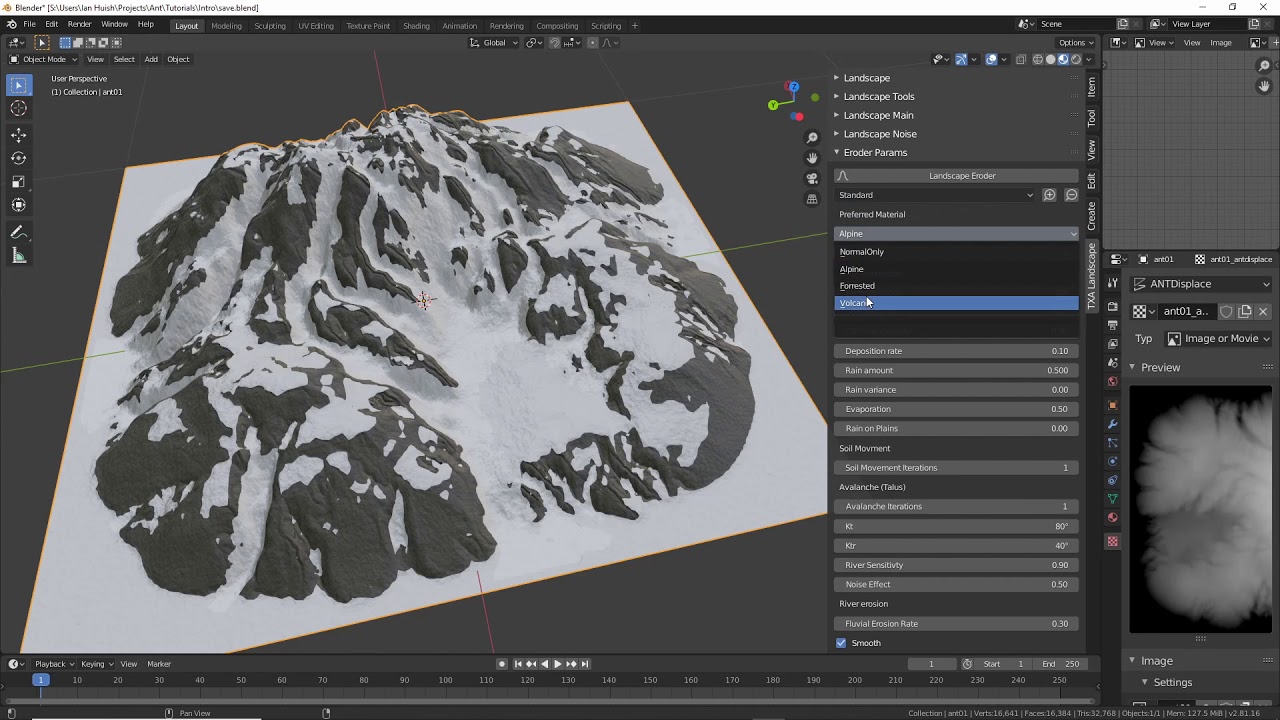
- Change Preferred Material to Alpine, Volcano or Forrested
- Click the Landscape Eroder button
Alternatively, watch the meandering video below…
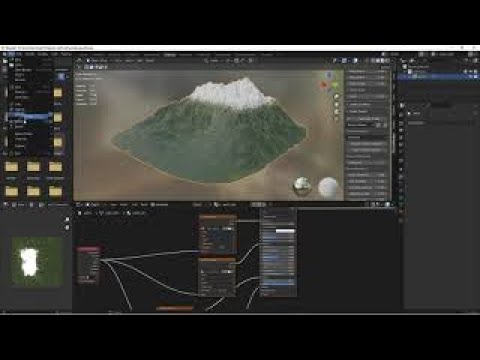
Another video runs through the process of using the ‘Bake to PBR’ function to export to Unreal Engine

 looks cool, thanks.