We went over the metal shader rewrite PR as it is a large patch. Is planned for 5.1. It removes many Metal specific implementation and will structure more like OpenGL & Vulkan.
Let’s hope this results in speedups for drawing and compilation! Full PR here.
Edit: I looked at the prices of laptops with RTX5090 and I think that buying this junk will not make sense after the MacBook M5 Max comes out. I wonder if the RTX6090 will deliver.
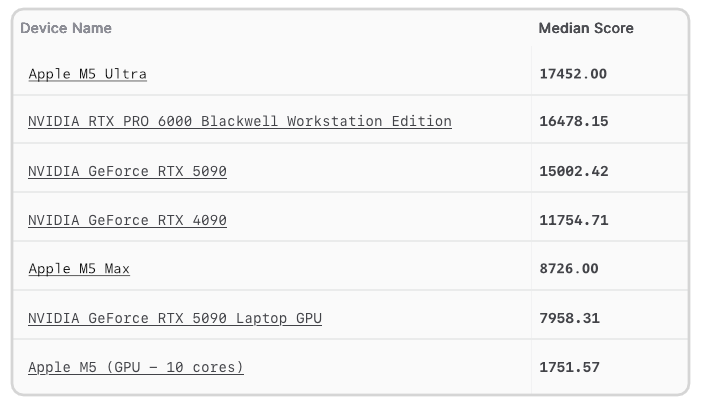
This is of course speculation, but note that the M5 is 1.9 times faster than the M3, and we can expect that the scaling of the M5 Ultra (if it happens at all) will be significantly better than that of the M3 Ultra. In addition, the M4 Max is 4.9 times faster than the M4.
M5 saw a 70% speed increase in Cycles thanks to better HWRT, the M4 speedup comes on top of that. So his numbers are correct if you expect 100 GPU cores instead of 80, extrapolated from the M5 (10cores) currently in the benchmarks.
Sorry, I’m old enough to remember Apple adverts claiming some new chip was 300% faster than Intel in Photoshop*, with very small print at the bottom which gave a caveat of something like *"when using gaussian blur".
I love it when hardware companies fudge their numbers like that. You can’t call them out for lying, because they are technically stating the truth. Rather, they’re “overrepresenting” some key points of data, and it’s your fault for not reading the fine print.
Guys, I am not talking about Apple marketing bullshit. I’m talking about BLENDER OPEN DATA results:
M3 - 919.06
M4 - 1075.77
M5 - 1742.76
M4 Max - 5274.64
Of course, one could argue whether Blender Open Data is a good benchmark, but for now, we don’t have a better one. The only better option is to test it yourself on your own projects. For example, I try not to render with more than 50 samples, and in this case, the speed of denoising is very important, or even the speed of writing files to disk, which, as we know, is lame in Blender.
In any case, the speed-up of raytracing in M5 can be called spectacular without exaggeration.
hmm fair, it does look like apple has a cadence of getting ~5x on the base to the max and ~10x from base to ultra variants on blender benchmark.
my caveat is:
they are only on m3 ultra right now. and they waited a good while to release that, so there’s a chance there’ll be an m4 ultra before an m5 ultra. it took 18+ months to go from m2 ultra to m3 ultra, so the wait could be a while.
Is it even worth waiting for the Ultra if it takes so long for it to reach the market. Theoretically M5 Max should be approaching 9000 points, which is ahead of the M3 Ultras 7500, a device that may still be sold in parallel. Could just stick to Max, update more frequently while keeping the older model as a render node.
May as well get two Max’es for the price of Ultra and enjoy the same level of combined performance much earlier into the generation cycle.
Even M4 Ultra seems rather pointless at this point, if we assume that it scores around 10 000 point mark.
Whether there will be an M5 Ultra will become clear if Ultra Fusion appears in the M5 Max. To be honest, I have serious doubts that the M5 Ultra will be released. Generally speaking, it is clear that the Mac Pro is a poor business for Apple. The M5 Ultra would make sense if Apple used it in its servers. Then the cost of introducing the new Mac Pro and Mac Studio with the M5 Ultra might somehow pay off for them.
Apple said that there wouldn’t be an Ultra in each generation upon releasing the M3 Ultra while the M4 was already launched. They added that the M4 Ultra wouldn’t be made.
You’re right: Apple is increasingly relying on its own servers again, from Private Cloud Compute to the new rumored Gemini-based Siri that would run on Apples own cloud.
I’m ready to trade in my M2 Ultra Studio for an M5 Studio next year, in only 3 generations I’m getting a 5x speedup in Blender. Will I finally be able to use Cycles in the viewport? That’s just too slow right now.
For creative professionals using software like Illustrator and After Effects, the speedup to M5 is way smaller that for Blender and its HWRT, even an M1 can often handle the workload of a complex vector design.


 .
.