Thank you. Those books are exactly what I was looking for. I still have “The Album book of Dinosaurs” illustrated by Rod Ruth from 1972. It was probably quite inaccurate but the illustrations were awesome when seen by a 7 year old me.
1 Like
I featured you on BlenderNation, have a great weekend!
1 Like
You’re welcome! I also own that book. I actually love older palaeoart. Outdated aspects are easily forgiven when the art is viewed in the context of its creation. And some of the paintings in that book are awesome! There’s a real sense of grandeur and scale to Rod Ruth’s paintings, and they all evoke the impression of living animals. And there are a few illustrations that have aged really well for a 1970s publication. Most of the dinosaurs are shown as appropriately quick and active, and while the detailed anatomy is quite dated, there are many theropod dinosaurs with tails held aloft!
Thank you so much for featuring my work, I certainly didn’t expect this!
2 Likes
The texturing is really nice especially on the face. Did you use blender for it ?
Bookmarked the artstation post, the muscle reference is interesting.
I think the big scales above the eyes for the JP one are there to amplify the “evil angry monster” look.
Nitpick: there’s a texturing artifact at the bottom on the tail. You can see a line that cut through the pattern from the end to the middle.
1 Like
Thanks! And thank you for pointing out that artifact, I don’t think I would have noticed otherwise, luckily it will be easy to fix.
Yep, all the detail was done in Blender, baked normal map from high poly sculpt.
You’re #featured! 
1 Like
@Sketchy-raptor That’s really great. Love it!
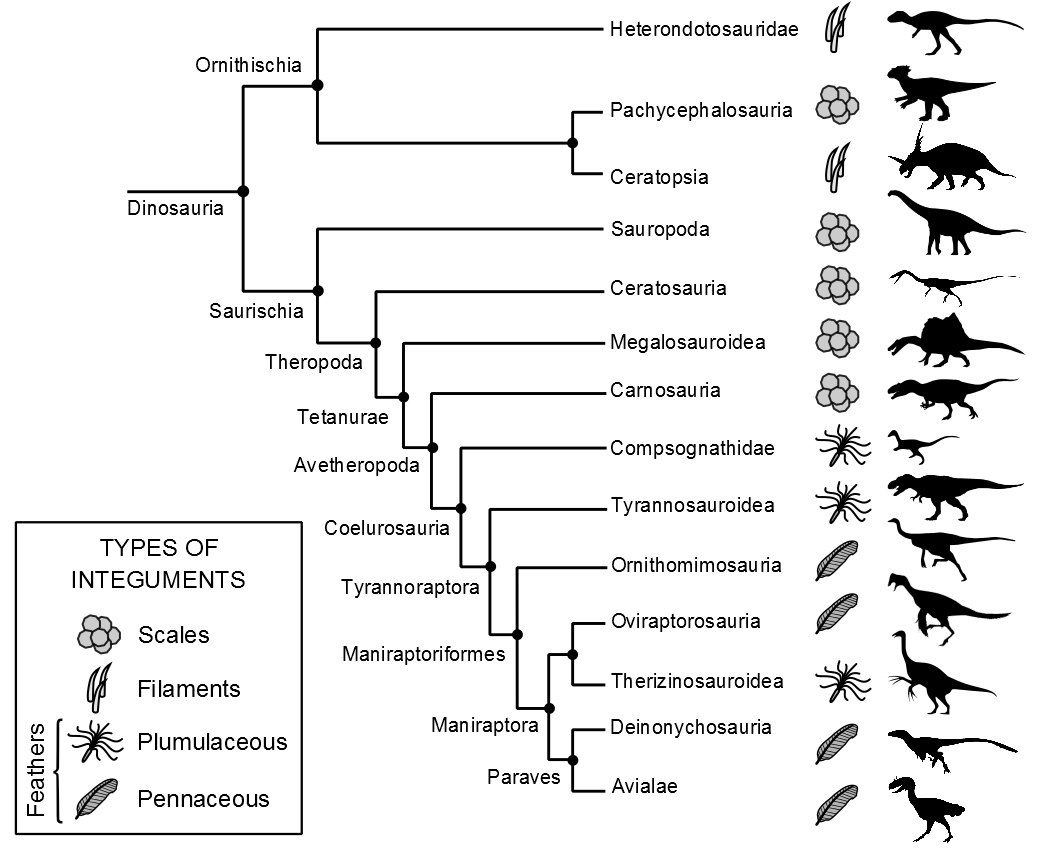
It’s not that clear cut. There was a number of feather and proto-feather types and also a lot of dinosaurs who had the scales we’ve come to love. Tyrannosaurs seem to have had a type of plumaceous (downy) feathers, though … 
From Wiki:
1 Like
T-Rex Hot Rod flames livery edition.
1 Like
So, an important distinction needs to be made between Tyrannosauroidea and Tyrannosauridae here. Tyrannosauroidea, which is the clade pictured in this diagram, appears to have been basally covered in filamentous integument that at least resembles stage 1 or stage 2 feathers. However, as explained in my original reply to jerzygorskiart, there is evidence to suggest that Tyrannosauridae (which are a more advanced family within Tyrannosauroidea, and include Tyrannosaurus itself) secondarily lost most of these filaments (at least as adults) and had scale-like integument. However, whether or not any filaments were retained in these advanced forms in unknown parts of the body remains a contentious topic.
See Bell et al. 2017 " Tyrannosauroid integument reveals conflicting patterns of gigantism and feather evolution".
That is great work, my man. You’re blessed to be talented as both a scientist and an artist. You should post a 3D “wraparound” version somewhere. (What is the term for that, btw? I’m sure “wraparound” isn’t it…  )
)
However, now that I have the chance to converse with a bonafide paleontologist, I want to get this off my chest:
How did T-Rex carry around such a huge, heavy head?
As they’re commonly portrayed, they look off-kilter, like there’s not enough counterbalance in the weight of the tail to carry the head (and torso) gracefully.
A modern bird that size would have a much smaller head (or a beak to reduce weight) so that it’s not top-heavy.
Even then, in order to walk upright, a bird would hold its neck in an “s curl”, so that the head is balanced on top (as an egret or heron does, for example).
…The only modern animal with a proportionally large muscular head and jaws like T-Rex’s (the hippopotamus) also has a short neck and a squat, heavy body as counterbalance, to allow it to wield such a heavy head and jaws.
T-Rex on the other hand, not only has a lot of weight concentrated in its head and torso, but it’s also typically posed with those portions leading, rather than balanced on top. Its posture seems awkward for a bipedal animal, especially a predator.
As a predator, it seems that if it were to chase and lunge after prey, it risks falling forward a lot.
(…And with the backward-curving teeth, it seems that capturing prey would be a pretty awkward motion. It would have to get those tremendous jaws well around the prey in order to grab it. No tripping the prey with its paw like a lion does. I would think most prey would be too agile and fleet-footed for T-Rex. Maybe it was an ambush predator? …Or maybe it battled it out with large, slow-moving herbivores?)
Since I’m not a paleontologist, I don’t doubt the accuracy of their portrayals. I just think the creature looks really off-kilter as it’s typically portrayed.
Thoughts?
I’m cool with feathers or no feathers, either way. 
I just meant to say that feathered dinosaurs are not the new paradigm and we would find all kinds of skin on them.
Thank you! An online 3D turnaround model will be available in the near future, but it is part of another project.
Yes, Tyrannosaurus does look quite ungainly from the outside. The secret is all internal - the skeleton of Tyrannosaurus is highly pneumatised, so there are significantly voluminous zero-density air spaces throughout the torso and head, making the “front half” of the body deceptively light, and bringing the centre of mass in line with the feet (e.g. Hutchinson et al. 2011). It’s all relative of course, Tyrannosaurus is still a very heavy animal, ranging between 6 and 9 metric tonnes depending on how you restore the soft tissues. Modern birds have a relatively far forward centre of mass due to the lack of muscular tails, they instead compensate for this by having their legs in a constantly flexed position, bringing the feet forward (e.g. Bishop et al. 2018). While backwards curving teeth are quite common in predatory animals (they can be quite effective at defleshing and gripping when coupled with neck movement), Tyrannosaurus has much broader, blunter teeth than a typical carnivorous dinosaur. Rather than being used for defleshing, Tyrannosaurus teeth appear to be well adapted to osteophagy - crunching though bone with considerable force generated by the jaw adductor muscles (e.g. Gignac et al. 2017). As for Tyrannosaurus speed - there are simulations that help shed light on this. Multibody dynamic models suggest that adult Tyrannosaurus probably couldn’t achieve a true elevated run - it simply puts too much stress on the long bones of the limbs. Instead, we’ve constrained a slower “grounded run” (i.e. no aerial phase) of about 17 mph / 28 kph (Sellers et al. 2017). This may not seen as impressive as the jeep-chasing Roadrunner from Hell seen in the movies, but it’s still incredibly fast for an animal of such mass. I doubt that adult Tyrannosaurus would have too much trouble keeping pace with the large ceratopsids and hadrosaurids it was likely preying on. Juvenile Tyrannosaurus are a very different story however - they have relatively longer feet and shanks , and overall are much more lightly built (e.g. Hutchinson et al. 2011), which implies pretty good running ability. No physical analysis has been carried out to estimate juvenile running speed however, at least not as far as I’m aware of.
I hope that this answers your questions!
2 Likes
Yes – & thanks for the in-depth response!
1 Like
Wow, thanks very much!
1 Like
Have you thought of using shape keys or a addon which can do the muscle system?
fascinating work, I really hope that we’ll see some advancement in visual representation of dinosaurs, as I guess it’s not quite accurate yet, I bet every palaeontologist dream is to find one preserved specimen remains in amber.
Nor we, to have a real Paleontologist on the Blender community, but hey… who’s counting? 
Muscle system is being proposed as we speak. Real muscle shakes, controls and splinning methods.
1 Like
I’ve considered using the XMuscle System for the superficial limb muscles and the larger epaxial muscles, though if a native muscle system is added to Blender in the near future then that would be fun to try. Shape keys will be used for smaller adjustments, things like the eyelids.