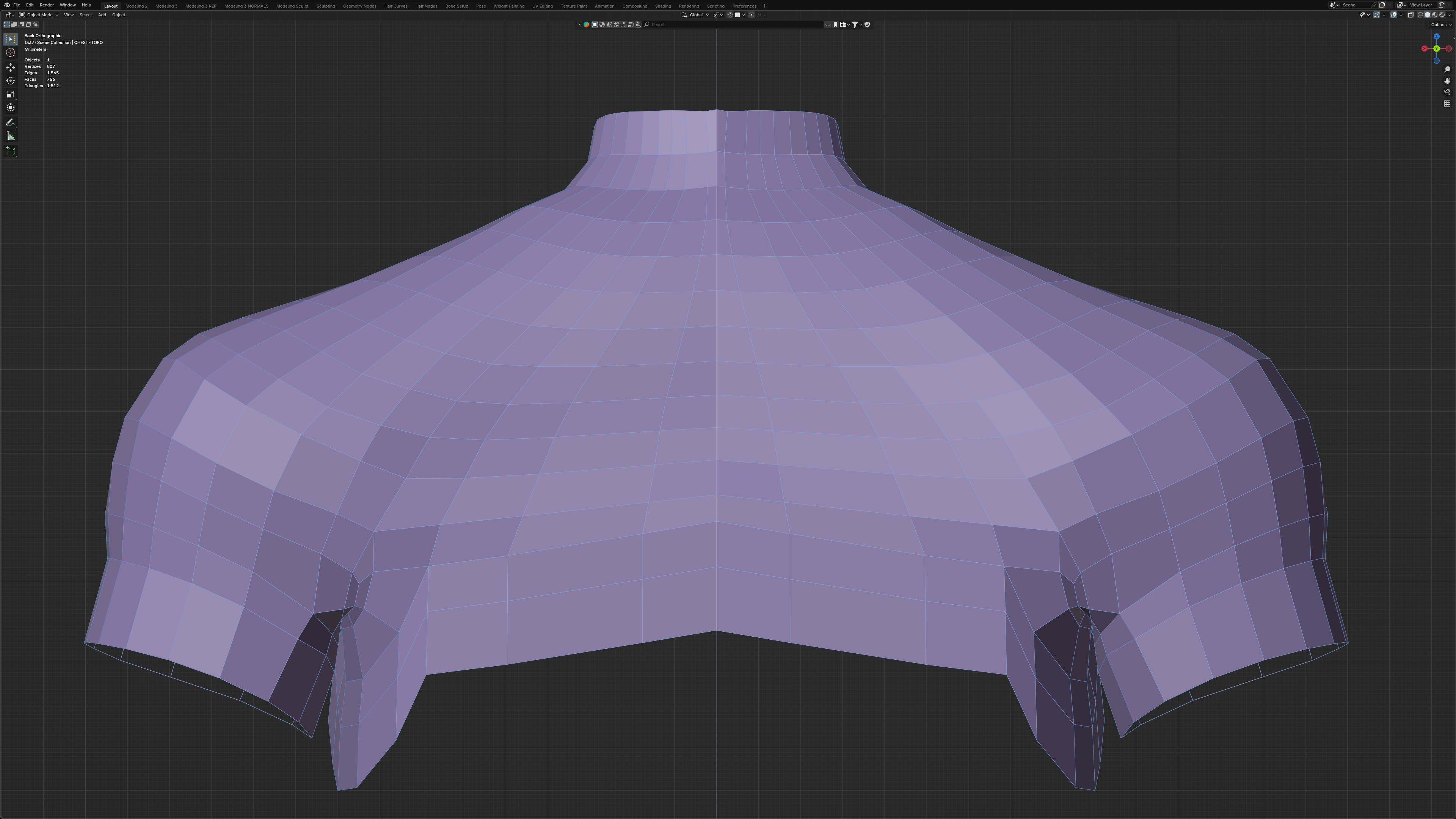
I’m trying to finish my character, but as is obvious from the post title, I have no experience with topology or organic modeling.
After a couple of tries—and a lot of “I don’t like what I see”—I’ve managed to create an upper torso topology that actually looks promising (for a noob like me).
But I need some help to know if it’s a good starting point or a bad one for sculpting and animation.
Well, in many ways, those are two different things. For sculpting it largely doesn’t matter so much, since you are likely to re-mesh it multiple times, etc and then once all done, model with good topology over the top for animation.
The recent Shoulder overview video starts with a look at the topology of the area but then shows why the whole process is important when it comes to animation.
Having said that, I feel you should maybe look at the two oldest videos first (Elbow and General Topology) in order to get a better idea of some base topology theory and reason for it, especially if the goal is to rig and animation the character.
Most of the things in the video are concepts I already have in mind, but I’m trying to avoid certain things—like the shoulder blade area and edge loops that are shared across large regions. For example, in the Blender topology posted by oo_1942, there’s an edge on the finger that crosses the body, loops back to the hands, and ends up at the head.
Since I suggested the “adaptive subd” idea, I’ve realized that it requires a modular topology to work really well (I hope that eventually I’ll be able to develop it).
I’m doing fine in most areas, but the lack of day-to-day experience is a real shot in the knee.
And since I can’t develop an advanced bone setup to test it, that’s another problem.
I’m also trying to create a generic base mesh to use as a starting point for developing characters, since I’m working on a game. So instead of using dynamic sculpting, I can work from a regular base mesh.
If the reference is meant for me, I can’t really refer to them because I’m not using it as a reference.
English is not my native language, so sorry if my speech sounds rude — that’s not my intention. I just don’t know how to express it in a more subtle way.
I don’t like some aspects of that topology—there are edge loops that are too long and shared across multiple body parts. My initial approach is to use a more modular modeling style. I’m also not a big fan of how the breasts and knees are done.
But thank you for the link—I’ll take a look at it to help me better understand the approach.
I’m also aiming to create something with a lower poly count.
But since the shoulder is pretty much the same, I’ll consider it a good starting point.
Well, these may not support form well on their own, but they seem to be good for sculpting specifically.
I’m (still) struggling with the same problem (actually I’m in the middle of remaking my base mesh again this very moment). And the thing I’ve become aware of over a few versions is that sculpting base works best when it has absolute bare minimum of any creative “shaping” loops. Every star can become a PAIN to sculpt over sweat_smile:
Kinda gave up on trying to make it one-for-all-cases mesh - it’s either game-ready animation OR sculpting. Though I look forward to be proven wrong.
These days I’d aim for making a solid sculpt mesh that can be quickly repurposed into final mesh with some editing.
For reference, this is how my attempts went before (spoiler: not that well, when it came to making actual characters):
That’s actually pretty easy, just use Rigify.
Once you have the overall general mesh done, match a Rigify metarig to it and use automatic weights. Then you can tweak or even totally redo some areas and keep parenting with automatic weights.
As such, and this is a couple of the things I have issues with, your mesh really is already too dense, you want as few loops, etc as possible to start with in order to focus on main loops and forms, while still being able to add/delete/move geometry fairly easily.
With the above in mind, I’m also very much against the should/arm pointing mostly down, to me it makes that area harder and weight painting way harder.
At the very least it needs to be an A pose, tho personally I find the T pose easier, but that may just be me.