I’m studying composition, mostly in books by painters and illustrators, and they’re always going on about seeing the work as areas of color and value on a plane rather than as trees, lampposts, etc. Of course that is how they create - slapping color and value on a flat surface.
Having previously done a lot of photography, and now 3D, it’s actually quite difficult to stop seeing objects in space, but truth is a photo or a render are 2D products. Perhaps painters do have an easier time making great art because their work is closer to the final result.
Ah, valuable lesson in the use of language. I agree with what you say, but obviously wasn’t being very clear in my original question. What I meant was - do painters have an easier time (than artissts working in a 3D medium) finding good compositions for their images? They seem to think that good composition is the most important factor in producing a compelling image.
Sorry, but I can’t think of any better way to explain that other than what I put in my first post. Basically, working with shapes, value, color is what is required for a good composition, not working with objects/details. According to two authors/painters on the subject of composition.
I find drawing/painting thumbnails a lot quicker, but I’ve been doing it a lot longer than 3d. Not sure someone who doesn’t draw/paint would find it easier, though.
As someone who was a painter and illustrator, no. Composition is composition in any medium.
And after that, there are as many or as little (but probably, as many) moving part in the creation of the final “thing”, whatever it is.
If composition is what you care for, in creating your images in 3D, you still start planning it first, before everything else, either by sketching literally pencil and paper, or blocking out for your camera with simple shapes in your 3D app.
Regardless, composition is not something that lives in a vacuum, regardless the medium: it serves the image, but you need to serve it, by complementing it when you work inside the specifics of the medium. Or even contradict it, if you know what you are doing.
The point is, tons of moving parts, comparison between mediums is a silly concept.
I think thinking in term of shapes isn’t natural when you learn how to draw.
As for 3D you can really think the same way.
When I build an image I try to look how each element are silhouetted against each other. I don’t look that much at the elements but at lines, shapes, values most of the time.
Just like when you draw the body you don’t look that much at the body you look at shapes, lines and details and the subject matter doesn’t mean that much…
And as marcolomeo said, nothing prevent you from blocking out the scene to look at the structure of the image.
Maybe what bothers you is that good painters make composition and everything else looks like it’s easy. And I think it’s just that painting is less forgiving.
While in 3D it’s always possible to focus on the technical side, and slap together models that are ok but within an image that lacks artistic fundamentals even though models could be good and materials and everything else … So you can make something that look ok-ish in 3D, and in 2D it will quickly show… But that doesn’t make learning that stuff easier or easier to apprehend…
It’s interesting to remember that 3D often uses all kind of tricks in service of final image in very similar way to 2D.
Think about all those “behind-the-scenes” images/videos where 3D artists shows how they completely broke a model or object positioning or LITERALLY BEND THE WHOLE SCENE just so the composition would look good.
Or, for that matter, how in photography and filmmaking, people do all kinds of tricks with lighting and camera angles and whatnot for the same purpose with the same reasoning.
2D probably can get their point across faster, but not easier because the fundamentals are the same. Fast iteration makes for faster progress, but does not reflect “difficulty”.
I think a lot of free 3d education is really lacking in education about composition and shape and value and all that, and tends to really focus on the technical aspect of operating the software and making individual models and texturing and etc. I also had to learn about composition and stuff from painters. But once you start to learn that stuff, its a lot faster to make and test compositions in 3d.
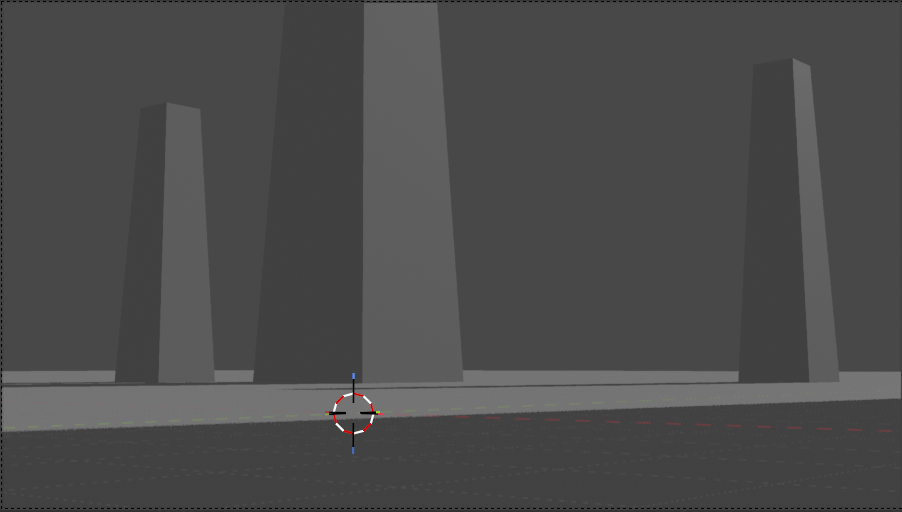
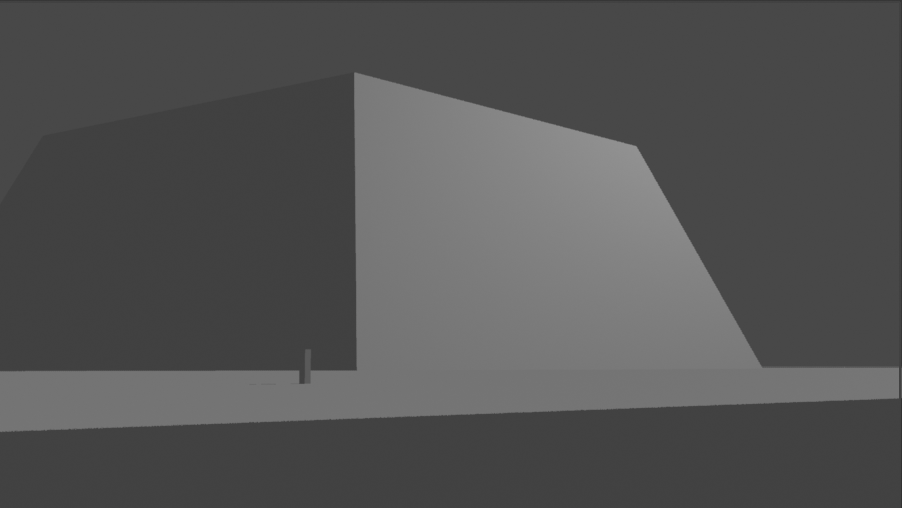
you can bust out thumbnails and compositional ideas that would take much longer in 2d, with just basic primitives and a single light, if its slightly off, you dont have to redraw the whole thing to test it, you can just rotate the light, or move a cube or whatever I’m certainly not the best 2d artist, but these three tiny little graphic thumbnails would have taken me a good bit longer even in digital 2d, than they did in blender just now. And if I want to go a little further with it, I get all the bounce lighting and everything for free, and even pretty deep in to the process, I can always adjust things without having to actually delete work by painting over it.
But I do get what you’re saying, when I just grab a pencil and copy a reference, that 2D piece feels soooo much easier and quicker than modeling a reference, because im just paying attention to the shapes and values and stuff, and only worried about the single angle. But I think that can fall apart the more imaginative I get with it while trying to do realistic lighting or whatever, because then I’m calculating all the bounce lighting and stuff that blender does so neatly and nicely for me almost instantly.
Hobbyist perspective, so, take it with a bucket of salt.
For the sake of discussion, let’s look at a few areas and compare, assume we’re talking about still images:
(Level of) Detail
In 2D, you can start with blocks and “sculpt” towards the final image, choosing when to stop at each level of detail required, eg background can be blurrier. It’s basically, “as simple as possible, but no simpler”.
In 3D, you pretty much have to make everything visible within the frame, details are relatively expensive.
Colours/Lighting
In 2D, highlights are easily controlled, just think of manga-esque eyeball highlights and replicating that in 3D. The further you stray from “natural” lighting (yes, I know the nuances), the effort in UNDOING the lighting engine increases, to the point where you might end up switching off all lighting and cheating everything using toon shaders.
Which is ironically closer to a 2D paradigm.
Perspective/Stretching
Same goes with any extreme angles, eg. One Punch Man covers, doing them using a 3D camera is just counterintuitive.
TL;DR
for geometrically correct images, 3D is a linear workflow: objects + lights + camera. The further you stray from “realism”, the more effort in working against the 3D world.
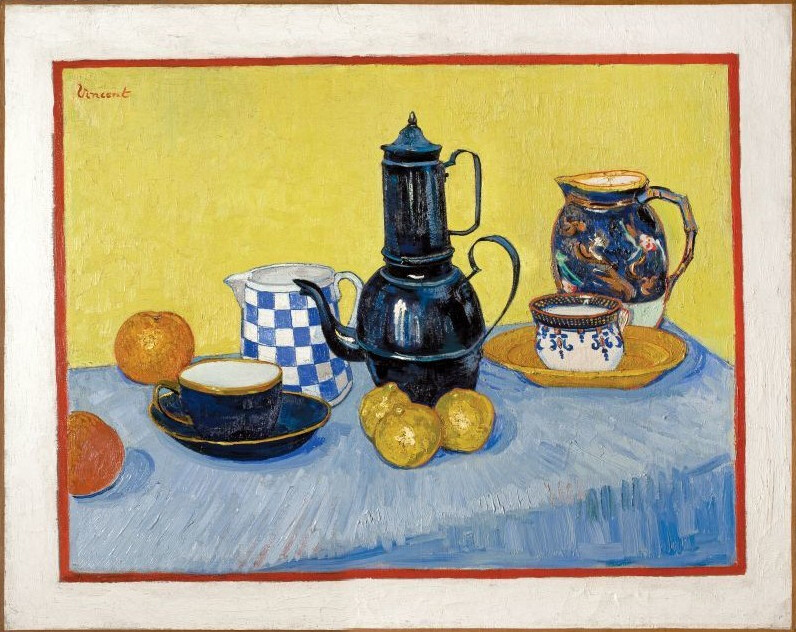
… on page 568 of The Complete Letters of Vincent Van Gogh, vol.2, Van Gogh writes to his brother Theo, including a sketch of the planned still life composition, great detail of the upcoming work including all of it’s objects, etc..
Go ahead and do that same still life in the realm of 3D.
Those same objects are basically just a spiritless mesh. That’s it that’s all … a mesh of vertices, edges and faces. Along with a zillion control+z, lool.
Plot twist: you are supposed to be making study thumbnails for value and composition before committing to 3d - in the form of storyboards. That’s a form of painting/drawing for 3d planning
edit: To add, the production of good 3d isn’t the tiny details in the collection of objects in the 3d view as models and textures as much as the consideration of lighting and value, weight to the amount of detail to draw one into the image/animation. In my mind as a painter, 3d is an extension of the same thing, a means to an end. The 2d artist as a painter has to actually paint the forms and details to sell an illusion of 3d space.
Hans Bacher (Disney Production Designer) is big on shapes too - much emphasis on negative space in his books. I must admit I have a hard time seeing shapes rather than things. I’m even contemplating doing thumbnails monochrome in Inkscape with primitive shapes before going to Blender, to force a bit of discipline. Maybe that’s overkill.
Recently I’ve been doing an exercise - going through a folder of images that I like collected from the web over the years and viewing each in Darktable with the Monochrome module enabled, and eyes slightly squinted. It’s quite interesting actually.
Regarding painting, I find it interesting that the old masters placed real objects
in front of them and arranged them for their compositions, e.g., with still lifes.
do painters have an easier time (than artissts working in a 3D medium) finding good compositions
My short answer: yes (kind of).
To me, it feels like different parts of my brain are at work when I’m creating a 3D scene compared to when I’m working on colors or composition. And those two areas are reluctant to be active at the same time.
I use sketches to get ideas about compostion etc. The good news is that you don’t have to be a painter; you can just sketch something on paper or rearrange elements in Photoshop, etc. It doesn’t matter if the result looks pretty—what’s important is that you got some distance between you and the abstract 3d stuff and come up with new ideas for composition, colors, etc.
I think you don’t have to overdo it, when painting you really need to break down something like a face into manageable shape… In 3D this is less useful, but you can still look how things balance out in your image : how big is your focal point in the image, where are the leading lines, is an area too noisy, or does it lack some breakups…
I think it’s something you get with time, at some point you start to look at how objects relates to each other within the frame and you see more forms and such…
At the end of the day, it’s just a tool to make a better image but it’s not a special technique that will save you …
But… It’s exactly the same with photography or 3d or with anything when making an image. Thinking about area of the picture is very useful no matter how you create the image. You cannot say it’s only for painters It’s exactly the same for us and for photography. Either you think about composition or you don’t. If you do, you should think about the area of the image as well. It’s easier to forget when it just appears when you hit render or click the camera button I suppose. If you want a nice picture, you better start thinking like those painters do. We have it easier than photographers, because we can control more stuff easier, but whatever you create it’s the same.



 Thinking about area of the picture is very useful no matter how you create the image. You cannot say it’s only for painters
  It’s easier to forget when it just appears when you hit render or click the camera button I suppose. If you want a nice picture, you better start thinking like those painters do. We have it easier than photographers, because we can control more stuff easier, but whatever you create it’s the same.