How would i being able to make this fluffy for my chair.
I have tried to make this with hair particles, interpolated. But it requires pretty much hair and makes my scene very heavy. I saw some were doing this with furr and combine it with geometry nodes too.
What do you say which approach is the best of making this kind of fluffiness. Is it good idea to make it with geometry node if it is possible?
Create and create fur (Geometry node or hair particle)
※ I think the selection criteria for 1 and 2 will be determined by the importance of the sofa.
And it seems to be determined by whether there is a high sense of heterogeneity with the surrounding composition.
If I make a scene with a sofa, I think I will consider it in the order of number one and number two.
But if it’s a simple scene with one sofa, I think I’ll consider number 2.
The criteria for choosing number 2 are also related to the complexity of the scene.
If memory usage is low, you can choose 2.
OK, so there are proper ways to do this like hair, particles, geometry nodes, displacement… but I am lazy, I don’t want to play with particles, geometry nodes or long(er) test renders while working on the look(it’s funny that I only don’t like that when actually working , in other circumstances I love it for some reason from the moment it stops being paid work - it’s really weird… anyway…). So this is what I have come up and it sometimes works OK.
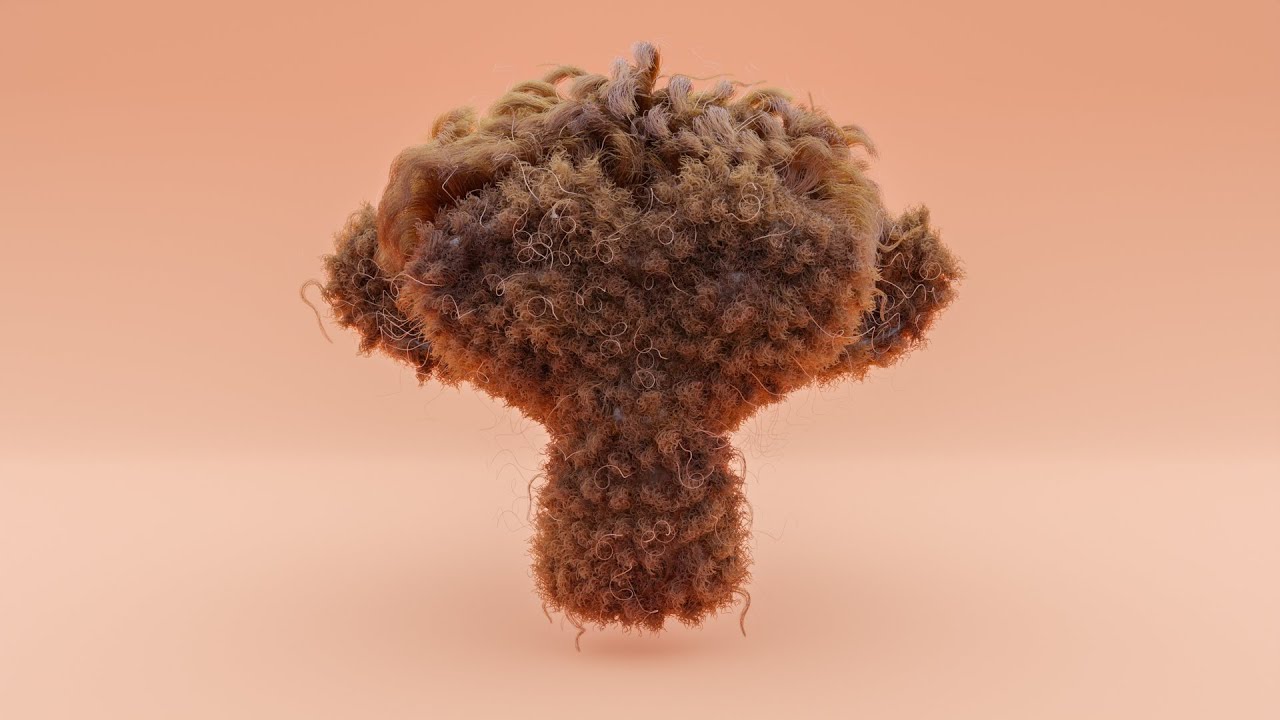
The idea is to simulate volume with transparent surface layers. If I have multiple surface layers that are offset from the original surface and they are transparent, but have some visible detail in the right spots, that can approximate a volume:
Starting to look better. From far away you don’t even need that many layers. Unfortunately with a complex form, I cannot use Z coordinate to control taper or scale my noise to look nicer, but I can set an attribute manually to the geometry. It’s not perfect, but it’s something and you can tweak it further to get pretty decent results in some cases. It renders fast and geometry amount while not insignificant is usually way less then other solutions.
This is just a proof of concept, it can start looking pretty good if you put some effort into creating just the right kind of volume noise and also mix in various other detail in color and other properties of the material. It’s also possible to use image textures instead of noise and control their ‘taper’ with Map Range node.
Since i want very high realism for my scene in most of the time i cant sacrifice anything by faking important things. In reality as in photo i want to create the pretty much the same thing.
What do you think what is the different between furr and hair particles. Which is the better way to go for realism normally if it is possible to being able not to make the scene very heavy too.
Like I said, it was just a proof of concept. I believe it is possible to atchieve photo-realistic results with my described method as well. It’s just a matter of doing the work. You will always need to fake some things, I think that doesn’t have much to do with the ability to produce photo-realistic results.
With particles or geometry nodes, the scene is going to be heavy. I don’t think there is a way around. I can definitely see geometry nodes being used successfully for that. It seems the material is made out of clumps of fiber:
it might be convenient to work with geometry nodes with that. I don’t think it would be practical to simulate strands in the clumps. I would guess they are quite tiny and are in the 10s of millions at least. I would not dare to attempt that myself. I would simulate the clumps, not the fibers.
Yeah… I think to replicate the subtle randomness of them is going to be quite chalenging. I certainly did not attempt to do that in the example though. I think it’s possible. But geometry nodes, if you have the time and machine that can handle it, is also a very viable option, in my opinion at least.
I see you got quite a few layers there. Looks quite good. That’s a perfect solution in the thread you link to. The savings on resources on something flat like a floor are unimaginable compared to other methods. It renders instantly… only need a couple of verts… it’s perfect!
I work in a lot of tradeshow booth / exhibition stand design, and sometimes I have booths as large as 100’x150’, and they can be fully carpeted. I did a lot of prototyping and researching how to best render carpet in this use case. It’s good for medium to long range, which worked perfectly for me. It would be literally impossible to render actual fibers at that scale, so I had to find a workaround that didn’t look totally flat.
Pairing it with geonodes opens up a lot of possibilities for non-planar surfaces. A flat carpet has been doable in cycles for like a decade, but a fluffy suzanne is much more doable with the power of geometry nodes.
I actually just duplicated the surface and used Shrink/Flatten to offset it a couple of times while assigning an attribute to each layer. Not too much manual work either. It would be nice to figure out a way to scale the noise in the direction of the normal though.
I generate the shells via GN and pass that attribute onto the shader. This could be fiddled with for eternity, and it quickly is no longer fast rendering when cranked up to higher detail levels


 , in other circumstances I love it for some reason

 and you can tweak it further to get pretty decent results in some cases. It renders fast and geometry amount while not insignificant is usually way less then other solutions.

