I have been working on this anime style character for awhile now. I don’t know a thing about modeling only from what i have heard and read on you-tube. I thought i could get blender and try at it , i would like to get better at it so that’s why i am here. I know i am kinda new at modeling and what i did sucked but i say i need the feed back to get better. I did this model and i want to know am i going in the right direction or not i am going to start on the head soon. The arms need work i have decided to redo them and delete the ones i have done. I spent two days on this should i start over or give up?


You’ll want to avoid quads that are overly stretched or folded. Note the shading artifact on the front/side of the waist area. It’s hard to tell when it’s subsurfaced, but I would guess that one of those faces has a bend or fold to it. Your edge flow is not typical, so it’s hard to say how well it will deform. You should make a copy of the mesh and put a quick test rig on it and see what happens when you deform it in various ways.
(edit) it looks pretty solid though, so maybe it will deform really well. it’s hard to say.
The topology of the breasts look a little strange to me. I guess the best way to model female breast is to attach a half sphere to the upper chest.
Body topology rules of thumb:
-
KISS Principle, keep it simple.
-
A body is a collection of tubes. The arms are tubes, topologically, as are the legs as is the torso and even the neck. Therefore your foundational topology for these areas should be a “tube” of polygons. Junctions (i.e. shoudlers and hips) are where things get complicated, but essentially the process is one of bridging these tubes one to another in these areas.
-
Edge flow vs. muscle flow, edge flow trumps. I just said, KISS and use tubes. You can twist the tubes, and tweak the tubes to follow muscle contours and directions of notable features, but you should not often do so at the expense of a clean edge flow.
-
What is a clean edgeflow? A clean edge flow consists primarly of quads and extends somewhat uniformly in a “surface” of patches or polys. They avoid large numbers of poles (non-four edged verts) and n-gons (non-quad) faces, instead using them to accomplish an end (like for example joining a tube of an arm to a tube of a torso). A clean edgeflow can accordian (contract and expand) and will shade evenly without smoothing artifacts. Their uniformity also makes them easier to weight.
In your case, your torso has gotten “messy” with loops that are following the contours of muscular anatomy and not the structure of “skin” or tubes. Your arms look pretty good, but from what I can see of your legs, you’re getting a little craziness there as well. Simplify, return to tubes and make the tube topology follow the contours you want to express in form, then worry about bridging the tube together, introducing a few poles (stick to 3 and 5 edges at the vertex, not 6 or more) to turn the edgeloops.
Going to respectfully disagree with my associate. Anatomy comes from form, the same form can be created from multiple topologies, even relatively simple ones. Case in point this example mesh:
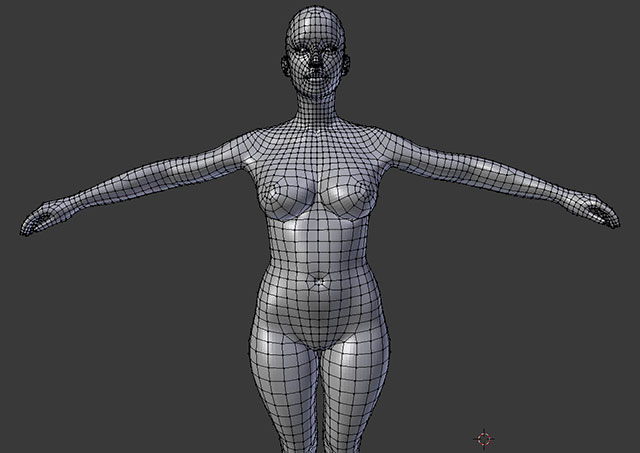

This mesh, created by Eugene Fokin is freely available via the Badking website: http://www.badking.com.au/site/shop/human/female-base-meshby-eugene-fokin/. As you can see, its topology is very regular, essentially tube based with a few exceptions to anatomic details (belly buttons, etc.) Those details however are isolated and terminated cleanly, maintaining the over all edgeflow.
There are of course compromises to be made and I’m not saying muscle flow should not influence edge flow. To make clear, what I intend is that muscle flow should not be treated with higher priority then the other tasks your mesh is going to be used for. This includes, rigging, animation, texturing and potentially displacement and sculpting. The more messy the mesh, the more difficult these other tasks can become.
Anatomy can be expressed with simple structures. It can also be details added at other stages of the process (sculpting/displacement). The only reason to build it into the topology is because you want explicit control over it in deformation. For example, if you want a muscle to bulge when an arm bends, you need to build the topology such that you can support that deformation. If you want belly to fold and crease as a torso bends, then you need structure there for your shape keys. Otherwise though, such structure is unnecessary and can be counter productive to your other tasks. Hence my original advice to keep it simple as possible.
nimajneb,
you are saying that you disagree with me, yet you then essentially re-iterated my own points.
I said if you want a simple crtoony model then tubes are fine. If you want muscles that stretch and bulge as real muscles do, then you need muscle flow.
What I find odd is that the very people who advocate basic tubes for all the arms, legs and torso are nearly always the same people who would be horrified at someone modelling a face from a cube. Then they would cry out that the mesh must follow the underlying geometry or it will not deform correctly and the shading will be all wrong.
Matt
No, I did not. I gave an example of a relatively simple tube based topology expressing anatomy, which you stated couldn’t be done. I then went on to say that the only reason to build anatomic detail into topology is if you need explicit control of that detail in deformation.
Topology informs deformation, how the mesh moves. You do not need every muscle group explicitly defined in a character’s back, for example, to achieve visually correct deformation. In fact doing so slaveishly can work against you. Raise the shoulder on a mesh where the scapulae bulge has been built into the mesh topology, and you don’t get the correct sliding behavior of muscle over skin. You get rubbery plastic stretching of features. With a regular topology, you can improvise sliding with shape keys, other deformers, etc. If a feature is built into the “skin” though, you’re stuck.
The same goes for the face. You build topology there for how you want the face to move. Anatomy informs you choices, but that’s all it does. The topological requirements of a face are much more complex than an elbow, as you well know.
And finally, sir, I thank you not to make generalizations about me or infer them. I’m a poly modeler, and I’ve built my share of heads from the cube up. Starting points are immaterial, cube, sculpted head, etc. You still have to build a working set of points and edges, no matter their beginnings.
This person asked how to “do things right.” I’m trying to steer him in a direction that will cause him the least problems when tackling all the potential tasks he may take on with his model. The long rectangular faces I saw in your model example worried me, because I know what sort of hassles that sort of topology can cause for later tasks, like displacement. Not to mention the distortions in texturing casesd by n-gons and the like. So yes, I disagree with you. I think you’re sending him or her down the wrong road. In the end, what is right is what can be made to work, but there are ways to make your life easier.
P.S. I thought of one more reference that might be of service to the OP and anyone else thinking on these things.
http://www.hippydrome.com/Sketches.html
That’s a link to Brian Tindall’s (Hippydrome) site on modeling for articulation. It’s a reference I return to again and again and find very useful. Anyone considering tackling a face should check out his iBook if able.
nimajneb,
I’m not going to start a flame here, but I still disagree.
The only way to produce ‘unmodelled’ topology underlying the skin is as you say to slide existing points around. this implies that there have to be a lot of points to slide around, which will if anything led to an over-dense mesh.
Let me ask you a simple non-human modelling question: If you modelled a sphere with a rectangular hole, would you or would you not align the edges of your hole with mesh? i would hope that you would answer yes. All topology has to follow the same rules, (unless the topology is considered trivial.
On the model images you included, i would point out that there are no scapulas modelled at all, and insufficient mesh to model them by ‘sliding them around’. Likewise, there are no elbows, finger joints, wrist joints, biceps… The mesh will collapse at these points when deformed, unless a lot of shape-keying is done, and even then there will be no mesh points to really hold the shape.
I guess we will have to agree to disagree.
Matt
I don’t think the original author of this thread intends to reply. Hate it when that happens.
yes i tend to reply i just been busy thats all,I would like to thank you all for the information it is helping me out while i am attending school.
ah. ok then.
Ok well i’ve done lots of real human body sketches with pencils, (not blender) and am very good and fast at it.
Based upon that, here spine has a too strong S shape; her back is too hollow i believe.
Breasts, well has already been said, but perhaps the goal is lowpolly ?, well i advice to look at least to some breasts to get them a bit more natural. Also the navel on her belly; its not there yet but you might rethink the belly mesh a bit.
Overall not bad, you got to think about what your goal is her, lifelike / cartoon /or an in-between look / animation / …
Whare does shape come from, … the skin mostly is a coat of a human’s life with worn wrinkles of work, pain, joy and tears and some love. That’s how i see where the human shapes comes from, its not tubes, more a mirror of a life story.