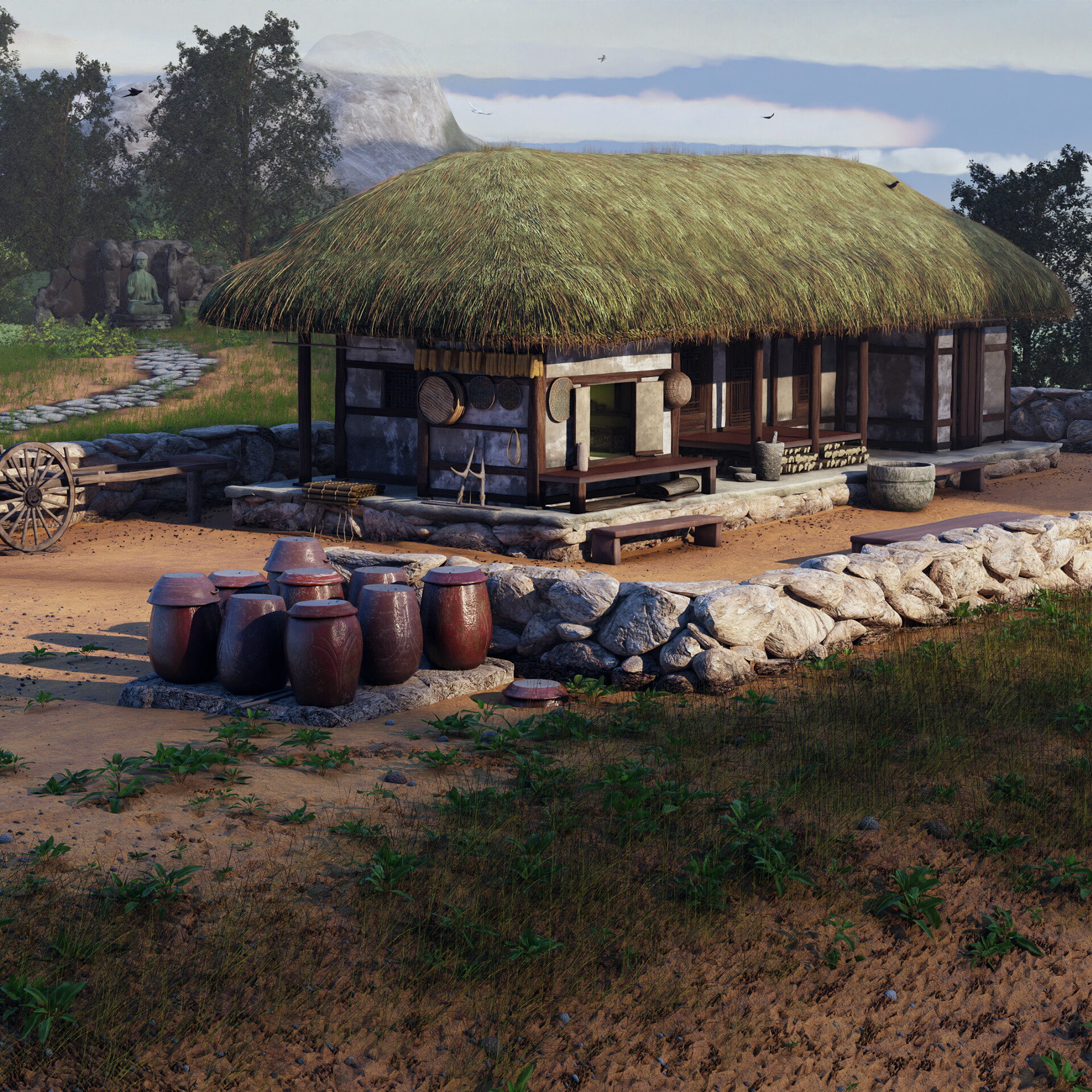
Korean medieval country house. Last of my serious "autonomous" Blender learning projects. Th Youtube


Photoshop post-compositing.


Blender Cycles rending.


Indeed, here is the last of my “big” learning projects. Everything I show here is spread over almost… 3 years of trying to learn 3D modeling from Blender :slight_smile: + :S + ?


As I discovered South Korea, with a particular connection, and like a certain number of Westerners, I sometimes dream a little of the “distant”, particularly of Asia, as I was also interested at one time in architecture then learned about wooden construction techniques (ingenious assemblies, rather ecological, with an essential place for hand work in connection with the spirit… Idealism?): in short, I wanted try to do this modeling there.
It was difficult, especially with a more limited graphics card than the one I currently have. I did some research for the items.
I also had the opportunity to sleep in a rather old country house in the Korean countryside: bad luck, it was in the middle of winter… Too much search for “authenticity” can “play tricks”… No, can be “demanding”.


If the characters still come from Makehuman, I integrated a rig into them, then animated them to obtain instructive postures, so to speak, from the state of mind of the protagonists.
It’s not much, but everything is thought of: the wife’s hand delicately placed on the husband’s shoulder (she is a little worried, a reserve in any case); the husband firmly camped in front of these coming ships (he is used to it, perhaps a former soldier himself, otherwise he is immersed in his idea of ​​the “homeland”?); the enthusiastic, energetic child (the benefits of the countryside :slight_smile: ), full of his dreams of epic, heroism and everything that presuppositions about childhood can sometimes lead us to imagine (he still has a clenched fist) . Well, for sure, we are in a somewhat old-fashioned vision of the couple… :-1

I modeled the clothes. But knowing that they would be seen from afar… Again, a little bit of research.

  • Error of scale: are the stone blocks of the low wall not too big for the manual work of people of this condition and time? I believe so.

  • We can regret the presence of the frame with a zoomed-in detail: but I took the trouble to work on these details, so I wanted to show them. Below, moreover, the landscape showed only grass.

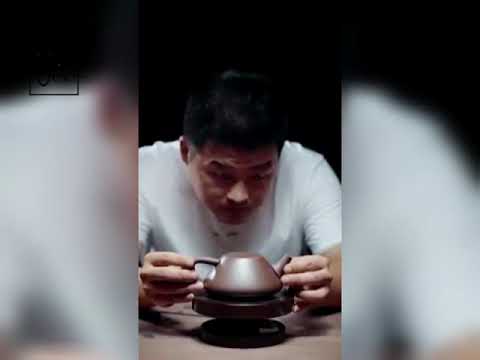
  • Onggi and kimchi :)… Thank you master O. H.J., for your pottery demonstration.

Nothing perfect, probably. I tried to make something pretty.
The Buddha statue in the distance is super ugly from a pure modeling perspective, but I knew it would be very far away.

This image is ultimately quite old, based on my learning: I now know that the Decimate modifier, if used correctly, can do wonders in terms of optimization.


And a viewport.


10 Likes

This render has absolutely delicious detail, and I love the way that you carefully made it historically accurate. The detailed explanation in your original post also adds a great deal to my appreciation of the image – and your very hard, meticulous work. This should certainly be immediately featured.

I truly love renders which “take me someplace” that I know I may never be. At the hands of an artist who is also a researcher, so that “what I see” is what I would see if I could be there (then).

This is too much praise, I can only thank you.
Merci :slight_smile:


Also, for the jars you see, one of which was buried on purpose, I would like to pay tribute to the work of Mister Oh. Clay is also a wonderful way to “model”, all the more proven by millennia of lives of our ancients.
“Onggi”, if my memory does not betray me, designates both the object - the jar - and the Korean technique of its shaping.

You see, we can still travel a little, from video to video. This may not be ideal. On the other hand, sometimes it is also a lot of “illusions” that we seek in “elsewhere”.

I find something soothing in this second video, not without a strange hint of melancholy.

At any rate thank you for your interest.

3 Likes

What a great post! :smiley:

I always just called them kimche jars or pots. I was about to complement you on them, and then your post added links and more detail than I could imagine. :smiley:

Korea is yet another country that deserves a happier time in history. :heart: Thanks for sharing this. :smiley:

1 Like

Thanks to you too.

1 Like

I featured you on BlenderNation, have a great weekend!

Jar that is buried underground is a way to store kimchi. (Maintain a constant temperature) :slightly_smiling_face:

2 Likes

You have the eye. Yes, that’s exactly how it is. We can see a reference to this technique in some Korean or Japanese films. Ffrom my memory, I thought this was the case in the very beautiful - and painful - animated film “Grave of the Fireflies”; but apparently not. Also I think it was used in many places around the world, even if it wasn’t strictly speaking with “onggi” jars. :slight_smile:
Thank you for your interest.

1 Like

Oh, sorry: “Kim” (?). I didn’t see him until a little late. I understand the full meaning of your remark better. I will avoid the little word of sympathy in Korean, which might suggest that I master the language: because unfortunately that is not the case, even if I can almost read it.
Well, anyway, it’s pretty much the same for English (…). In another life - and I “absolutely” believe in it - I will be a “genius”.
Accept my greetings. And be careful all the same with the pepper too, too, too much?.. A little bit ?too much? pronounced [?]. :slight_smile:


Ps: Your portfolio is interesting (or “pretty”?) as far as I can judge. Congratulations.

1 Like

It’s almost flattering, thank you. :slight_smile:
I finally managed to unlock my access to Blendernation.

1 Like

Thank you :slightly_smiling_face: