doesn’t apple have something similar to RT cores?
These new M series SOC chips are hard to digest and put a relatable name to what was once normal tech industry jargon. i.e. SOC unified RAM makes us think about RAM a little different now even with what use to be called unified memory with CUDA from 2015. Obviously the CUDA variant doesn’t work the same as Apple’s unified memory cause Nvidia GPUs still have to come with its own RAM and can’t pull equally with the CPU without that dreaded time consuming copy function. Which I believe they just don’t do, hence the out of memory prompts people get even though their system may have 64GB RAM.
Metal raytracing may not need to be accelerated the same way as Optix with dedicated cores?
RT Cores? Who really knows. Would Apple being Apple even call them that or just leave it unsaid as being part of the GPU. I mean if Nvidia didn’t tell us that a group of cores in the GPU’s die is there to accelerate raytracing then we wouldn’t even know.
We already know Apple’s SOC GPU can process and render with raytracing so… we also know about the ML cores already present in the SOC.
Will the newer Duo or Quadra M series have 2- 4 identical dies stitched together? Or will the other dies be slightly different having more ML cores or RT cores or a bigger GPU to CPU ratio on one or more of the dies?
I mean, do all four dies need to be identical? If Apple is stitching 4 M1 dies together to make a massive SOC why not redesign and have one quarter for the CPU one for the GPU one for RAM and one for all the acceleration goodies etc.
The next few years will be fun to just sit back and listen to the experts and track the changes that are rippling through the industry right now from Apple’s SOC “stone” that got tossed into the pond.
1 Like
yeo that is very true - I would not be surprised if Apple has something similar there. They clearly focus on image, film and 3D aka content creation.
1 Like
I didn’t want to fully bite on this one, especially since we already got a thread lock and a warning for getting into brands wars, but hear me out.
First let me say that I understand exactly where this comes from, I have been there and I get it… but let me offer a different picture at least to take into consideration if you will.
This RAM comparison is not an apples to apples comparison, it’s just not the quantity of it but the system and technology around it, if you could upgrade that 64MB system to 64GB today what are you going to do with it? Probably tied to a 133MHz processor, HDDs, no thunderbolt, no usb, no PCIe, wifi, slow ethernet, etc etc etc… SSDs of several TBs today have 20 times the effective data transfer speeds of those 300MB/s EDO 64MB RAM (or was it 300 megabits? even worse in that case). You have to not only upgrade the size but a whole lot of other stuff to keep it relevant, at least for long-ish term.
I’m going to tread into unpopular grounds regarding upgradeability, as it has been alluded here, related to the “why nobody complains that you can’t upgrade an Nvidia” GTX 970 from 1GB (or whatever it had) to 4GB or 8GB?
Upgradability advocates in my experience, and I’m totally NOT against the concept just stretching one side of the coin here, are not being fully honest about what really happens… sure, you can add a new SSD (or an external one via TB3/4 which I find preferable in the end) or an extra RAM stick, but then the memory doesn’t match, or the « dual channel something » or « speeds other » are not the same, so some of those modules are taken out (i.e. waste) anyways. “But I can upgrade the CPU!”, sure, but to get that nice new upcoming Alder Lake CPU requires a new CPU slot (which they keep constantly changing), hence a new motherboard, maybe a new faster RAM interface so it would be nice to match it with the best available RAM for it. And sure, you can swap that RTX 2060 for an upcoming $3K+ RTX 4090… after also swapping the PSU for a double power output one (unless you bought an overpowered one thinking about future proofing). So, in the end you end up with a half disassembled computer on the side in the name of a fully “upgraded” one… do you know how many RAM, CPU, heat sinks, PSUs, Bluetooth/WiFi/Ethernet/etc components I have left aside? Zero, there are fully functional laptops from 2010 still alive and kicking within my family that I have passed along with whatever hardware they came with (minus the required battery change here or there).
Source? People around me plus myself in my younger years went through a lot of it, since the Pentium and Cyrix days, through the cheap “Celeron” era to the very first AMDs Athlon64 dual cores and more.
Case in point, I got an iMac 2020 with 64GB of RAM, I love it, it took me like 5minutes to get it up and running (since it’s only ONE cable to plug and everything else is wireless), no drivers hassles, truly plug and play and snappy… YET my brother’s M1 MacBook Air with 8GB of RAM that consumes a tiny fraction of the wattage needed feels a darn whole lot faster and snappier regarding everyday minor tasks. I also find myself gravitating towards an iPad Pro I have on the side anytime I’m not working or doing less computation intensive work like emails or project management time, it just feels faster and more responsive. And this has an even tinier fraction of the whole “on paper hardware” than the desktop.
I kinda realized that maybe I don’t know any better when I bought a MacBook instead of a MacBook retina when they came out because “it didn’t have a DVD reader”… I used that DVD slot a total of zero times. When I finally bought a retina MacBook Pro (2014) I also bought the separate SuperDVD reader which I also used a total of never times, the need for it had parted and Apple did know better then and there.
Geekbench is it’s own thing not an “Apple” marketing thing, actually Geekbench tweets have mentioned that the tests aren’t showing the full picture because they were made not taking into account this new type of architecture, the GB5 scores are actually appalling when compared to what RTX scores show… 2x or 3x at times, yet when put into actual offscreen game benchmarks without any translation/emulation/hack layer M1Ms are very close in performance. And above and beyond more performant watt vs watt.
Let’s just wait until Metal (and MetalRT) is finally put into Blender, and a real nice test would be from a blank desktop: open blender, load a heavy mesh count scene and display a rendered screen.
And I have seen it already in videos which they don’t really expand on: currently an M1 Max might take 1.5mins to render an image while the 3x more power hungry “pick your favorite RTX number” takes 1min or maybe even 30 seconds… yet the M1 Max will get to start and finish that render a whole lot faster while a non-unified system will still be opening and loading, compiling shaders, preparing/tessellating the geometry, loading the textures, etc etc to then later on claim that 1min ‘faster render’. And let’s not get started with unplugging that RTX enabled system, it will crawl and downclock everything… a lot of the time clamped to 30FPS in most things to avoid taxing the system.
All of that said, I get that some people need upgradeable systems or Linux systems and what not, to which I say by all means get those, it’s nice that at least for now nobody is forcing anyone to go to a specific platform in the strict sense.
I hope this opens up a bit that this technological discussion isn’t strictly black or white, apple bad nvidia good, etc.
5 Likes
What would be interesting is really to see how much people do upgrade their PCs after buying it.
I can see he or GPU to be swapped out but don’t we mainly buy a machine work with it and then get a new system again?
That seems to me to be the most common case.
Max people I think mainly don’t want to get the screw driver - just a system that works easy.
That’s also one source for why Apple can perfect their software so well for the user hardware.
I mean look at the drama with windows 11 and games DRM - that’s is so embarrassing for Intel and windows 11.
I’m a pc-desktop and laptop user and only because of m1 and insane gpu prices I’m thinking about switching. Upgradeability of pc is mostly limited once you built it.
For example if you want to upgrade cpu you have to plan ahead so that socket is matching for example. Same with RAM you need to make sure to have free slots and then buy some matching sticks.
The only real benefit imho is being able to buy much more powerful gpu like 2 years later. This is something that prolonged my desktop lifespan many times cause it’s also the most important thing when you do rendering on gpu. But we’ve reached a point where I can buy a whole laptop for the price of a gpu. To think that I bought rtx2070 brand new shortly after it came out for a bit over 500 euro is crazy today.
I think apple could bring an external m1 egpu box. So you could have a mac mini + easily upgradeable m1 egpu with a ton of just gpu cores or whatever, it wouldn’t even need it’s own memory maybe. Or there could be options.
Think about using only macbook air and having an array of m1 egpus ready to just plug in and use as a freaking renderfarm. I’m actually curious why such thing doesn’t exist already
1 Like
Yeah that’s true . The macPros got three times new GPUs from NVIDIA but I also had those since well a long long time.
Most of my students who do similar things are gamers. The rest don’t which in my surrounding are the majority.
No, definitely not, you don’t get the difference between meaningless synthetic benchmarks that model no real world workload and real benchmarks that show real world usage. YOU are buying into the marketing bullshit, nothing more.
I never said anything about geekbench. I ran ACTUAL games…not sure how you think those are synthetic benchmarks. …you are threatened and scared and lashing out in a mac thread about something you shouldnt even care about. Why are you so concerned that Apple tricked us all…let us be stupid sheep then. why do you care so much? do you work for intel?
3 Likes
I can’t think of a single situation where a machine scored well on benchmarks, yet fell behind considerably in other real world tasks.
2 Likes
That’s funny because Geekbench isn’t even showing the actual maximum score the M1 Max is capable of getting
1 Like
Can we leave geekbench behind us ?
I mean if you need put yourself onto a spankbench and test that performance
1 Like
I’m afraid this person isn’t actually reading the messages or interpreting results properly, besides nitpicking situations or company “conspiracies”. I tried to put a reasonable (albeit monologue length) perspective but went to deaf ears.
I think it’s safe to say that we should just ignore and move on, wait for those Blender tests.
On that note, if some of you got hardware to test at some point when it’s all good and dandy, to try from loading a scene, hitting render and having the final image on a somewhat heavy scene between an M1 to any other.
1 Like
Curiosity got the best of me and I will try to compile Blender with the patch if I can figure out how.
Cloning the blender source from git.blender.org is a bit slow however.
3 Likes
Great - I am really curious to test it !
Do it!!! Gelert said it wasn’t too tricky to add the patches. I’ve compiled once and only while reading carefully and following the BF guide. I don’t even have X Code on my machine anymore.
I have a feeling the first official version will be out next week sometime.
2 Likes
Speaking as someone who’s complied a program twice…
…no matter how easy they claim it is to do, it’s still a giant pain in the ass.
5 Likes
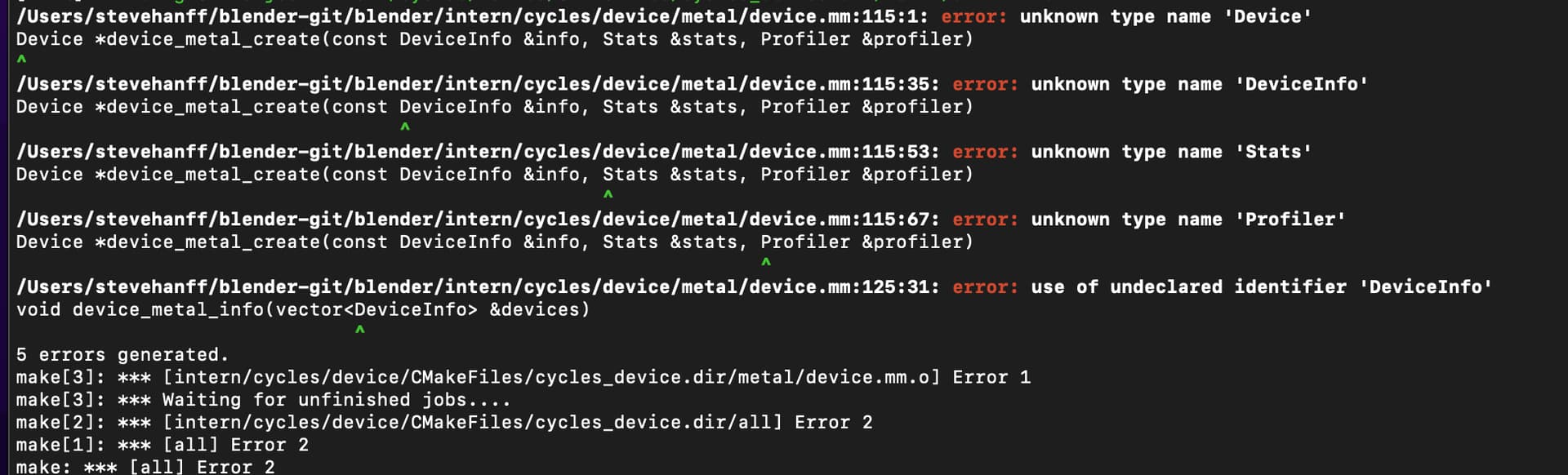
I get it to compile. Then tried applying the patches but I must be missing something as I can’t seem to get it to render on the GPU.
Decided to empty the build folder and trying again with the patches applied.
1 Like
I’m sure you read this comment, but if not this may help
"The only slightly difficult bit was getting the new patch added, which I did like this:
patch -p1 < ~/Developer/D13423.diff [downloaded the RAW file from the Dev site]"