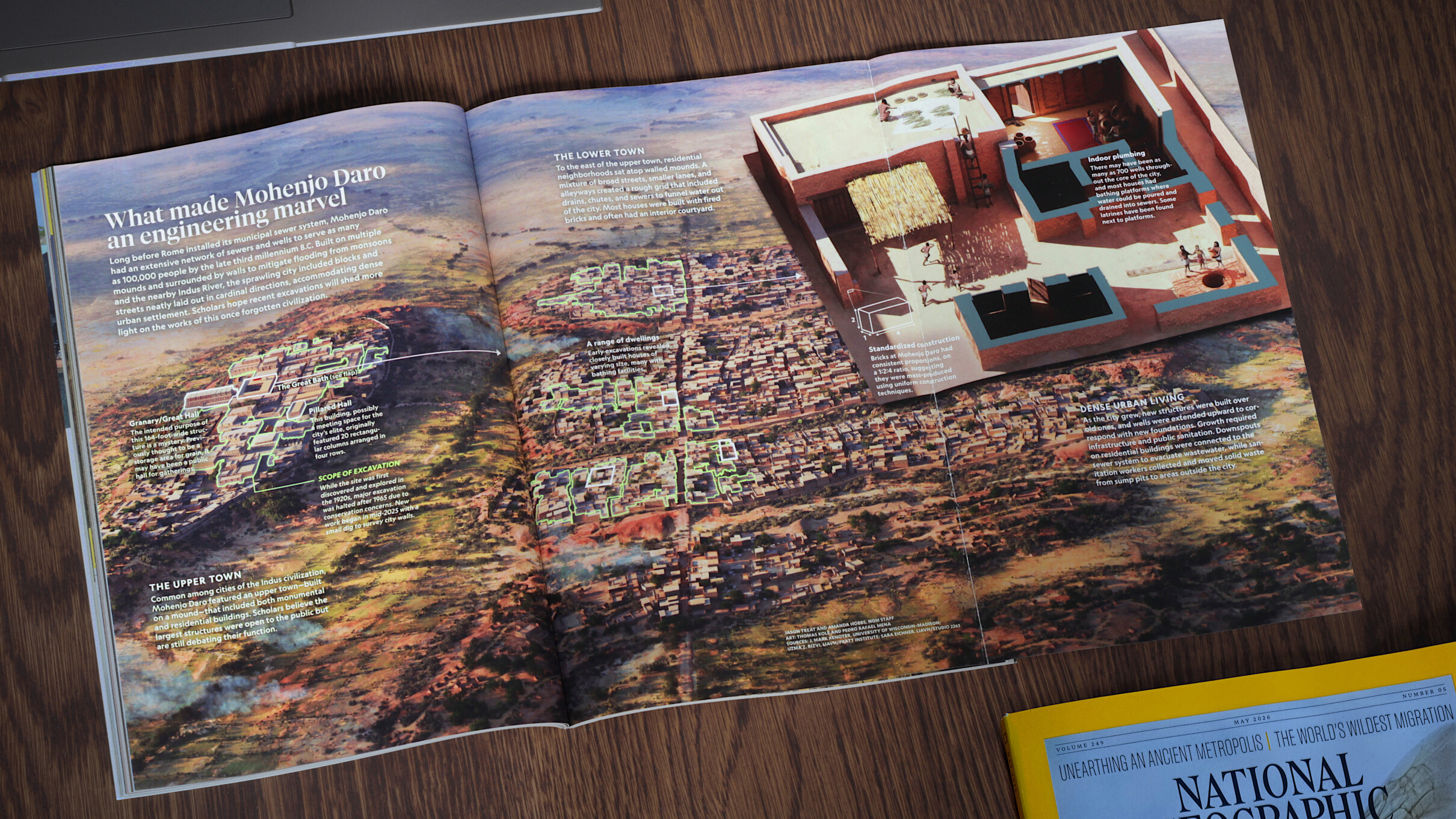
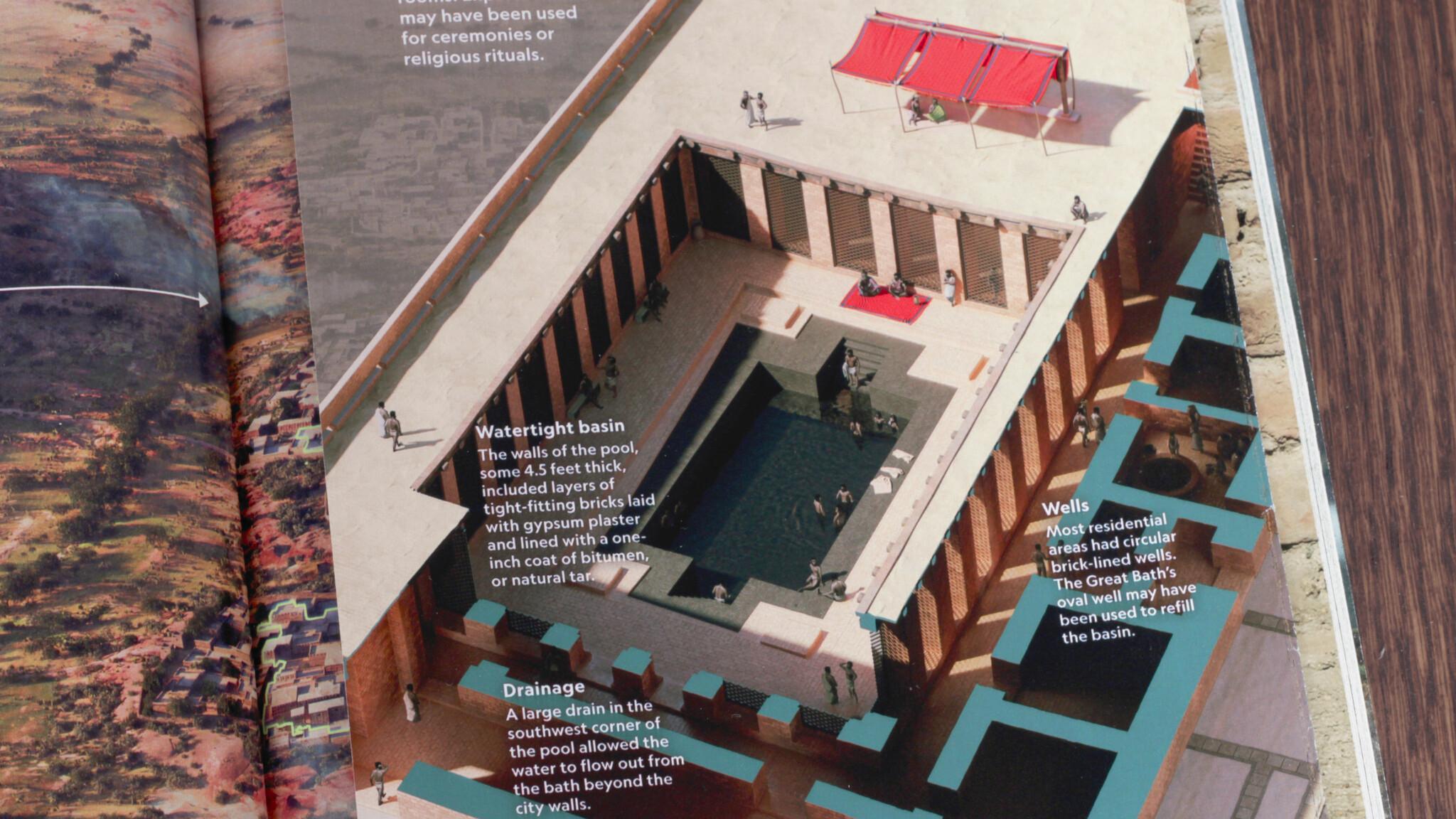
For an article on Mohenjo Daro in the May 2026 edition, National Geographic commissioned three 3D archaeological reconstructions.
They appear in the article as a fold-out page, where in inner flap contains a reconstruction of the bath, and when folded out, the full city is revealed with a cutaway of a residential area.
The piece was made in close collaboration with NGM staff.
Credits:
National Geographic Magazine staff Jason Treat and Amanda Hobbs.
Sources: J. Mark Kenoyer, University of Wisconsin–Madison; Uzma Z. Rizvi, LIAVH/Pratt Institute; Sara Eichner, LIAVH/Studio 2263
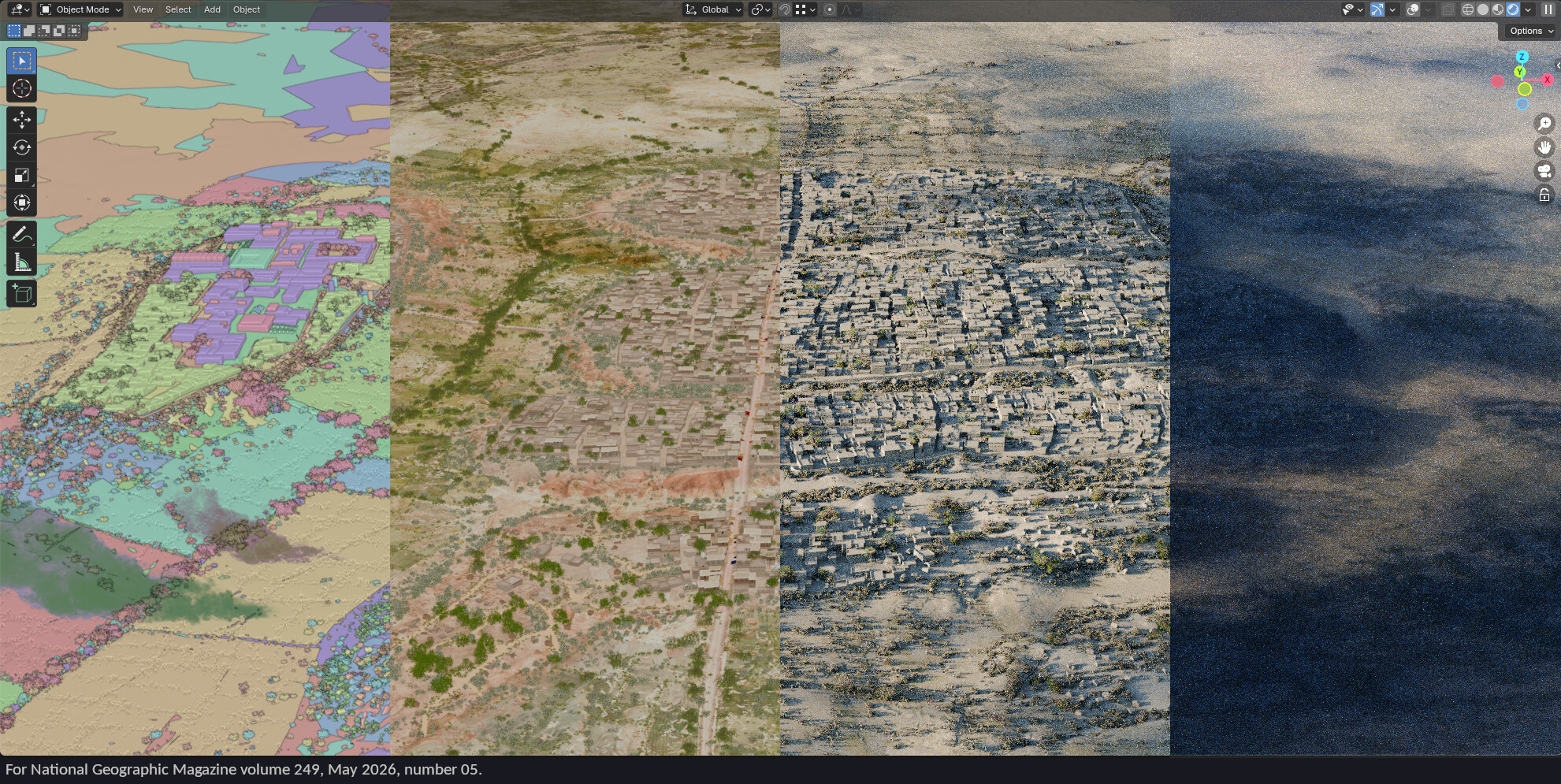
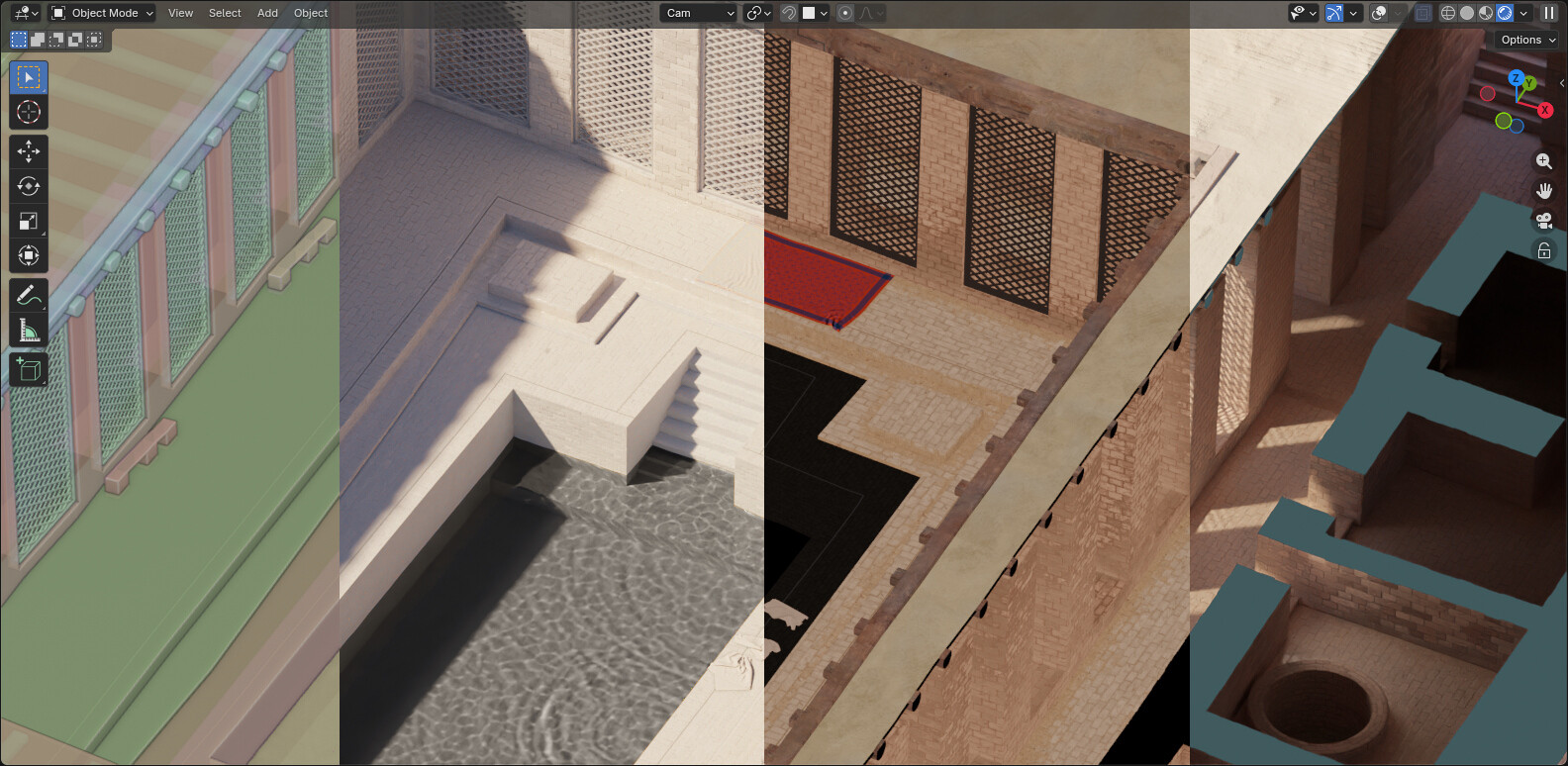
It goes without saying that all 3D was done in Blender. I made extensive use of Geometry nodes and procedural shading, as I did with my Tenochtitlan project.
There’s hardly any artificial light in any of the scenes (I mean it’s all digital but you get what I mean).
I use bounce helpers and boosters to push the natural light into the corners wherever needed.
My friend and illustrator Pedro Rafael Mena (https://www.artstation.com/rafael-mena) drew the figures in the cutaway illustrations. He drew them in 2D, and I projected these onto proxy meshes for decent shadows and reflections. This turned out to be a great fun way of adding life to the scene.
You can see the article for yourself in the current issue, number 05. It has a bee on the cover !
Amazing stuff !! it’s super cool to see that after following your Tenochtitlan project, it shows how much tough and practice can go into a project like this and you are the right person for the job.
Out of curiosity, how long did the project took ? and what was the main steps, I suppose you used geographic and archaeological data as input, how did that go ?
In most projects back and forth with client is a good chunk of the work, since here it’s very grounded, how much part of iteration and back and forth you got ? Anyway, any information you could share can be very interested !
As always it’s a pleasure to see your work and it’s very inspiring !
A reconstruction like this always is an exercise in extrapolation, where you have to paint a complete picture based on scarce puzzle pieces.
But you can’t start when you have all information complete, you have to make a sort of running start. Start with what you know, and go from there.
So, there usually is a lot of back and forth with academics, where you propose something, and they comment, and that is fed back into the reconstruction.
In the credits you can see who we consulted for this.
The project spanned a few week-long stretches over the course of multiple months.
Hahaha thanks for the answer ! I was super naive thinking this was straightforward, probably because the end result is so neat ! Also I’m very unfamiliar with this type of work…
That looks like a very interesting process, and you both did an amazing job especially given that it sounds like a short time frame !
 !
!


