Hi,
This is a personal project i started to test, improve and solve some issues related to the techniques and workflow i’ve used in modelling and shading the assets made for Mango , main question was (and generally is , for all sorts of environments) making lots of models and textures , make them quickly, detailed and not too slow to render 
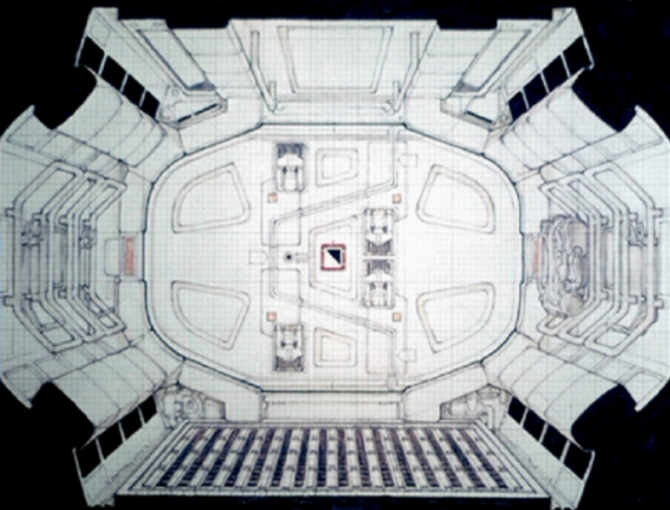
I looked for a good test case, and watching again the opening scenes of ‘Alien’ with the camera flying through the ‘Nostromo’ seemed perfect : great design by Ron Cobb for inspiration , reasonable to work on 2-4 quick shots of interiors, recycling some assets and building some new.
This is still work in progress ! shot 1 is basically done , 2 needs a few detail models more , 1-2 more shots to add to test other cases.
For texturing i used the tecniques described in the the Mango env art videos (http://www.youtube.com/channel/UCDSBZIemT12ZTjTqwTFjd6Q)
There’s no custom painted textures here, all tileables and dirtmaps , and only a few are baked AO, the much lighter ‘dirt vertex color’ proved to give some great results in many cases .
The key point was to test more on the renderspeed , so have these scenes animated : while using dirtmaps and blending can produce some great materials the question remains on how heavy that is compared to using 1 higher res. texture per channel…
There’s no quick universal answer of course , but in these tests i managed to get rendertimes per frame of 2-3 minutes (full HD , on a i7 3930k cpu) … with direct light (0/0 dif/glossy bounces) and AO , using non-progressive mode.
The question with complex materials (texture wise) in Cycles seem to be that each ‘sample’ means recalculating the whole node tree , so it’s quite slow when using 100s or 1000s of samples , but it’s dead fast when using non-progressive with low AA samples. (these shots use 6-8 AA samples)
However, non progressive is tricky to setup , and right now it only seems to be convenient when using direct light only or vey limited GI.
I made a tutorial on the subject : http://www.youtube.com/watch?v=7Hb5fJ00P2w
So … interestingly, i ended up using Cycles to do some quite ‘old-school’ setups : using 0 glossy bounces means basically no raytraced reflections , only speculars … but still often some sweet looking area-light speculars
And there’s no GI in these renders , only AO … but when trying to keep renders very fast even Vray won’t guarantee an easy life (tons of parameters to tweak, blotches and other complicate glitches…) while AO is easy and reliable …
So i’m testing and figuring out just how much can be obtained with these setups . For sure they have some serious limits when trying to achieve photorealism , but for animation or architecture videos … fast and reliable is important , and the question remains on how limiting it is for various situations (soft shadows are slow anyway, chromes and mirrors require 1 bounce of glossy, etc… )
But enough technical render stuff (Cycles … you got to love it, but as usual with render engines and lighting you’re never done testing and learning workflows :)) below is a frame with some passes breakdown :

Thanks for comment and critique , i’ll post more about other aspects (like compositing) in updates.