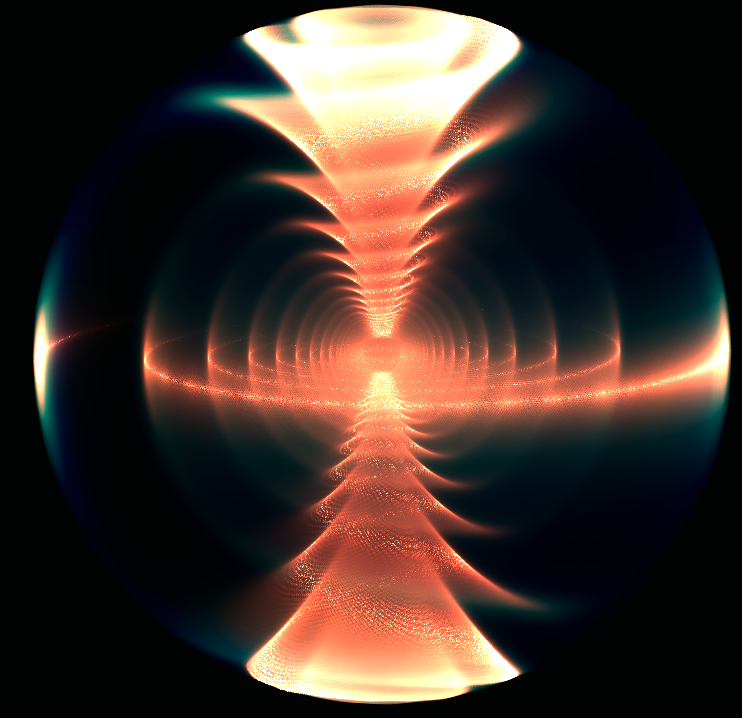
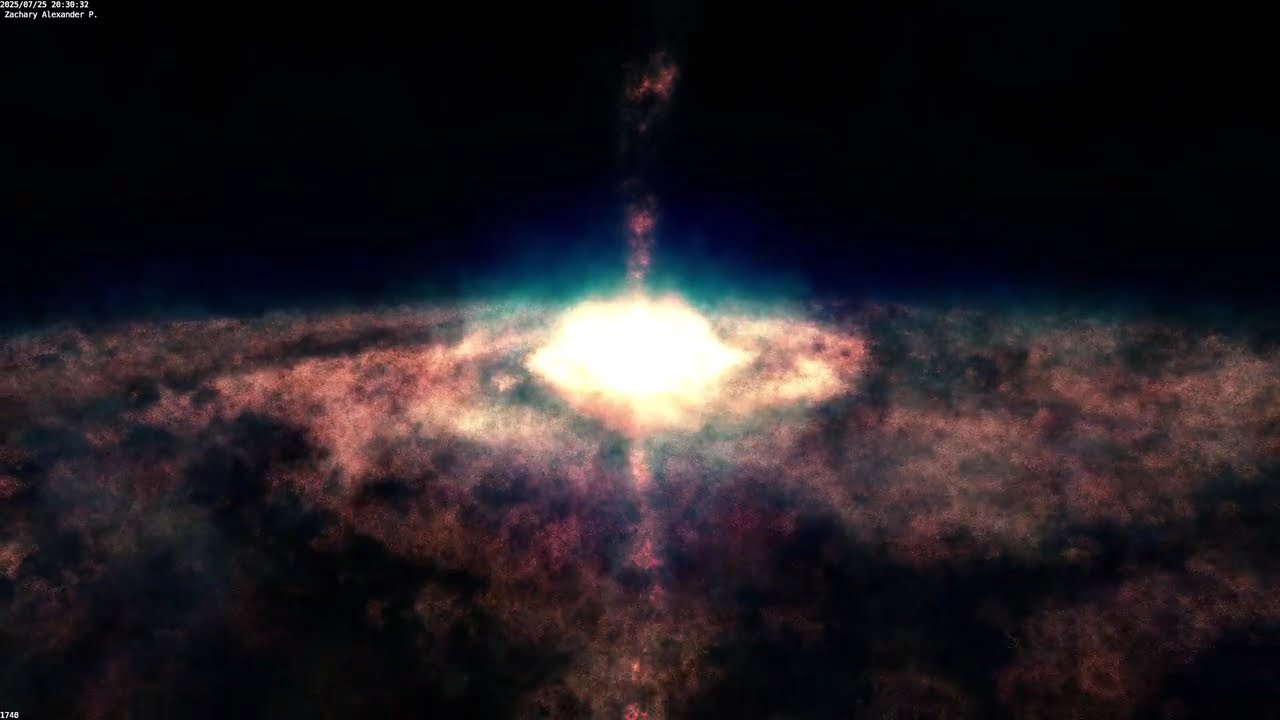
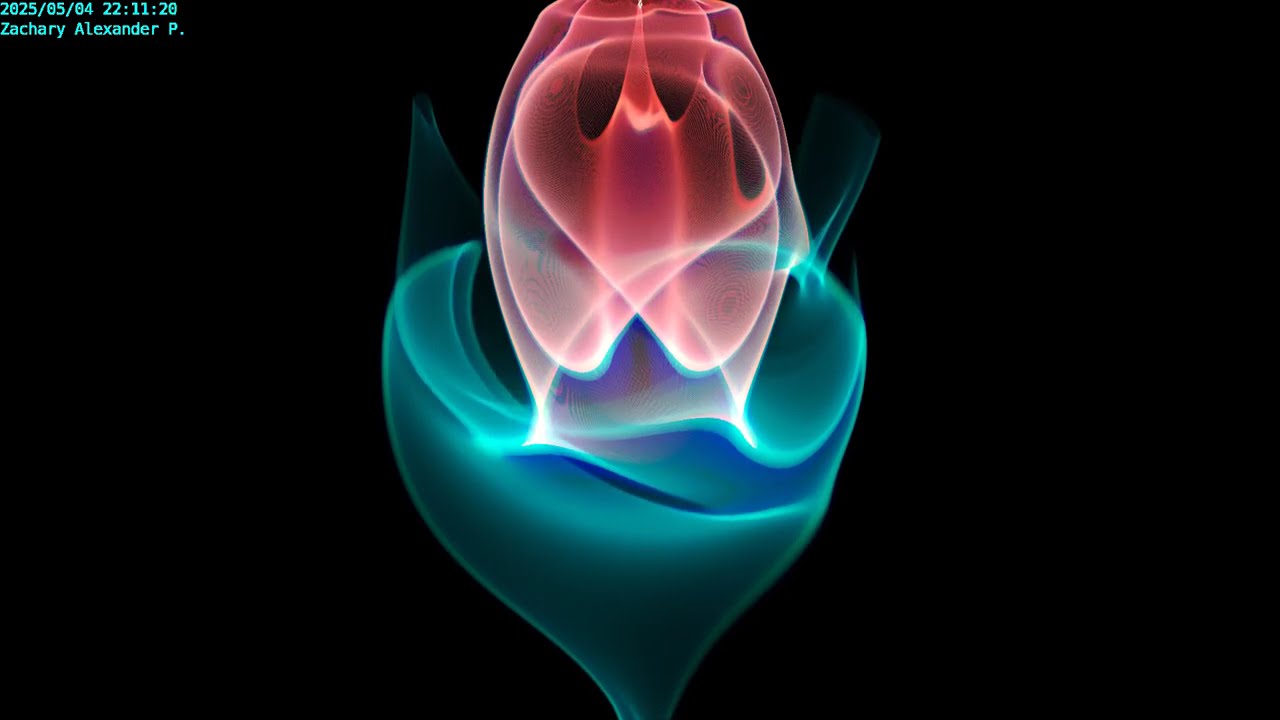
Greetings! This project has been an honor to work on. Without the Blender Foundation and all the hard work from developers, this would not have been possible!
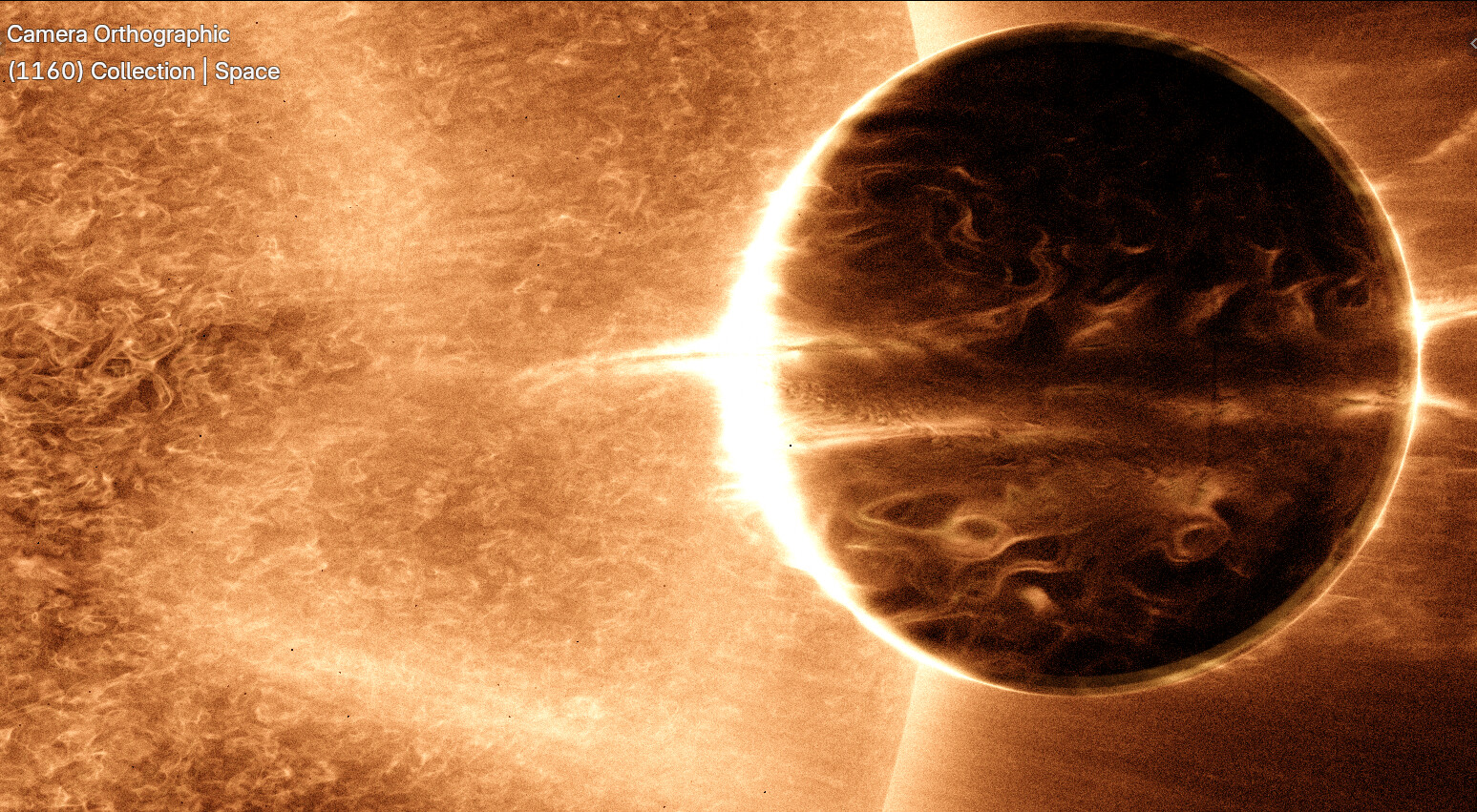
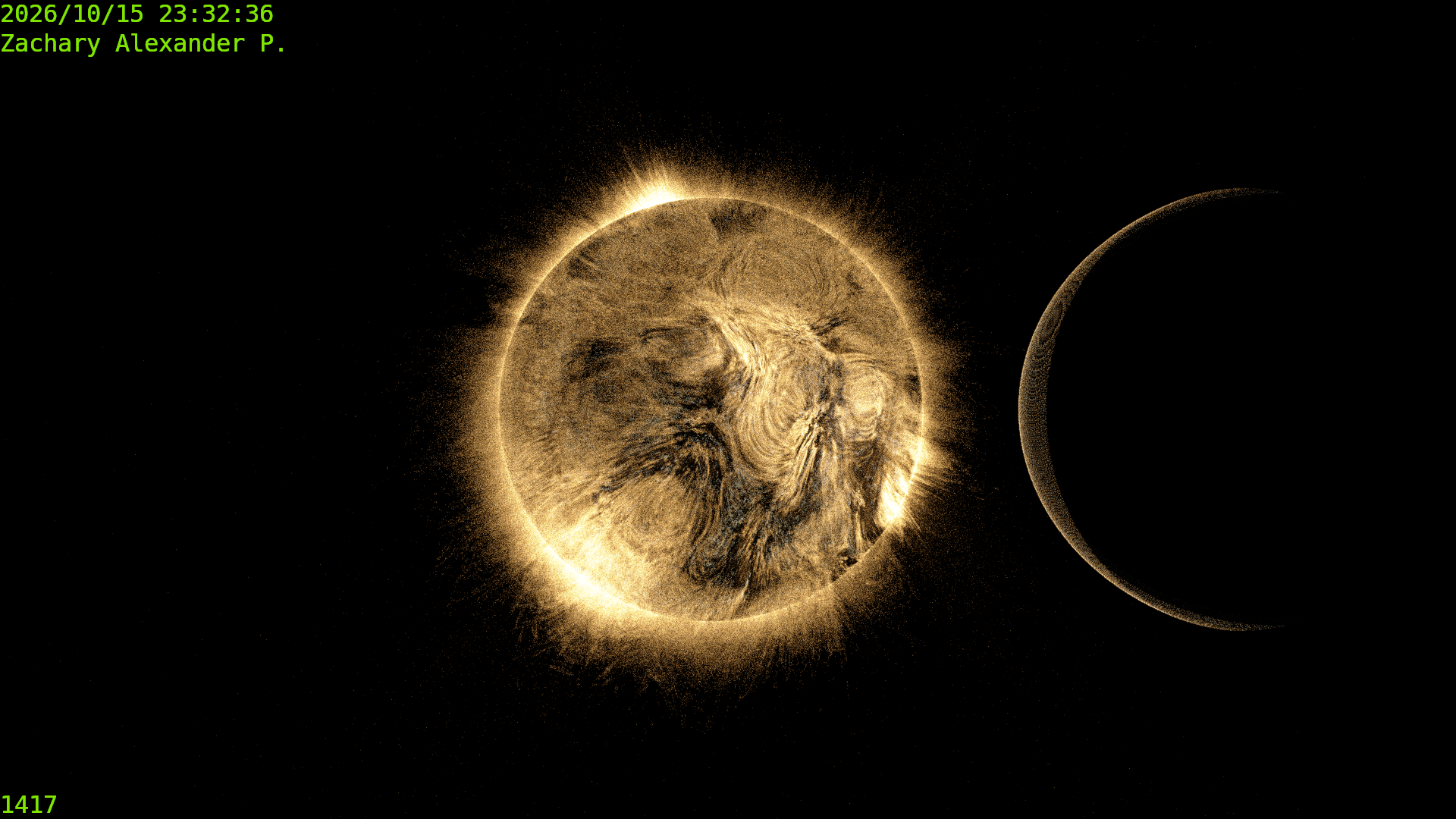
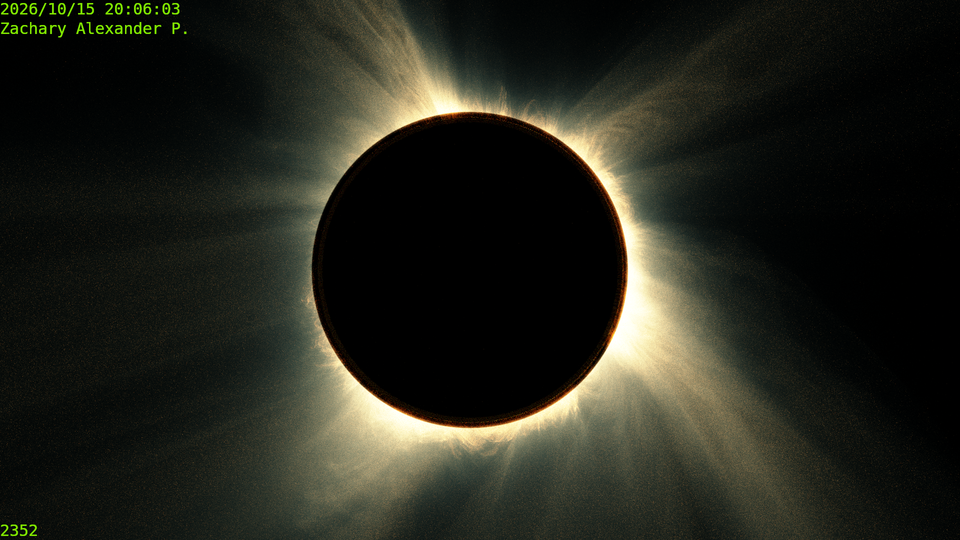
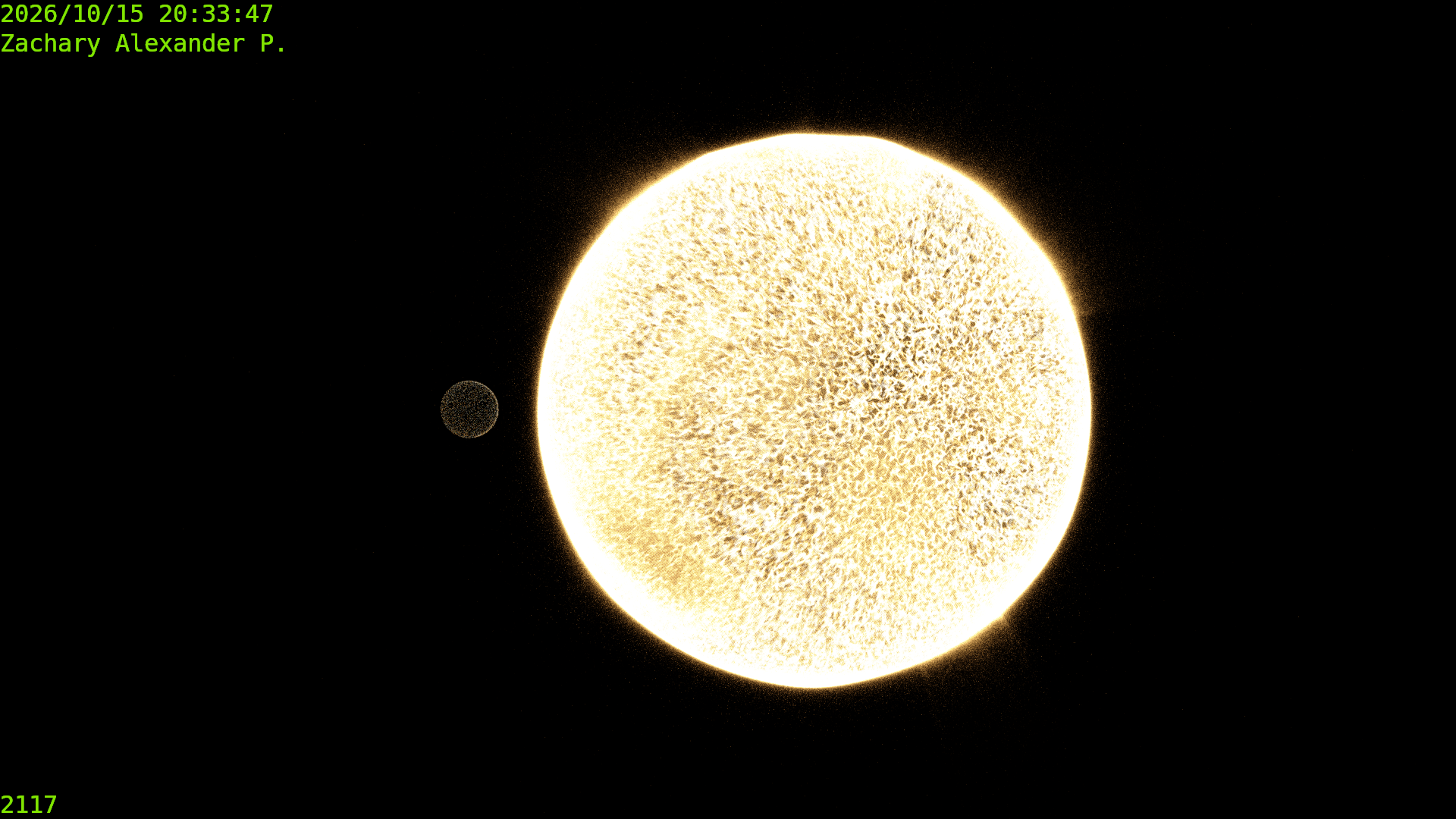
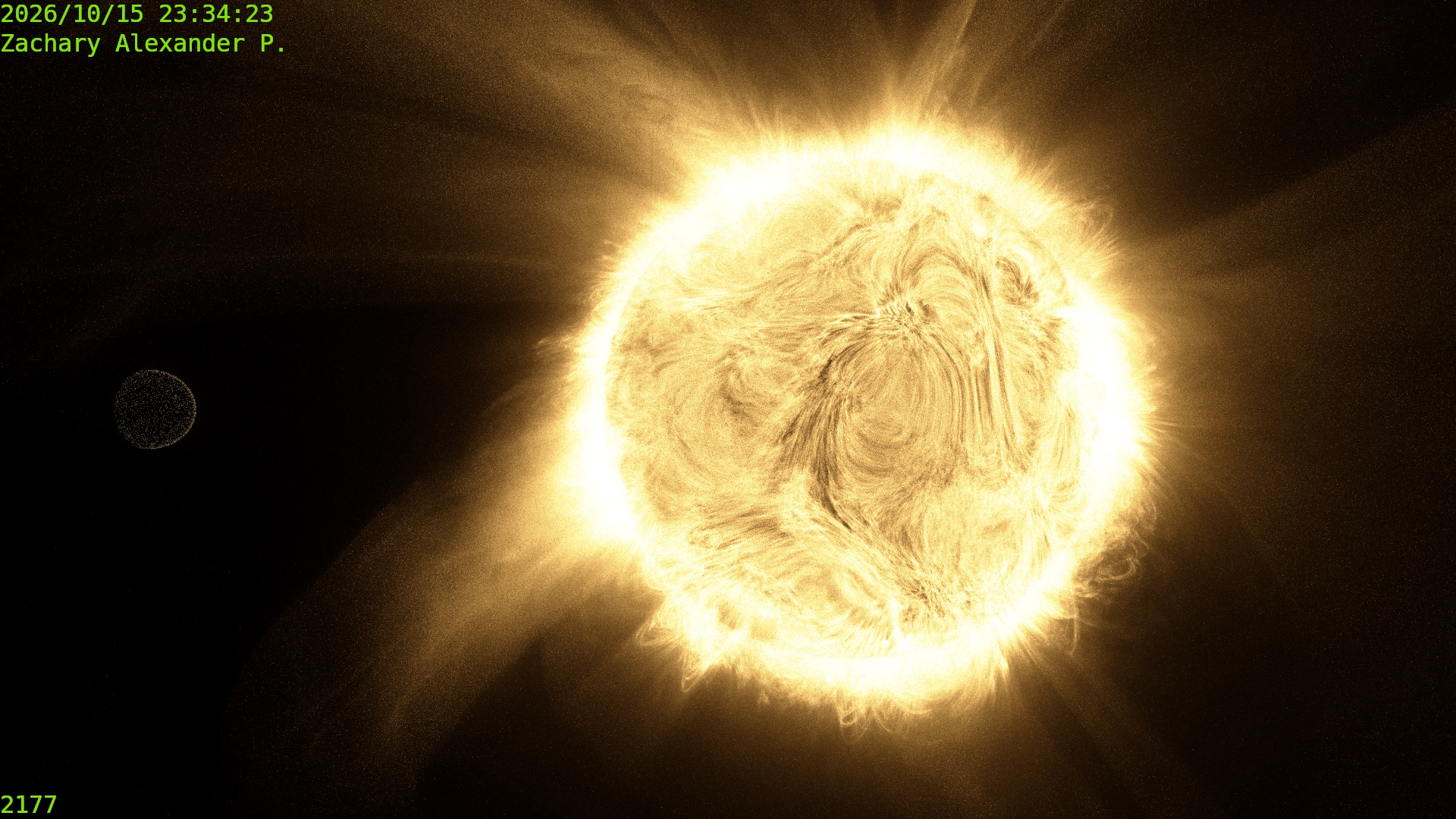
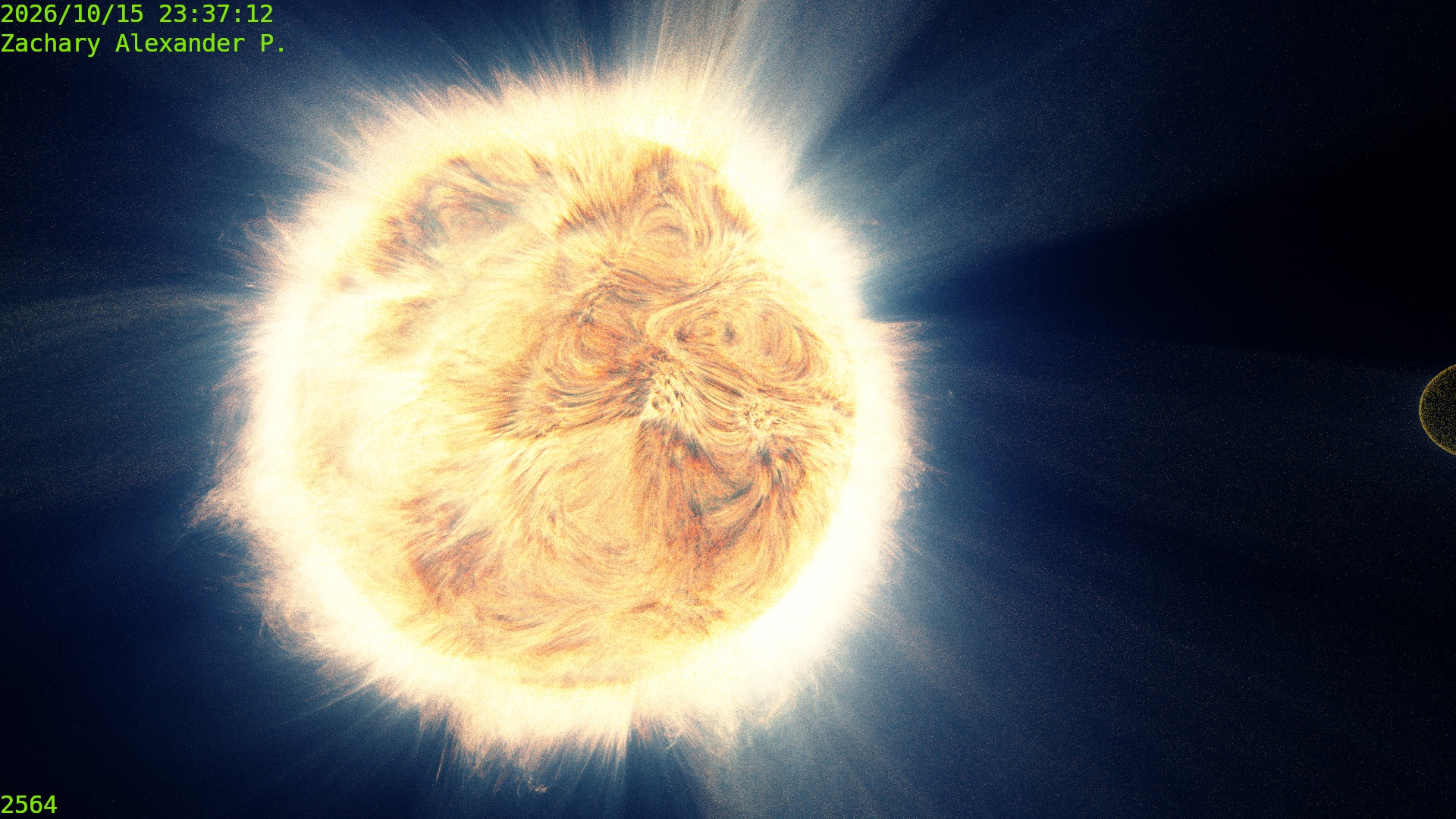
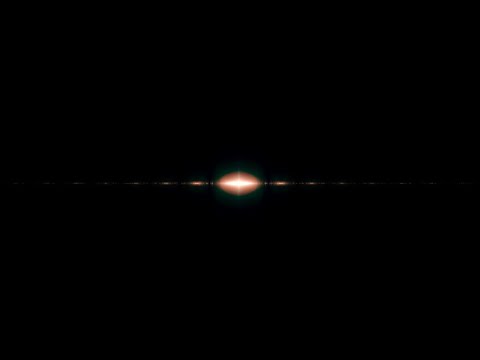
This is a 100% procedural XYZ shader plot. These images are generated with 100% procedural math using only a single volumetric output shader. No particles, polygons or image textures were used. Only a unified procedural vector-wave field-equation. This simulation runs in real time 30 fps at 1080p in the 3D viewport using the EEVEE render engine with volumetric steps set to 128 and 1:1 resolution. This formula could be used in real time space videogames. The vector field can be viewed in perspective and orthographic mode with minimal banding artifacts.
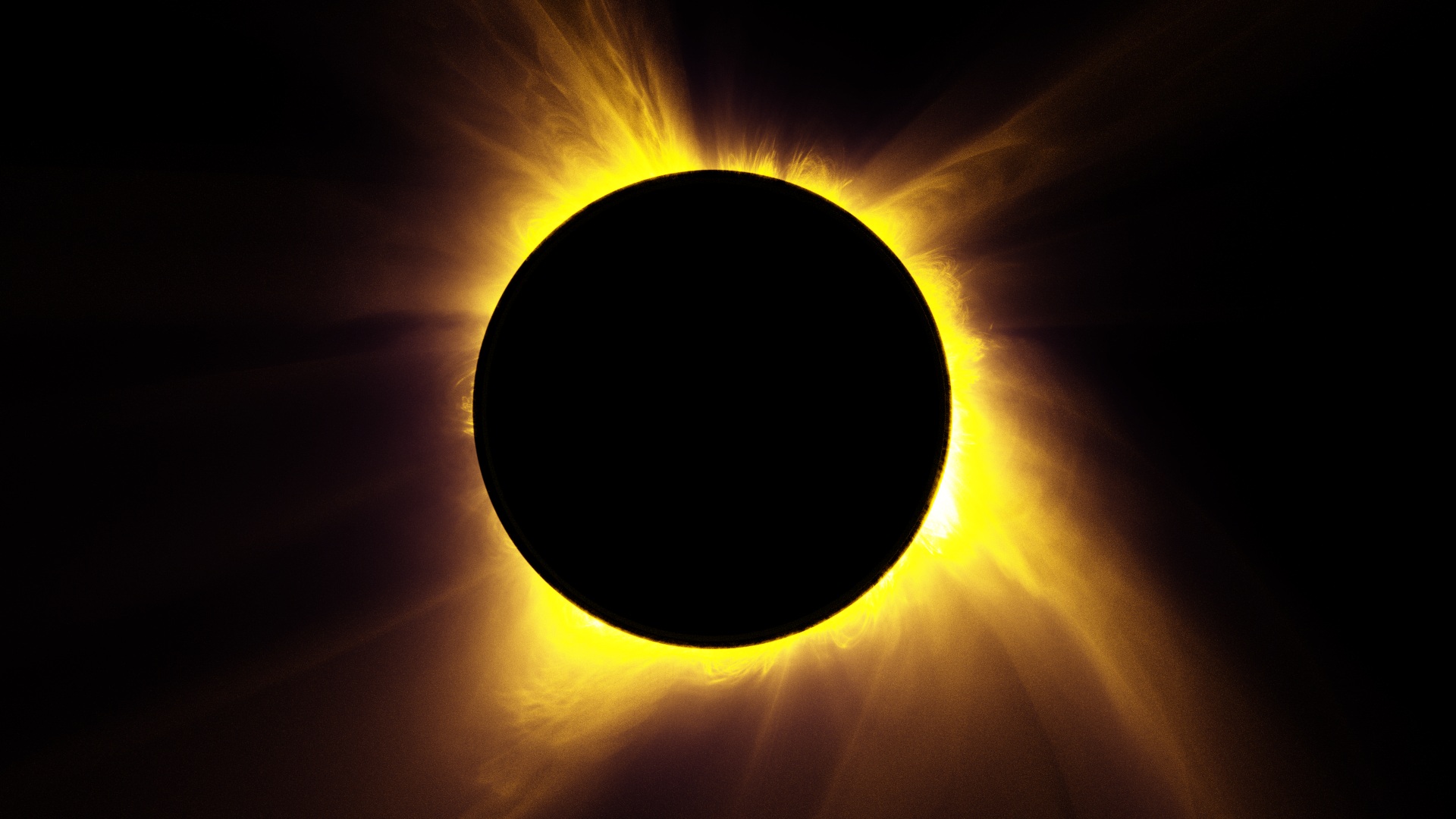
This also runs in the cycles engine - though the colors are not as vibrant because of the way cycles works with pure volumetric objects. EEVEE operates better in this case because I am holographically plotting a dynamic field that can propagate light and color from within a real time wave-field network at step 1 - when the geometry is drawn in the field by the pure vector wave interference. I discovered a novel way to force internal shader occlusion of waves to specific coordinates of the spherical wave resonances as you can see in the eclipse photo below. I am currently working on perfecting the shadow-producing math with more accurate umbra and penumbra.
The real time performance comes from years of optimization work seeking for elegance and simplicity in the procedural math equation. I originally started attempting this with compute heavy particle systems which would not be possible on a consumer grade GPU. I found a better way through trial and error and by following intuition - and stubbornly sticking to pure simplistic math and fundamental physics principles. I did not even need to use imaginary numbers because I am using a special holographic field equation that is comparable to a Hilbert space in that it is “complete” where its output boundary can be surpassed because it is contained within an infinite domain. All the vectors boil down to a single dot product (inner product) to output what you see in these images:

These lower images are only rendered with 32 samples. The two above have increased contrast and 256 samples. They are the cover renders.
Video Renders:
2k:

4k:
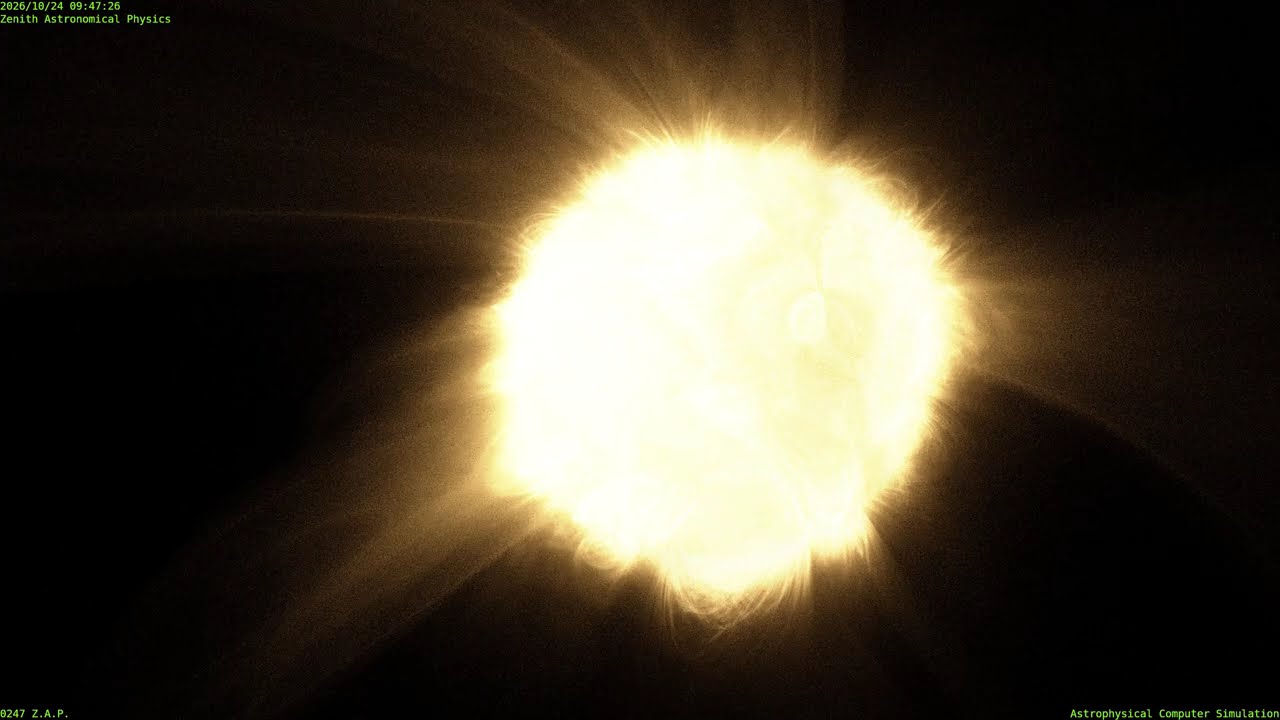
I plan on modifying the equation with values that morph the star into different stellar classifications. From Main Sequence, Red Dwarfs, Red Giants and Super Giants. Then I may donate it to the scientists at ESO and NASA to help them map the sky and understand our universe. There is much scientific phenomenon I can predict with this math. The physics revelations I am witnessing are beautiful! Pure math can deliver answers in physics, but not determinable without reference to the observable universe.
Below is a screenshot of my Blender workspace. As you can see there is only one collection with a camera and a sphere named “space” that is used for the volumetric domain. Everything you see comes from that shader tree. The tree is not very big because it is has had many iterations of equation simplification for throughput optimization. I apologize for zooming out so far on the node setup. I will only share it with people who I meet and get to know me face to face. This is my foot in the door. I will be working on this for the rest of my life because this is only the tip of the iceberg.
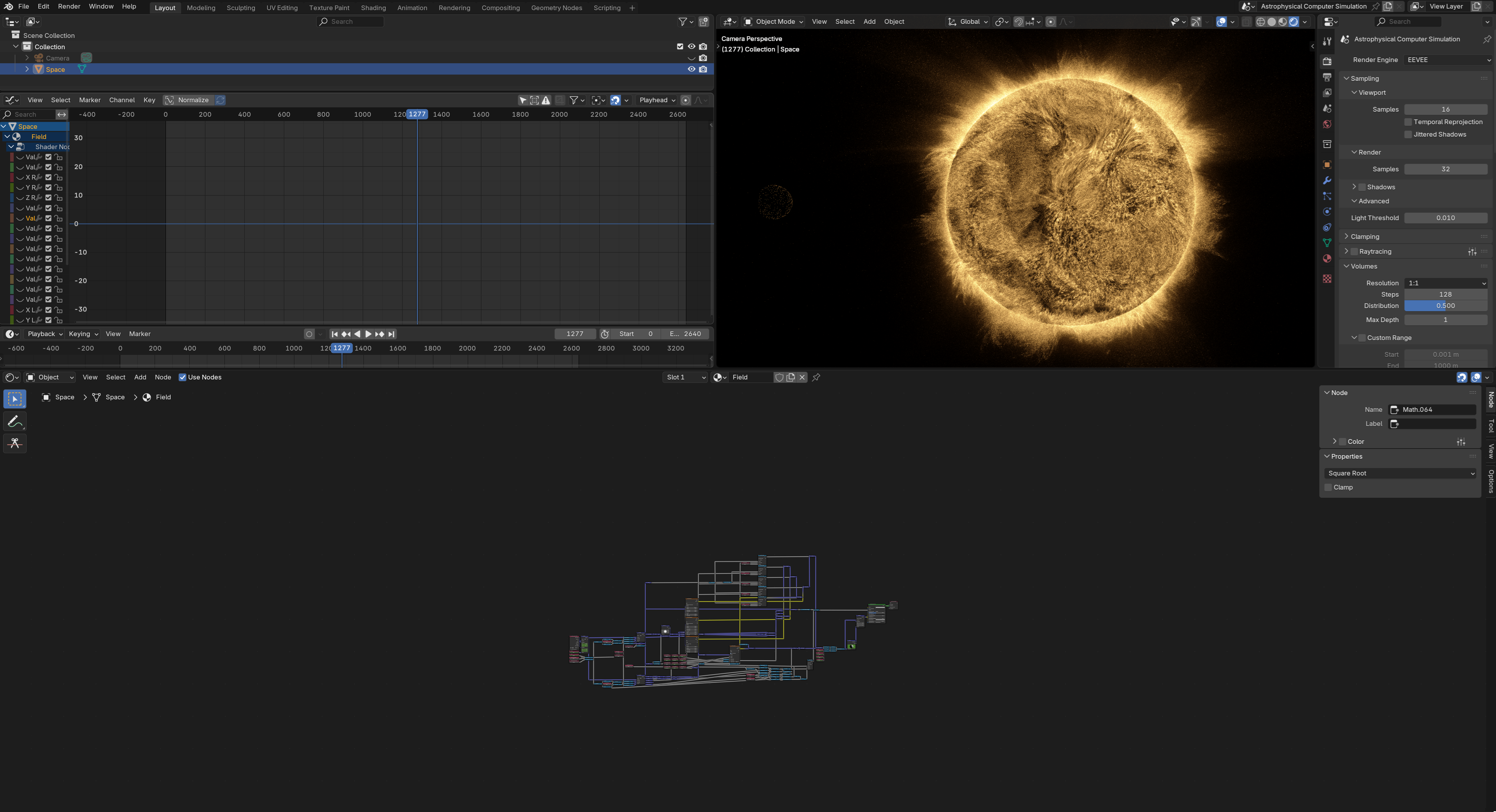
This is a robust framework for building a realistic universal physics engine. Certain physical dynamics (such as relationships between mass, orbital resonance, and dynamically computed gravitation I have deliberately held off. The bodies are all tied to one value node named “time” which is the only node that is keyframed in the video concerning movement. The planet movement is tied to an orbital resonance value node integrated to the stars rotation period. The equation is ready to simulate solar cycles and a relationship between orbital velocity, solar rotation volumetric oblateness and mass to mass barycenter location. I am using procedural texture nodes as a filter for the photosphere where it passes through the chromosphere and corona to simulate a cosmic ray heliospheric noise map. This star equation has a core, a photosphere, a chromosphere a corona and a heliosphere that all interact dynamically through waves and spherical resonance to produce this render.
I am in uncharted territory, but I believe I have found a vector that unfolds most of the answers intuitively. Stars do not sustain themselves by fusion. They require an external input of energy. Every star in the sky is located within a galaxy of billions that produce a supermassive central galactic core of energy. Individual stars do not appear in the space between separate galaxies for a reason - they are dependent on a higher dimensional scale (galactic nucleus). Stars have extremely large heliospheric field-nets that capture and release electromagnetic waves. Stars are cosmic-scale energy-wave nodal-resonators that capture higher (galactic) dimensional-scale energy-waves and transform them down to our (stellar) scale through a process of fusion - which in simplistic terms is an energy field dimensional scaling process. I would argue that the scalar-dimension below the stellar (atoms of earth) are dependent on the 24/7 continuous resonant energy waves from the sun. The elements are not only dependent on stellar supernovas to exist as they are, they are also dependent on real-time stellar waves. Atoms are dependent on stars to exist in their specific “state of matter” which could affect many other variables such as isotopes and half-life.
Here is another recent simulation where I am attempting to simulate the Betelgeuse Siwarha system. This is a theoretical simulation because at over 500 lightyears away its difficult for scientists to gather dependable data.
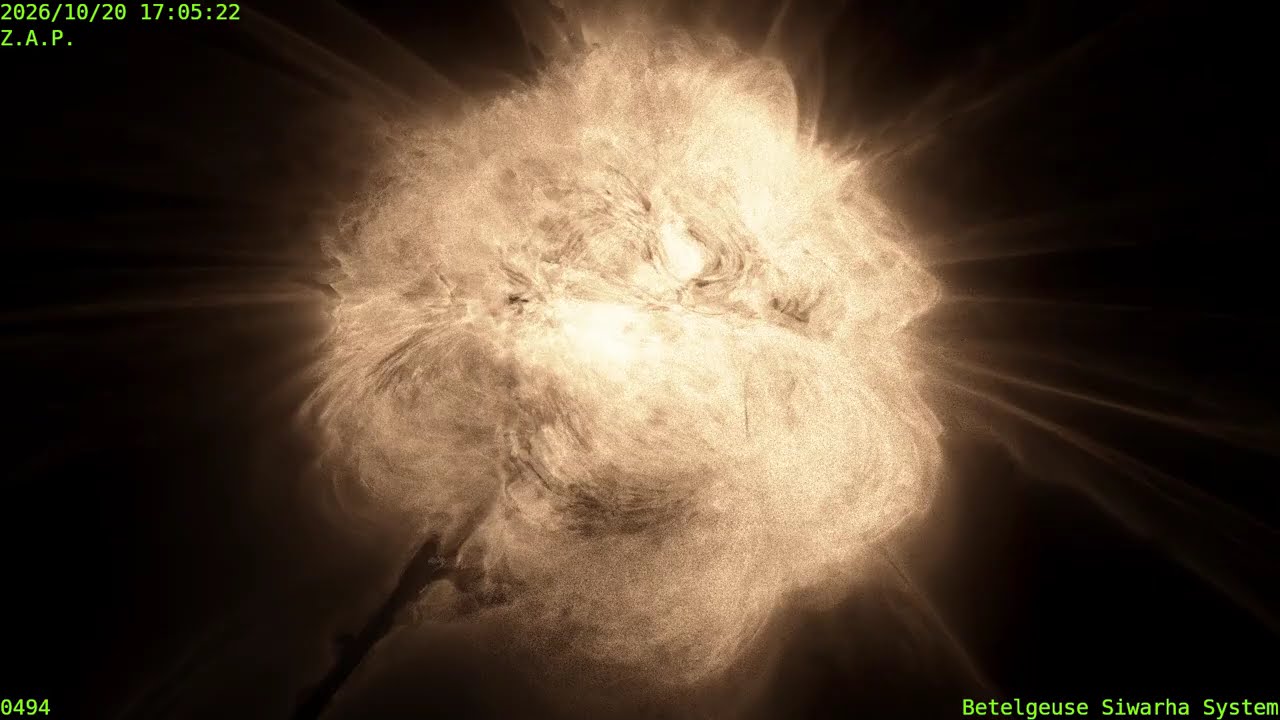
I am certain these are accurate computer simulations of electromagnetic fields.
The results I am getting are definitive:
The universe is full of scalar-invariant nucleus systems (nuclei<stellar<galactic) that build upon each other and become more and more complex. Here is an image of the atomic scale using the same fundamental field equation:
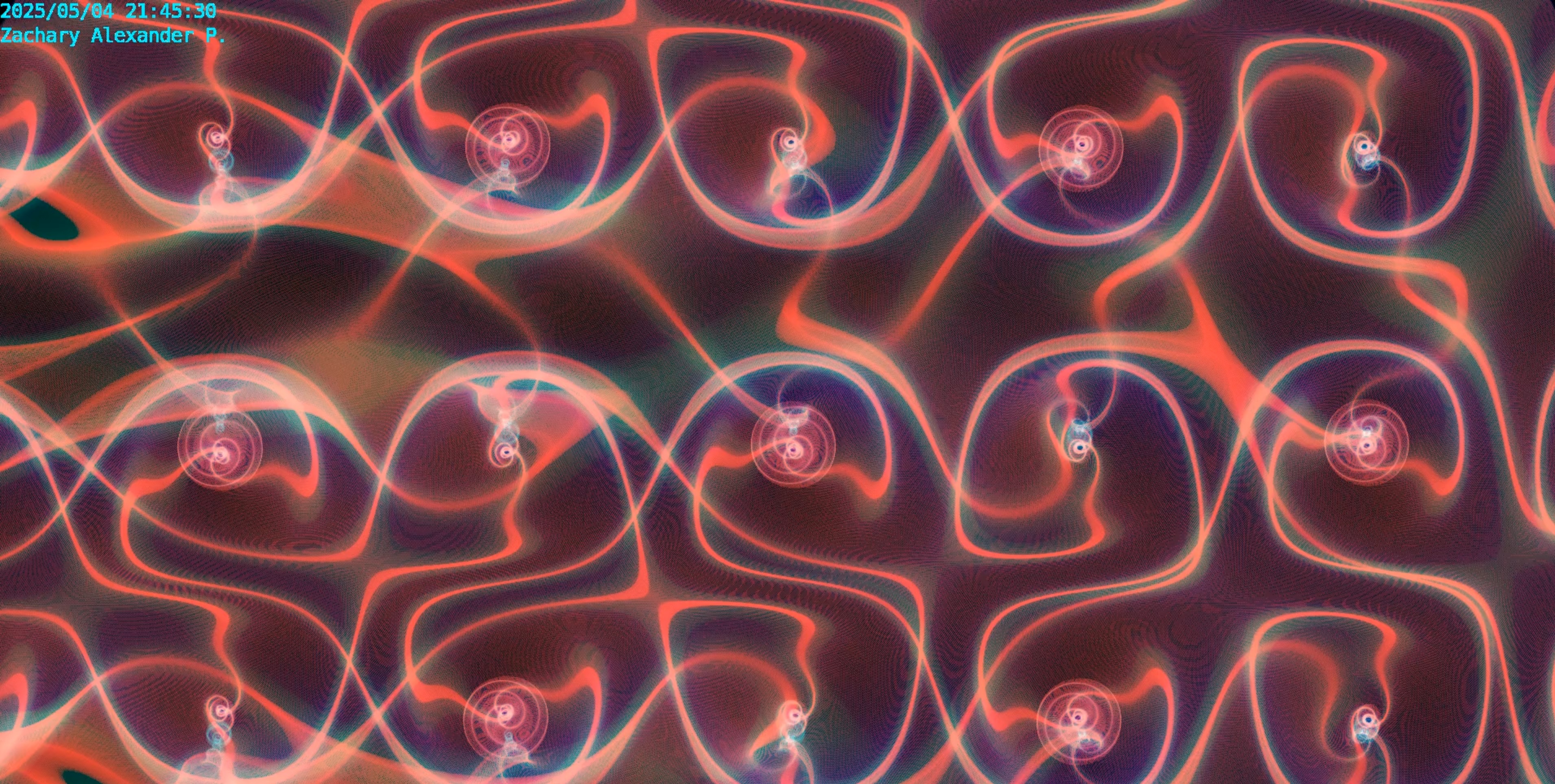
As you can see in the image, there are small nodes with waves tied to them. These nodes are atoms that are resonating in a standing-wave field-lattice that operates as a continuous quantum field network. Photons are waves that appear as particles because they can only be detected with these nodal systems which appear as particles also. Electrons appear as particles, but their root is in waveform. Electrons are like standing “wave packets” in the continuous spiral shell-wave that wraps around in onto itself toward the nucleus. Electrons do not “jump” shells - instead electron “wave packets” slide along a continuous resonant standing wave that spirals toward the nucleus. The image below is of atoms. There are cyan electron waves in this image that curl up in a concentrated energy ripple (wave packet) inside the atom on a continuous spherical/ loxodromic nested shell.
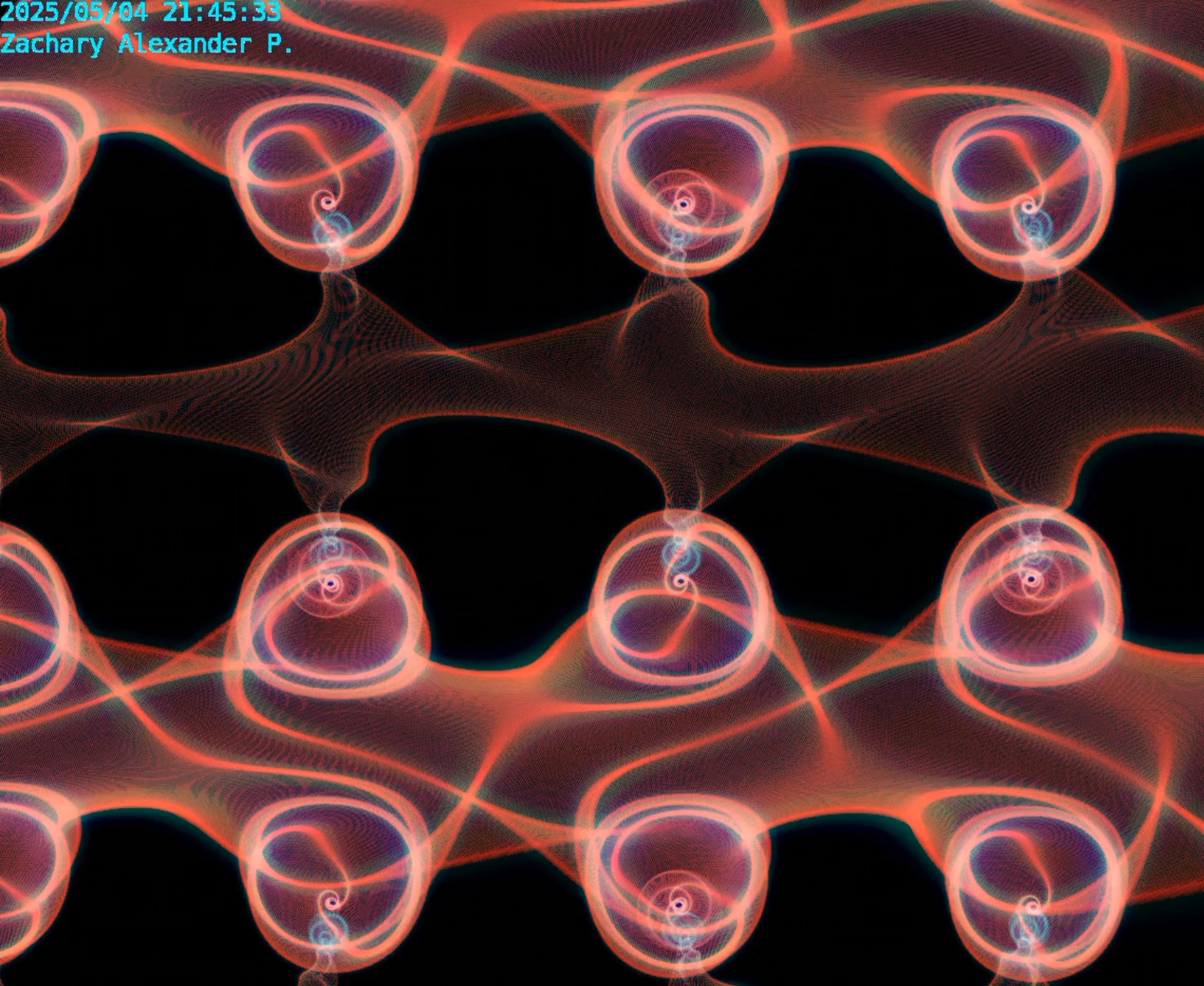
The electron appears to orbit the nucleus, but in stable temperature/energy, the electron remains the same distance from the nucleus along a continuous spiral wave. View a capacitor. It is not the electron that moves. Its the continuous shell wave that moves - and the electron follows. It is the exterior to interior resonating field waves that move the entire electron shell-wave as one. This is how electrons can remain at a fixed energy-distance from the nucleus along a continuous spiral shell of multiple 360 degree wraps that make shell climb further and appear as more. The velocity of an electron cannot be accurately measured at a specific location according to the Heisenberg principle. It is uncertain precisely because an electron that appears to travel as an isolated particle is not actually traveling as an particle bullet. An electron travels as a wave-packet that spreads across empty field-space and re-constricts near baryon matter. The point where the electron collapses into the appearance of a particle is when the scattered wave re-constricts near the baryon matter we use to measure its existence. An electron wave packet is quantumly entangled to a Mach’s-principle-grade electric-gauge-field which means that a given electron vector follows a quantum field transformation as it travels. The entire quantum field network compiles its predictable projectile-like destination.
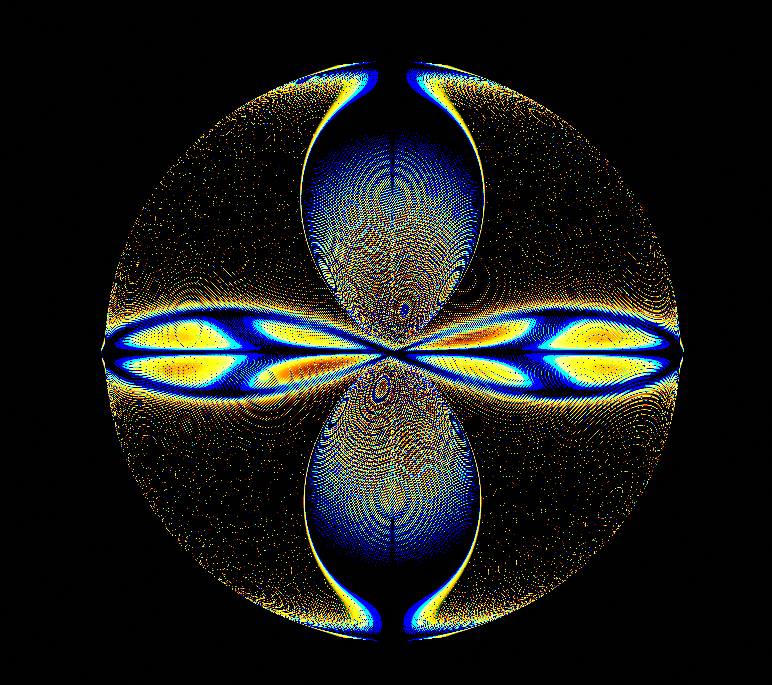
Here is an atomic wave electron cloud probability map. (All of the regions it tends to drift around a specific elemental resonance node).
The photon operates similar to an electron because electrons are motivators of photon waves. Plasma glows because electron and proton activity is excessive in a volume. Plasma emits photons because continuous external waves are being pumped into its elemental volume. Every input has a rebalancing output. When electron wave packets slide along the continuous shell and change their distance from the nucleus, the proton-electron system-energy rebalances and emits an electromagnetic wave. The electron or photon can be “quantized / quantified / counted” as individual / separate because a wave has a crest and a trough that builds a distinct domain for its resonant nodal location. The entire quantum wave-field network compiles the predictable projectile-like destination of the photon-wave. The photon is an energy wave change emitted by an atomic electron shell that travels fastest through a vacuum because electrons (photon motivators) require a vacuum to keep a momentum vector. Photon waves can travel slower according to an index of refraction because they are propagating through a less direct index / medium. Obviously a perfect vacuum is the most direct medium because there are zero indexing sequences of nodes to refract through - giving a traveling wave the least interference. A photon does not attenuate in a perfect vacuum, but even outer space is not a perfect vacuum - which is why there is a limit to how far we can observe galaxies with telescopes.
In my studies of physics and math, I have come to believe that particles are emergent effects.
Supercooled liquid Helium below 2.17 degrees Kelvin exhibits zero viscosity without friction precisely because the particles in liquid Helium are emergent effects of a continuous field-wave that can volumetrically synchronize as one. Particles are wave-energy derived resonance-nodes suspended in a continuous network of field-induced shells.
The nucleus of an atom operates like a Soliton. A Soliton is a self-reinforcing, localized wave packet that maintains its shape and speed while traveling over long distances, even after colliding with other waves. The strong nuclear force is a wave momentum barrier that requires high wave energy to penetrate. This stellar Blender simulation is a tribute to the wave momentum equation p=ћk. In wave mechanics, momentum is a measure of the spatial rate of change of phase. A wave with a very short wavelength (high k) has a steep phase gradient. To push a wave into a tighter, higher-frequency oscillation, you have to pump energy and momentum into it. Therefore, k is literally a direct measure of how “compressed” and energetic that wave’s momentum state is. p=ћk is more accurate than p=mv. Matter is a resonant wave structure within the electromagnetic vacuum, and inertia is simply the “impedance” of that vacuum to changing the frequency (and thus the momentum) of the wave packet. p=ћk isn’t just an equation for momentum; it is the defining relationship of the particle’s interaction with the background field. Ernst Mach argued that inertia is not an inherent property of an object, but a relational property determined by the sum total of all other matter in the universe. Einstein marveled at Mach’s theory. Everything in the universe could be tied to a single input energy-wave arc that was split like white light through a prism into many different interacting wavelengths that holographically rippled down through smaller dimensional scales.
Light’s speed cannot be measured one way, only out and back, because measuring anything means comparing it to a reference, and two distant clocks can’t be agreed without already assuming how fast signals travel between them. Certainty about nature seems to need a return to the origin before it reaches us. I see this pointing toward a deeper truth: we are not the origin. No one chose to be born, and no one arranged for the sun, earth, and moon to exist under conditions that allow life. Something else chose. So while I study and simulate the power of a star in software, it’s not irrelevant to ask whether a greater power, God, holds the real stars in their place. It’s even less irrelevant given that the oldest account of creation begins with God speaking about light. Physics explains how events unfold within its laws, but it can’t explain why there are laws at all, or why their constants fall within the narrow range that allows stars, chemistry, and life. A game’s physics engine governs how its characters move, but nobody thinks the engine wrote itself or runs by itself. Physics is the framework, not the author. It enforces cause and effect so that life and spirit can make choices that mean something through their consequences. Even at its foundation, in quantum mechanics, physics sets probabilities rather than dictating every outcome, which leaves the universe open rather than closed. Some people would rather see themselves as effects of nature and chance alone - but if that is what we are, what secures the dignity we insist on for ourselves?
The sun is one of many in the universe (one-verse).
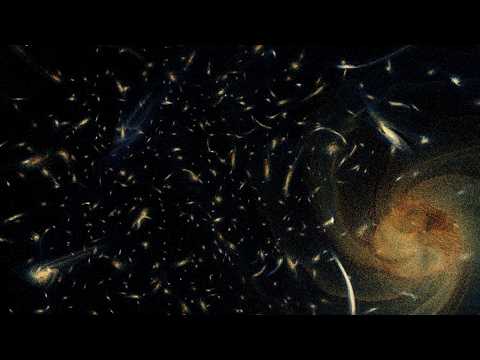
The universe is an electromagnetic phenomenon.
Please leave a comment and tell me what you think.