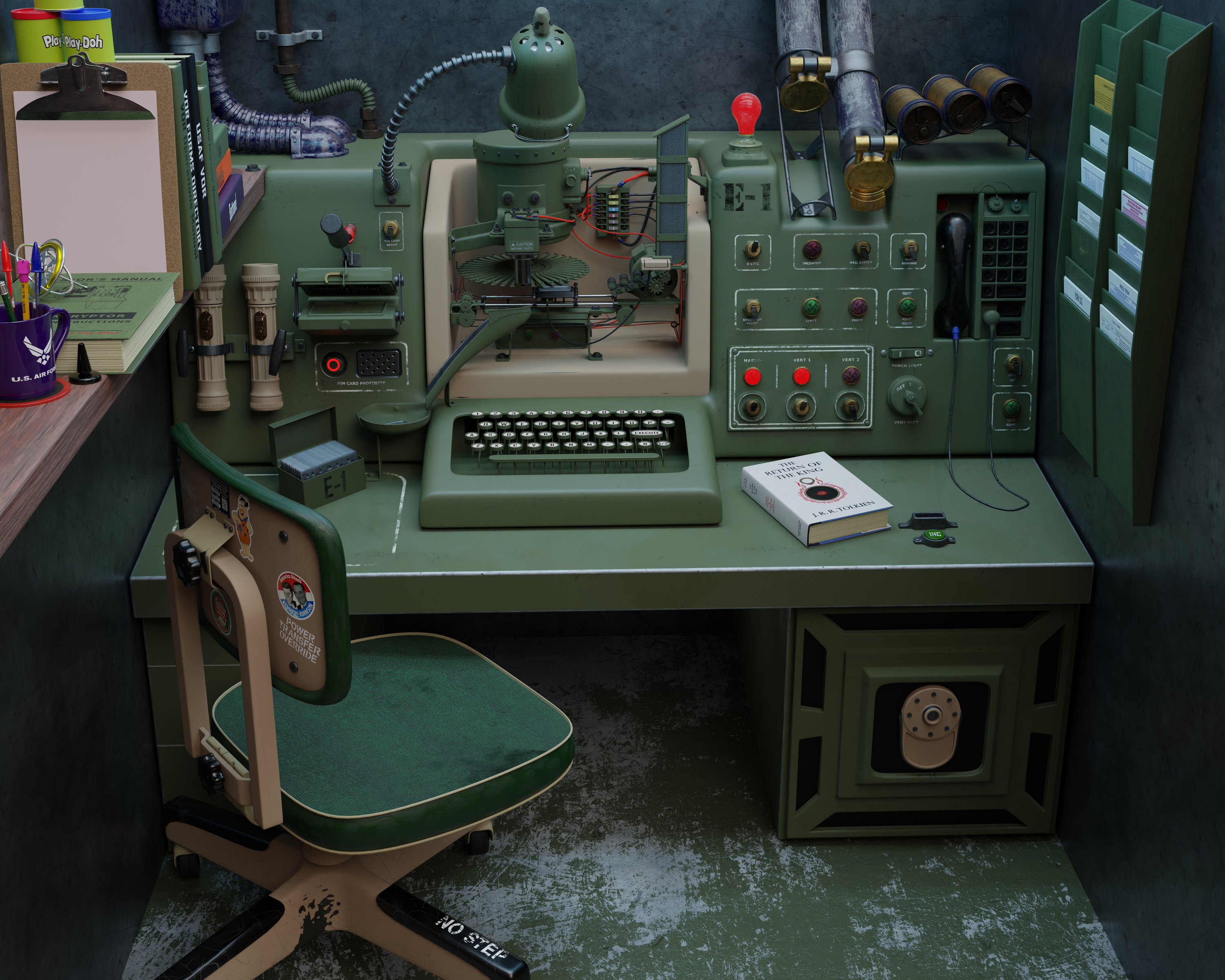
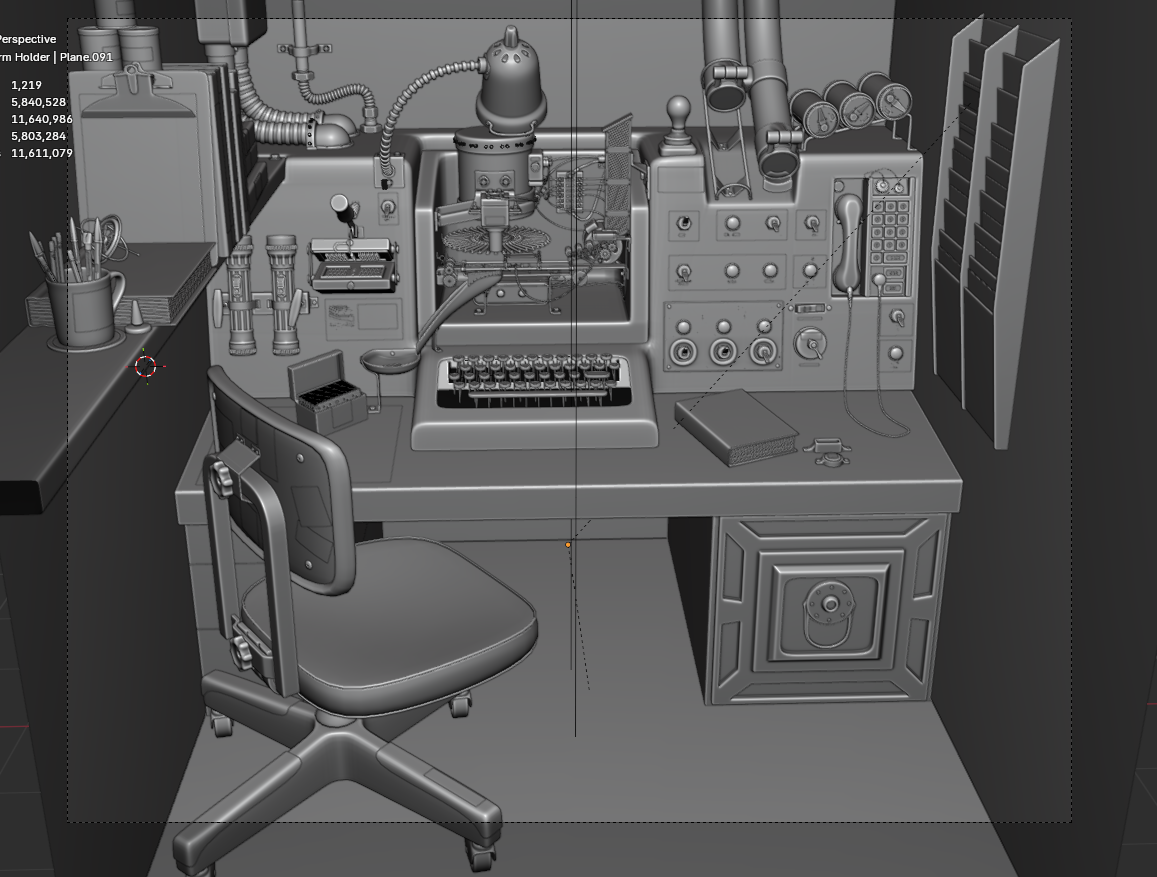
This one took me a moment to create even though the texturing is still a bit rudimentary. I’ve been working on a story where encrypted messages needed sent during the second world war, and this how I imagined that technology to look. This machine communicates with a field unit that stamps messages into dog tag sized pieces of metal that the operator, who sits inside of a vault, then relays to leadership inside a secure building using a pneumatic mail system. This allows the soldiers on the ground to communicate in near real time back to headquarters for the always changing battle plan. This machine, although created in the 1940s is being used in this image in 1960 for a slightly different purpose, but where encryption is still required. Each switch and light on the machine serves an actual purpose inside the story, and the mechanics of the machinery itself is fundamentally workable.
like it a lot, never had a chance to see anything like that in rl so, thanks 
Thank you!
It’s entirely convincing for the 1940s, you’ve conjured the style of the mechanics beautifully.
I want to like it (and but for this one thing I do, actually) but what is really bothering me is what I perceive to be an irresolution between metals and plastics.
I know that the ’60s and ’70s had molded plastics in computing, but even so a lot of computer hardware was still made using metal even into the ’80s. My father’s keyboard for the Z80 was a metal box with a keyboard (literally, circuit board with keys on it!) mounted in it such that the keys protruded through the cutout in the metal. This was normal for the very abnormal state of having a home PC in the ’70s.
The entire console in your image looks to me like it can’t decide whether it is molded plastic or metal that has been painted by industrial vat-dip.
The reason is that by the ’70s the ability to form a large piece of metal into the pretty curve shapes like your console has did not exist. The infrastructure to be able to do that was still being built.
Likewise, while it was possible to injection-mold plastic like that, the plastics of the era could not have been made so thin as they seem to appear in your image without being chintzy.
The screws and supports look like they should be metal and attached to metal.
Likewise, the card file on the wall, for example, looks plastic, even though those things were mass-produced with metal! Yes, I know you could get them in plastic. The plastic ones were very, very poor quality, and the metal ones were just as cheap to buy and significantly more common.
tl;dr:
The whole thing looks to me like a very modern plastic mold — something not possible in the ’40s through the ’60s.
And that breaks the illusion for me.
Alas, I am aware that I am a product of my own upbringing. IDK where you are working from. Maybe in your part of the world or in your experience plastic things like this actually existed. IDK.
Very cool. I really had no issue with the metalness (or lack thereof) of the materials, as you stated the textures were rudimentary. The concept is very nice. Looking around at the various items you have cryptically placed makes me (as the viewer) feel as if I am meant to decipher some code in the image itself. Well done. I happen to have occassion, in my employ, to come in contact with many different items in use by the government/military from the 1940’s - 1980’s and this would blend in rather nicely. Thanks for sharing. I look forward to seeing an update when you have further polished your materials.
The way I look at this excellent render and design is that … it doesn’t have to reflect actual encryption techniques of the period. (“Dog-tags in a pneumatic conveyor?”)
But, it simply doesn’t matter. This extremely-detailed and believable workstation is entirely entitled to be fantasy. If this place were real, this is indeed what it would look like – to the finest brown-painted government-issue detail.
Thanks, I appreciate that!
Thanks! Unfortunately, there aren’t any hidden codes to be found in there, but that’s a cool idea that might make a good weekend challenge. Now you’ve got my gears turning with ideas…
Thank you, I was kind of steering more towards something I thought looked cool, rather than what was possible. Although, I will say, I did spend a bit of time messing around with the mechanical section in the center and theoretically, everything has a purpose and a better than average chance of actually working. So, I spent time making parts of it real and believable, and other parts, not so much.
To clarify, I was going for an almost entirely metal design for this. I’ve got a bit of a fascination with the old dog tag machines from the 30s and 40s (The Graphotype in particular). That machine had many rounded corners which I always found really cool, and if you’ve ever seen one, they are over engineered like most military items from the day. I would bet one of those could take a bullet and keep on working. Here’s one of the reference pictures I used.
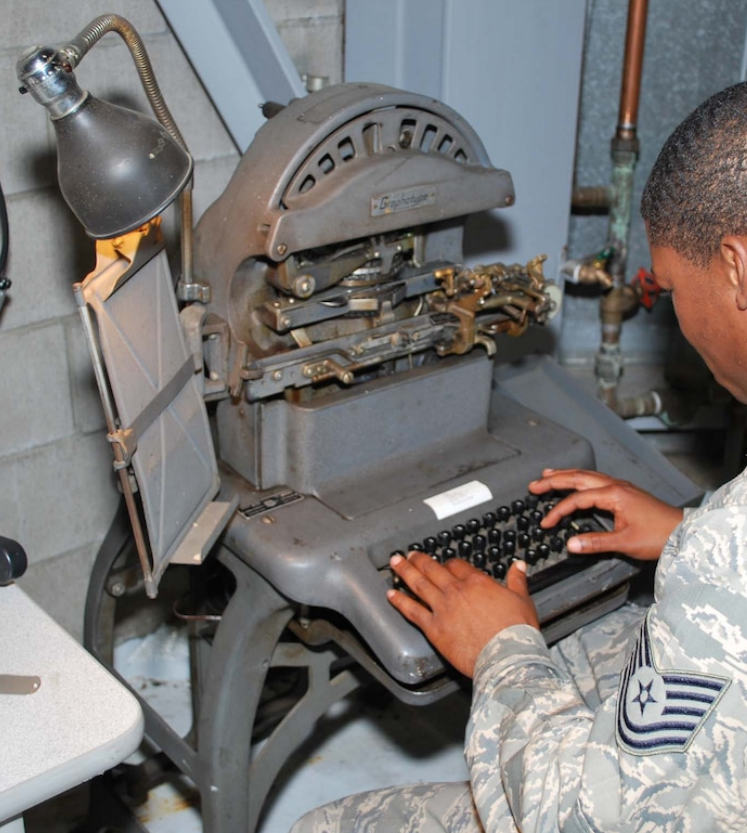
I really like how the keyboard morphs into the main body and I tried to capture that same vibe with my version, so that’s where most of the roundness comes from. I think those old machines weighed around 350 lbs, so I figure my machine weighs as much as a small car, especially when you take into account the thickness of the steel you can see in the edge keyboard area.
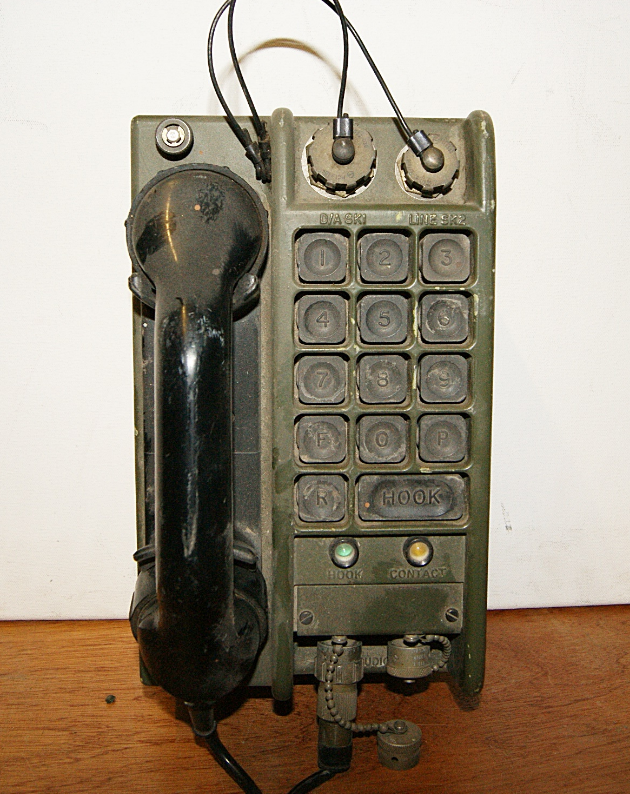
@sundialsvc4 made a very valid point in that for the most part, I didn’t really care how someone would have to make such a thing, or if it would be possible to make at all, because I had an image in my head and went for it. A good example is the “phone” section on the right hand side of the machine. I looked around for something I wanted to model and settled on something that was probably made in the 70s, or possibly the 80s, and has no business on this machine, but I stuck it in there anyway, just because I thought it looked cool.
Although, I didn’t put much thought into how something like this could be made from steel back in the day, I’d say if it were solid 1/8 inch steel like I envisioned, it would most likely have WAY more seams where all of the pieces were stamped or cast on a smaller scale and then a ton of bolts to hook all the pieces together to make the larger machine. I might throw a few strategic seams in there to sell the idea of metal a bit better, plus, fix up the texturing a bit too.
Thanks for your thoughts on this!
You’re on the featured row! 
Awesome, thank you!
Well deserved friend.
Thanks, buddy, I appreciate that!