I often think about how transformative it would be if Blender integrated a full-featured DAW environment directly into its core. Imagine having a native audio workspace where you could record, edit, and mix soundtracks in real time — all synced perfectly with your animation timeline. Instead of exporting scenes to external software, you’d have waveform visualization, audio buses, plugin support (VSTs, AU), and procedural sound generators built right inside Blender’s ecosystem.
With access to an open library of DAW-style add-ons — synthesizers, samplers, sound analyzers, and beat generators — artists could compose and experiment directly next to their visuals. It would completely eliminate the gap between sound and animation production.
Once Blender reaches that level of integration — combining geometry, motion, and audio under one unified workflow — it wouldn’t just compete with traditional DAWs or animation tools anymore. It would redefine what “creative pipeline” means, becoming the world’s first truly complete environment for visual and sonic storytelling
When Sound Meets Geometry — The Next Evolution of Blender
The VSE at least has been around since Blender’s early days, and it is literally the only thing FOSS has in this area that is not an outright dead project or at least not in a zombie state.
A DAW meanwhile would have to be built from scratch, and it would currently be more practical to send resources towards the development of LMMS or a newly created fork of it. That is not to mention the possibility of it taking resources that can be used on the other modules that already need a lot more attention than what they are getting currently.
Using the python backend and the mido module, you can output midi signals from blender into a parallel daw. I was just playing with this, you can output note signal or control change values. I set up a simple scene with an empty outputting its xyz coordinates as 3 separate values to drive volume, frequency and filter cutoff.
turning blender into a DAW is probably not going to happen, but if you want to use blender to make music, there’s options out there.
Throughout history, every major innovation has started with people saying it’s too hard, too complex, or simply impossible.
The first rockets were designed only to hit targets on Earth — yet, through persistence and evolution, the same technology took humanity to the Moon.
Early computers filled entire rooms and were thought to have no use beyond military or academic work — and now we carry far more powerful ones in our pockets.
Mobile phones began as simple tools for making calls, but they evolved into cameras, studios, and creative hubs that redefine how we interact with the world.
Technology always moves toward integration — combining once-separate tools into unified systems.
Blender is already one of the few platforms where 3D, video editing, and scripting coexist.
Whether Blender takes this step or not, it’s only a matter of time before someone else does. History shows that once an idea becomes imaginable, someone, somewhere, eventually builds it. And that’s exactly how progress works.
The truth is, I do understand it’s difficult — but once an idea is spoken, it’s only a matter of time and patience before it happens
I don’t think it is only a matter of how hard or impossible.
It’s a matter of priority, focus and not the least of which would be resources.
Then of course the demand and the need.
Who will benefit, and in the end even use it?
Of all the areas of production work, audio has been around much longer than 3D.
There is no shortage of capable even some free or open source audio solutions.
You can’t say the same for 3D tools like Blender.
It might be grand to have, no doubt. And the path to get there would be riddled with obstacles.
But you have to pick your battles. Not everything needs to be done. This is not rock climbing where the only reason to reach the summit is that it is there and presents a challenge. Then yields the personal satisfaction of having done it.
Blender is here for the community
I KNOW .and i love it
Maybe it sounds a little bit silly, and maybe it’s a simple dream —
but many people are afraid of new things.
They often feel that change or growth means losing what they already know,
so they choose to stay in their comfort zone, holding on to how things are,
hoping the world around them never changes — even if that means staying the same until the end of time.There’s no battle here — no war to fight.
Music in blender is like grease pencil, in the past people would say no, it has no place in a 3d app, there are better alternatives out there etc etc…
It just needs someone to start… Once it’s there people will start to see the benefits and potential… It’s always the same story…
It was not the same technology. And the cost of creating new technology and landing on the moon was - adjust for inflation, $288 Billon Dollars, with a team of 410,000 people.
I don’t think Blender has that level of resources.
FWIW, I think this is a pretty natural extension of Blender’s capabilities, it’s something I’ve thought about on and off for a few years, and I think it might make more sense if you put it in the context of what you need out of a DAW vs what is already available in Blender:
What you need from a DAW:
select a hardware interface, sample rate, format and buffer size
summing buss (no mixing busses, only the final downmix sum)
no recording, but support for mono, stereo and surround mixing
audio file conversion
no realtime recording of anything (outside of keyframes)
So, the big missing features are:
realtime audio recording
VST, AU etc FX and instrument plug-in support
formal MIDI/OSC support and an editor
multiple audio busses - e.g.: Dialogue, Music, SFX etc.
And, of those features I would say only realtime recording is an absolute must-have, with the rest being ‘nice-to-have’:
there are a number of non-linear video editors that don’t support per-track audio FX, and you have to save a preset and drag it onto every clip
not every DAW offers VST, AU, CLAP etc support, some make their own FX, others just don’t include any
MIDI and OSC open a world of possibilities, but it is one that is already available via addons, so I don’t think it should be considered a priority
multiple audio busses would also be very nice for organization, but aren’t an absolute necessity on smaller productions
I worked in pro audio for years, and I have at least a half dozen DAWs, paid and free, but there are times that I wish I didn’t have to open another program, switch my brain to a new set of hotkeys and export a .wav file just to record a quick voice sample or sound effect.
Not trying to suggest that any of this would be quick, easy or painless, but I don’t think it’s all that unrealistic given how much of the groundwork for a DAW has already been laid by the Sequencer.
If there was a dedicated developer that really wanted such a thing in blender, then it’s quite possible that someone could push it through as a passion project.
Unless you are that unicorn though, I wouldn’t hold your breath waiting for one to come along.
If I knew the first thing about audio code, I’d be tempted, as it sounds fun and I’m not terribly impressed with the free DAW offerings out there. But I will freely admit this is far beyond my capabilities and scope
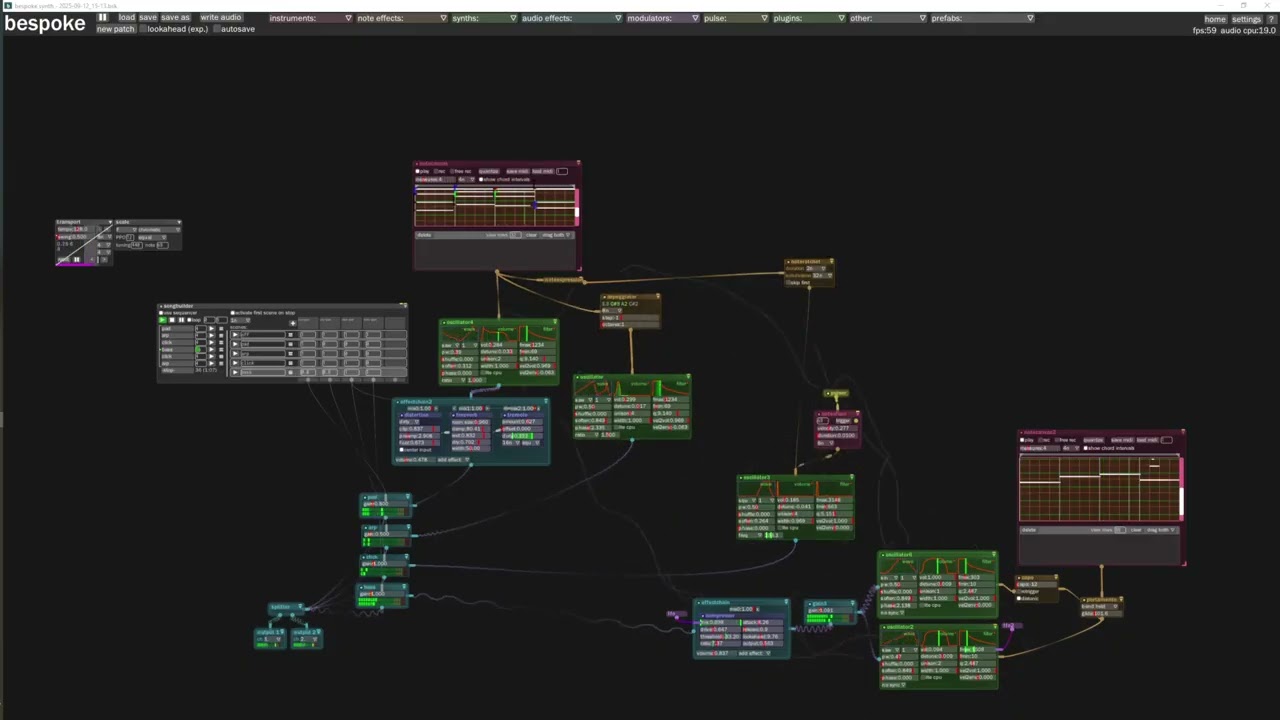
It’s fully nodal without trying to skeuomorphically emulate an oldschool eurorack type synth. There’s some really cool visualization effects, seeing the signal pass through the wires is pretty neat.