Why Blender may eventually defeat Maya: An objective view

There have been a number of conversations lately with regard to Blender’s inability to be adopted by mainstream AAA or industry film studios. In particular: Flipped Normal’s Youtube conversation, “Why Blender Isn’t 3D Industry Standard” and Grant Abbitt’s reply, " Will Blender Take Over as the Industry Standard."

While both are very worthwhile views, neither approaches the topic from a macro-economic perspective-- one which forces change in all industries: the very real concept of Disruption.

Clayton Christensen talks about KODAK in his famous book, “The Innovators Dilemma,” and points out KODAK was too involved with their distribution pipeline to be able to react quickly enough to the upcoming digital photography tsunami. They dismissed quickly the fact digital photos were of poor quality and incorrectly believed they would amount to no competition.

Their partners were a huge and monolithic supply chain consisting of chemical companies, paper manufacturers, film and camera corporations and a host of other symbiotic relationships-- all too intertwined to be able to shift quickly to a new paradigm.

Listening to the Flipped Normal video and their insistence that Blender had no place in “the pipeline” because there were better applications at every step of the way, I couldn’t help but picture KODAK and the obvious similarities.

One thing Christensen points out is KODAK thought they were in the photography business, but didn’t understand until it was too late, they were in the memory saving business. Their eventual competitors would be the MySpaces and Facebooks along with photo sharing apps and texting photos.

Industry studios should also strive to understand what business they are in as well. As economics around movies change, so must they.

Larger studios may be too invested in years old pipelines to be able to move quick enough to keep from being disrupted by quicker, faster, and more efficient smaller teams with less expensive tools and training budgets. Just look how Video Copilot has created a generation of users who now compete at top industry levels with non-industry standard tools.

It is now obvious to everyone the strong trend in creating more movies and shows for less. Netflix, Amazon, Disney and now Apple are throwing their considerable weight into mass production of consumable moving pictures. Those studios who can produce at the appropriate quality levels with efficiency and speed will thrive.

Of course there are a number of big studios which will still be financed to create the next mega-Avenger movies-- but even these are providing less return in a hit-based model that is seeing fewer and fewer hits.

So, it is up to the studios now to become nimble, or else be disrupted by the new upcoming smaller studios using more efficient and less costly workflows. As the quality of FOSS continues to rise, it would make sense for these new companies to use them, especially if they do anything where the economics of scale are concerned.

Marry this with the multiple trends: realtime video is getting close to film quality, free tools abound and virtual studios are on the rise, and it becomes clear to me there is a huge opportunity for disruption.

Oats Studios ( oatsstudios.com ) is one such nextgen studio with an A-List director, Neill Blomkamp, at the helm. There are surely more to follow. Check out their release of ADAM part 2, entirely created and rendered in realtime in Unity:

Just my two cents as someone who has been involved with digital graphics and 3D since the early 80’s.
17 Likes

You know, in the past few days I’ve seen a dozen videos on my feed that tell me what the pipeline is and…the funny thing is that Maya tends to make up a very generic and replaceable part of that pipeline, they do retopo(sometimes), rigging and animation in Maya and use some render engine of choice. Simulations and Sculpting is done in other applications and ported in and out as needed, as well as clothing and texturing is done in other applications and ported in and out as needed.

It is not so much that Blender is getting closer to the industry standard as Maya has become more and more an very generic and replaceable cog in the industry workflow. Right now as soon as a file standard makes perfectly smooth imports/exports from all other steps it is not going to matter what the name of that rigging and animation cog is.

7 Likes

It’s interesting to me, and I’ve stated this numerous times here and in other forums, that AD is scrambling to figure this Blender thing out – how could this upstart, free, seemingly less powerful program be working it’s way into more and more workflows? Trust me, AD is concerned, and they are trying to figure out how to counter Blender’s influence. When studios have to tighten their belts and figure out where to save money, you can be sure that Blender will come up in conversations as a solution.

6 Likes

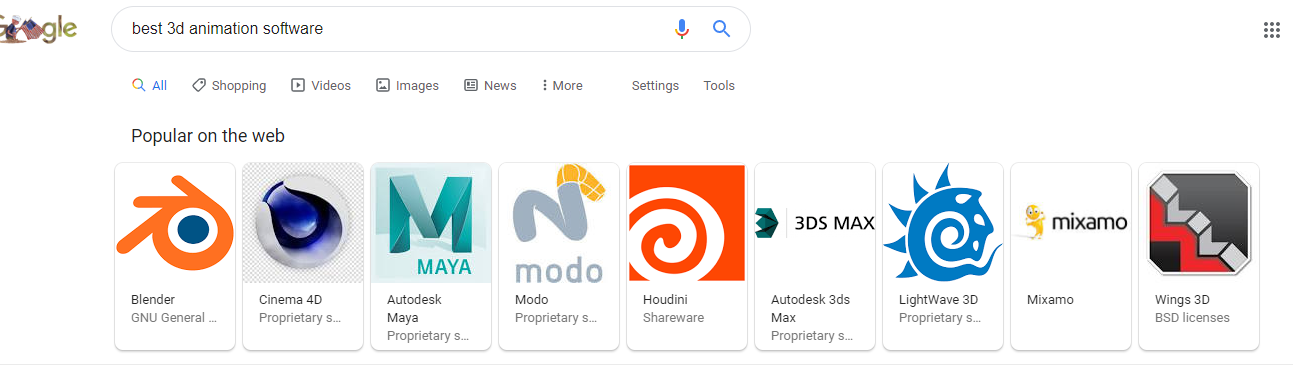
image You know…when google search results starts to put the freeware version before your paid version there might be a problem. Blender use to show up on the page 2 of most searches for 3d animation softwares and now…yeah. Granted Google is just using a bit of AI to handle the layout of these search results but it is telling none the less.

5 Likes

It will be interesting to see what happens in the next couple years. I think change is going to happen faster than people think.

My background is in web development. In that industry Open Source dominates because proprietary stuff can’t keep up with it. 10 years ago Flash on the web seemed unstoppable. Only 5 years later Adobe was rebranding it. Hardly any change in tech seems to happen slowly.

I’ll have to pick up “The Innovators Dilemma;” it sounds like an interesting book.

3 Likes

Slightly different results for me – Lightwave behind all the big boys, with Mixamo hot on its heels.

Do you have a screenie for compare? And I was doing a search on animation softwares.

1 Like

I have a road trip in a month or so, I might just make a couple clean laptops and add this to the list of things to google search from clean IDs and addresses. But even playing around with a tor browser I’m starting to see lists that show autodesk in the middle of the lists and not near as often in the top of recommendations. But Maya is a generalist software right now that has a dubious specialization in its animation suite. Animation is the only thing that is consistently said to be the main advantage that Maya has when I aggregate what the masses are saying. Granted some of that may be echo chamber but even looking at several blog posts of people in the industry they pretty much echo that over the years Maya has become more of the generalist software in the workflow.

Look at this search:

Very interesting.

In a broader view, it is still not very clear, but in the next 4-5 years I suspect that many things will change not only in the film and video game industry … I would also put the manufacturing industry into it.
Industry 4.0, car and trucks autonomous, 5G networks, artificial intelligence, internet of things, smart cityes.
I believe that the next few years will be much more disruptive than when there was a transition from photo paper to digital photo …
We should think better of what is about to happen.
The Rise of the Machines – Why Automation is Different this Time

1 Like

Objectively, Blender is used by more and more studios.
It was lagging behind proprietary softwares 15 years ago, but it’s no more the case, feature-wise.

Tangent Animation made a feature film with Blender (Next-Gen), for the average viewers it’s like a Disney Pixar film quality. And more and more TV series are produced with Blender too. Let’s mention Ubisoft (animation studio) too for the records!

I work for studios that already use Blender or plan to use it in the coming years, most of the time for economical reasons. 30 Maya or 3dsMax licenses is a huge cost per year, while Blender can deliver same features at almost no costs (there may be a few high-end features that are only available for proprietary softwares, but it’s really a niche)

I don’t know if Blender will dominate the industry someday though, i’d like it to be because I love this software, but it will certainly be side to side for a while with others. With the recent peak in the development funds, we can expect a bright future, but it certainly depends on Autodesk reaction, maybe they will lower license prices and finally decide to really improve their software on each yearly update… Let’s see!

3 Likes

I don’t like the analogy. It’s very much apples and oranges.

Ignore Kodak and tell me, are they wrong? What is it that Blender can do better?

It’s not obvious to me why FOSS tools should be MORE efficient and faster.
As it is now it isn’t like that.

You are using the word disruptive again, it makes no sense since Blender currently isn’t disruptive except when it comes to price but not in terms of abilities.
If you would exchange Blender for Houdini, it would make sense. Houdini is highly disruptive and eager to eat into Maya’s market.
There is a huge opportunity of disruption, that is true, but it has to be based on efficiency and functionality, price alone won’t make a huge dent.

Blender has great chances of becoming part of the industry standard family, but replacing Maya is not gonna happen.
Maya’s animation tools are 5+ years of development ahead of Blender and 1 or 2 removed from Houdini.
If anything, Houdini will try to take it’s position as character and creature animation software, but not without Autodesk fighting back.
You guys are assuming Blender can move with the same speed along it’s current trajectory, while you assume (wrongly) that Maya is or stays stagnant.
Maya got Bifröst now and it is AD way of fighting back against Houdini.
I have no idea how that will play out, but i know that rumors of the imminent death of Maya are greatly exaggerated.

Also Oats Studios is not a great example, since they used nothing but proprietary software in the production of their shorts. It’s all Maya, Max, Zbrush, Substance, Quixel, Mari in addition to Unity.

1 Like

As far as I think that Blender may eventually be universal standard application in the next decade. Is that it has great degree of adaptability. Provided that there are enough funds and a clear vision then things can change in any way. As for example users kept constantly complain about Blender’s viewport and gui and finally now they got the attention they deserved. What comes next? Video editing? Real time compositing update? The point is that at any given point in time things can be organized in certain ways to offer some improvements.

While however a private company might be very solid on their business plan and direct development in certain ways to play the safe card. However considering their financial status, if they are running loans, if they rely on investor funds, if they are publically traded. All of these stuff makes them very sturdy and slow.

Which it essentially translates to, that if Blender users make up their mind on what they want and start funding and nagging Blender Foundation like hell. Eventually things will take a turn for what is best.

Oh, Maya and Autodesk is not going to die any time soon, but more and more Maya is becoming less of an integral part of the pipeline and quite frankly when I look at any discussion on pipelines it comes down to the ability of a software to faithfully import/export a scene with minimal effort on the part of the user. But Maya does need to get out of its stagnation and start depending on their devs to make a product that sells itself, rather than the PR team selling the product.

3 Likes

I think you are missing the point. It’s not what can they do better-- it’s why they are more efficient. Ford outsells Mercedes, but Mercedes makes a better car. It’s not always who makes the best product with the most features-- there are a lot of factors.

While I would’ve agreed with you a couple years back, I don’t think that is case anymore-- at least for certain FOSS apps, Blender in particular. Blender has moved very quickly-- much faster than it’s competitors.

Furthermore, stalwart vendors like Adobe are being attacked from below as well. Gimp and Inkscape continually improve (though not as fast as Blender) and Affinity Photo is a terrific replacement for Photoshop for 3D artists and general use. In fact, its non-destructive workflow is better than Photoshop’s.

Not to mention, Davinci Resolve is getting a lot of new Premiere customers (just see all the traffic on Youtube about it).

Certainly price is a disruptive factor!

Make no mistake when a studio has 400 licenses at 1K each, there is significant incentive to replace half of them. And don’t forget, Maya fits in at 2 spots in the pipeline. Blender can certainly easily compete at the first spot: modeling.

I have a very good friend who runs and owns a ~200 person asset modeling, rigging and animation studio that is used by most of the AAA game companies. He used to advertise for Maya and Max artists. Now it’s exclusively Blender. He also tells me Autodesk is getting more draconian in their license policies, now asking to come inspect every computer at his facility once a year.

While he has many many Maya and Max licenses, he’s creating an internal Blender group to begin to create models. Furthermore-- he has clients asking for Blender file format models as well.

The writing is clear-- the timing is just not. Don’t forget, Wordperfect cost $5,500 when it first came out. You can now get word processing software that runs in the cloud for $0.

The 3D industry has always been about disruption-- with price a leading factor. An SGI Indy originally cost $14,000, now we’re seeing way more powerful systems for one-tenth of the price-- most certainly a disruption which left SGI going into bandruptcy.

And also there are many studios that just never kept up either. See Rhythm & Hues.

The way of 1500 dollar/yr subscriptions for custom software will see its challenges soon enough. Many companies can not move quickly enough for a variety of reasons. Electric Image comes to mind as a company which had a bright future but could never become customer friendly enough and inexpensive enough to figure out how to survive. It eventually sold itself to some customers.

Even the ultra-expensive CAD market is seeing disruptive downward pressure-- primarily via price. Online products like OnShape are true professional level products, and are providing incentive to Solidsworks to rethink their pricing.

Perhaps, but neither was the first Sony digital camera.

Your comments are not unlike the KODAK executives, defending their product and processes. That said, I think this notion of disruption is a topic more focused at people who drive future strategy decisions-- not the folks actually running the pipeline. They mostly do an amazing job at what they’re told to do.

5 Likes

I don’t think Maya is going anywhere in the immediate future, and it’s still obvious from threads in other forums that the BF still has a bit of work to do.

For instance, there is a thread on CGSociety right now where, believe it or not, saw replies from people who still think Blender is a hobby project by a few coders working in their spare time (ie. completely ignoring the fact that it’s had a team of paid developers for a while). A lot of people have recognized Blender as a serious force, but we still have others who remain of the opinion that Blender is a dinky little FOSS app. that barely sees development.

2 Likes

Why looking so far away, when we have an example of Maya itself? It wasn’t an industry standard up to 2000, but then it became it, previous standards, as Softimage, just died off.
I have no clue why people forgetting about that or thinking that it will be any different way next time.

1 Like

Good point-- though I would not exactly say SoftImage was disrupted by Maya, as Autodesk owned both of them and decided to kill one of them off to save resources.

Aren’t they bought Softimage exactly in 2000? When it became apparent that they can sell to Autodesk now for some money, or later, for much less.