Yes, I’m certain that we do that 
Oh - I thought you meant tools FOR realtime video…!
WTF is an “overcustomized” site??!!
Forgive me, I’m not a native English speaker, I mean sites that are designed in a way you can’t really do with regular grids and buttons. Custom visuals, funky effects and all that jazz.
Here in Brazil piracy is probably 90% of all software usage. That’s why educating people about Free or less expensive software is a good thing. For instance, Blender is growing a lot here.
1 Like
Hey gang, excuse the sorta offtopic intermission for a minute here, I just wanna add something;
Similar thing here in Argie, maybe worse. Fun fact, even the government uses pirated software.
But nothing special really; piracy is rampant on the whole continent, and I bet a good number of folks don’t even realize it’s illegal. Heck, teachers had us buy photocopied books in school.
One might say it’s just a matter of enforcing regulations but honestly the whole no one gives a crap aspect is just so ingrained into the culture I think the people would riot. I talked to a friend about free software and she just looked at me and said, “ain’t all software free?”. I mean, daamn.
So aye, bringing (legally) free alternatives into the popular conscience needs to be done.
The other 10% are all the Zbrush artists.  For whatever reason some of the best Zbrush artists in the world are Brazilians.
1 Like
I was a life long 3DSMAX user. I purchased the software and upgrades over the years for my personal freelance projects as well as television stations I worked for. I kept up with Blender’s development off and on over 15 years. Around Blender 2.78 I made the switch. It was pretty frustrating to learn, but the amazing amount of tutorials and resources smoothed that transition. I was excited at how the user community had exploded and the quality of work that is being produced. I was so excited that I became a silver sponsor. I love that I can load it on multiple machines and not deal with license keys and software subscriptions. If I switch jobs, I don’t have to ask the company to shell out thousands of dollars for a license of C4D, Max, or Maya. Blender 2.80 has been a game changer in allowing me to integrate it into my motion graphics work in both my freelance work and at my job doing corporate video. I have no doubt Blender’s future is bright and will continue to be adopted at studios across the globe.
3 Likes
I understand your point but, nonetheless for whoever in other parts of the world does have to deal with the industry, this topic is quite relevant. Personally, I do care about what’s being discussed here.
That said, I cannot relate directly to any Maya comparison as I don’t use it. I can express my opinions, though, regarding the motion graphics industry. Even though Blender was never meant to be a direct C4D competitor, I’m recently seeing more interests in that field with Everything nodes, Sorcar et similia. In that regard, the argument Flipped Normal brought to the table is extremely valid. I don’t see much chance for Blender to enter that market as the tool of choice for motion graphic designers is obviously C4D for one main reason: simplicity. Even if the above-mentioned add-ons/solutions will get close to what is already possible with C4D/Mograph, the complexity of the nodes the designer will have to deal with will definitely be a deterrent.
But if for a moment we forget about C4D/Mograph tools altogether and we focus on a more generic VFX set of tools, again, it’s hard to see this happening soon. I’ve been playing with Blender for years, with ups and downs, and I picked up again with the 2.8 release. And once again, I wanted to give it a spin in a production environment just using some cloth sim only to realize that tearing a cloth is not an easy task if I need a convincing result (just watch this: https://tinyurl.com/vqxk39t or this https://tinyurl.com/wbxprf8) Then you have the particle system. Just take a look at the Scatter thread and all the issues and limitations submitted by the author of the script: https://tinyurl.com/vabayg7
Soft bodies is also another good example (https://tinyurl.com/vpj69vt or https://tinyurl.com/wujkrz4). These situations, despite being common in the motion graphics industry, are not extraneous to any other 3D DCC app. Perhaps some things are faster to work in C4D but that doesn’t mean that 3DS Max or Maya can’t handle them (I’ve actually found Pflow easier and more advanced than the ancient particle system in C4D).
I’m not pointing out what to me is not working at the moment because I want to be negative. All the opposite. I’d love to use Blender for my work and I understand my field is probably too specific compared to a VFX pipeline where instead Maya can be considered the natural competitor. Personally, it would suffice to see those areas (particles, cloth, sim in general) addressed and pushed but as far as I remember (since v 2.3x), those are the areas that kept lagging behind despite the steps that have been done. Sure, there are many things to tackle and I read requests and interesting ideas being posted on BToday regarding UI, modeling, and so on. But even though there’s still room for improvement in those areas, I wouldn’t say UI and especially modeling are the areas where Blender lacks. In fact, my weapon of choice for more demanding modeling tasks is always Blender.
It’s just too bad that the circle cannot be full yet, and that’s what I take away from the Flipped Normals conversation. I hope the new funding resources will make it possible to address some of the current limitations.
I somewhat agree with you, and I say this as someone who used C4D for about 10 years. Now, everything regarding my work is done with Blender, even mograph work. While I do agree that C4D is better than Blender for some tasks, Blender is better than C4D in others. It’s pretty much a matter of using whatever suits your creative or economic needs best in my opinion.
A couple further examples w/regard to the impending disruption of the industry.
One thing perhaps overlooked by some: my example comparing KODAK to digital cameras. KODAK was focused on the entire pipeline. To them, photography was always about chemicals, paper, and the process of developing. That was their whole world. As I said, they weren’t focused on their business: the end product-- the business of sharing memories.
Similarly, many of the “industry vets” are stuck in the same mindset. They too focus on the entirety of the pipeline.
So, what happens when the pipeline changes? That’s why it becomes important to keep your eye on the intended result, and not the current process. That’s why it’s important to remember what business you’re in.
Here are some recent examples which significantly challenge critical parts of the pipeline.
The first example works to cut-out much, if not all, of the compositing process by using a virtual set powered by giant LED screens and realtime FX with Unreal engine. Gone are green screens. This is a game-changing direction and saves a ton of money, not to mention forces new thinking for not only FX work, but storytelling as well.

The next tech of interest also includes Unreal engine-- this time V5. Many have already seen this video. It’s important to understand it’s potential impact on modeling and texturing workflows. UE5 basically retopos ANY model for use in their pixel accurate render pipeline. This means you can drop a ZBrush model with millions of polys into UE5–and it supposedly just works. The goal is photorealism with limitless polycount. If this is as simple as shown, it, too, is a game changer as more people will begin to use realtime engines to augment and create video and film production.

And this last demo heralds from our own Ian Hubert of Blender fame. Ian has a unique and wonderful take on VFX. His inventive use of the 80/20 rule, combined with the latest tech in EEVEE allows him to actually composite live actors in the viewport with production quality results with a minimized team and super low budget.
Check out this amazing video. Everything you see is EEVEE rendered. EVERYTHING.

And to prove the point, check out this amazing video showing the magic in the viewport!
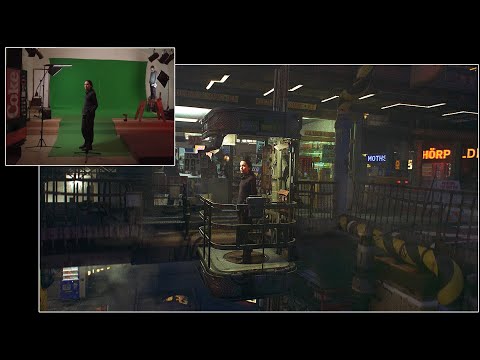
While none of these examples are the final disruptor, they do point to the fact that people are thinking outside of the box-- way outside the box.
Downward pricing pressure continues to drive FX decisions. Netflix, Prime, Disney, Apple, HBO, Showtime and other consumer based media delivery systems are looking to maximize quality for minimized outlay. And directors, too, are wanting to minimize budgets as well. They would rather spend money on screen talent than FX as long as the quality is good enough.
More and more game studios are farming out their asset development-- and they also want more for less. Modeling and texturing have become commodities and the best price gets the contracts.
And when you have 400 developers and you pay well over $1000 per seat of AD products, it becomes harder and harder to compete.
I never said this disruption would happen overnight. But, it’s like the story of a slow boiling frog-- it never knows it’s in hot water until it’s too late.
1 Like
I think it may be worth then Kodak scenario. In Kodak’s prime, I don’t felt the dislike of their business model. But Autodesk’s user felt very differently from Kodak’s user.