Often, the main problem I face when working in 3D is myself. Many times I arrive at a point were I begin to wonder if I could improve this or that part if I did it differently, whether it’s worth correcting something in the geometry that won’t even show up in the render only because I am a maniac, or trying to figure out if it’s better to fix something or just start over. Aside from that, my Achilles’ heels are Planet Node, not taking written notes, naming elements in the most chaotic way possible and, of course, not having a life.
Planet Node?
4 Likes
This is the most important step. Keep this up, and you’ll be a pro in no time! 
6 Likes
He says it’s part of his Achille’s Heels, that was a lot of heels but it’s great to see it that way rather than a driving strength…
I think the problem with 3D or art in general is that it asks for a lot of continuous training before being able to do something. If you do a pause for 6 months when the knowledge isn’t engraved yet in the brain and you just need to start over, spinning in circles.
To me it’s a bit like in the foundation books, the learning chaos period is inevitable, you can just try to reduce it by having good practice. Obviously a lot of artists have a tendency to bury themselves in all that and neglect many other aspects in life, but really that’s not worth it and we need balance.
Especially when you want to make art, it’s supposed to be grounded in your life, but how can you be successful in that if you don’t have one ?
4 Likes
I felt the same about shading nodes at first. All those lines and sockets look like a wiring diagram. What helped me was starting with just a Principled BSDF and changing one thing at a time, like roughness or base colour, and watching the preview. For retopology, I found it much less scary once I practised on a simple shape first instead of a full character. Small steps really do make both of them click eventually.
4 Likes
This is a master technique. Do something small first… that lets you explore and get a better idea of how a thing works and points out things to avoid.
Even the ancient (art) masters did this: they would first paint a small version of the full-size painting they intended to create. People build models before building full-scale items. Etc.
The same is true for Blender. Even for things I already know how to do I find it useful to create a simplified version to go over everything before trying to manipulate something significantly more complex.
Good job!
3 Likes
A pro? No, for God’s sake!
I’ve been retired for a few months now, I’ve already been through enough battles. Now, I just want to wander the streets of Barcelona, go to the gym, cook inedible meals, and watch *The Sopranos* again. My problem is that I can’t stop messing around with 3D, I like it way too much.
6 Likes
That, in all honesty, is the greatest asset to have when learning 3D. Like Sozap said, there is a lot to learn, and it can be overwhelming when you’re first starting out. If you try to do too much in too short a span of time, you will burn yourself out sooner rather than later.
In my opinion, the best way to learn 3D isn’t to start small exactly, but to start simply. Learning to do low poly art is my go-to suggestion for newbies, because it provides a lot of room to be creative without bogging you down with the minutiae required to make more photorealistic works. You’re only worrying about learning a handful of things with low poly, all of which are foundational skills: basic topology, basic material work that only concerns itself with colors and roughness, lighting and composition. It’s something you could learn within a week, while giving you plenty to practice and improve upon.
Later on, you might think that you’d like a texture on your ground instead of a flat color. That would you introduce you to UVing and image nodes in the shader editor. Maybe afterwards you’d decide that you don’t like the color of the texture you’re using, so you delve into the shader editor and look for nodes that allow you to tweak colors on your image texture a’la Photoshop. Maybe after that, you’ll decide you want a little more detail on your models. Since you already have learned a bit about topological flow (like that old Enya song) and control, you’ll be able to build those smaller details into your geometry. Maybe that will eventually lead you to learning about normal maps, which could lead into learning about baking materials, and so on and so on.
If you jump into the deep end expecting to make an epic piece of art that will melt everyone’s brains, the only thing you’ll likely achieve is making yourself frustrated. Start small, build up, ask simple questions. You’ll learn it faster than you think, and the fact you’ll be accomplishing things in the meanwhile will help bolster your confidence, driving you on to tackle that next step.
…because shading nodes and retopology aren’t all that complicated. They just seem so because you still haven’t built that foundational knowledge yet. Once you do, you’ll realize it’s all just image tweaking, edge loops, and squares flowing into other squares.
4 Likes
excellent advice by @renzatic.
only one [small] thing to add: try to learn modelling, even the minutiae, without the help of the subdivision or retopology tools, keeping the good topology flow in your modelling steps first [in “those olde times” there existed only polygonal or nurbs patch modelling tools, not much else].
this will help you to learn how to use the additional newer modelling tools more efficiently.
happy  ing!
2 Likes
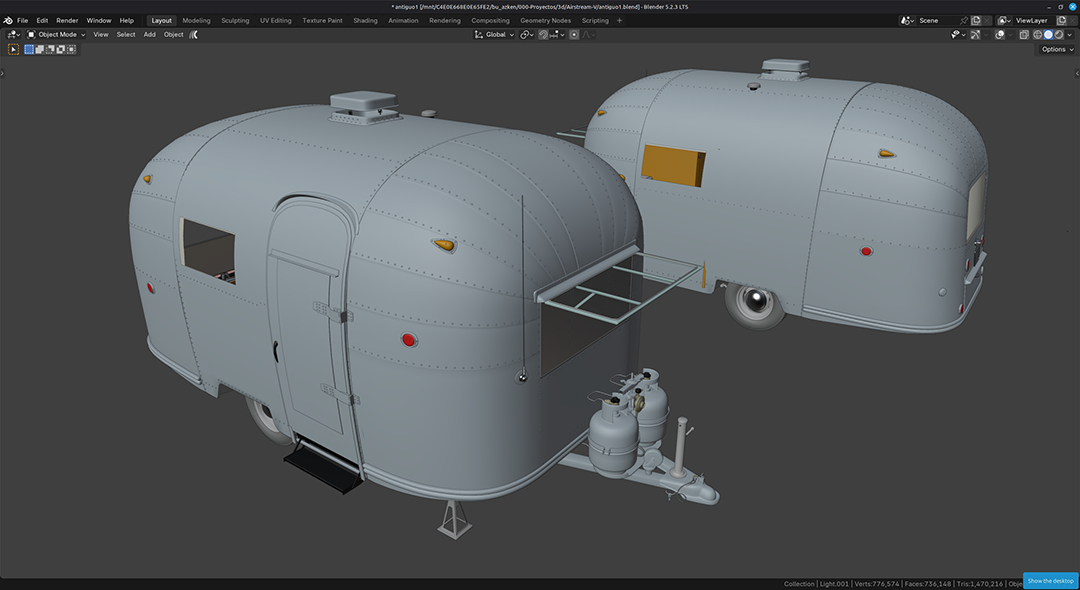
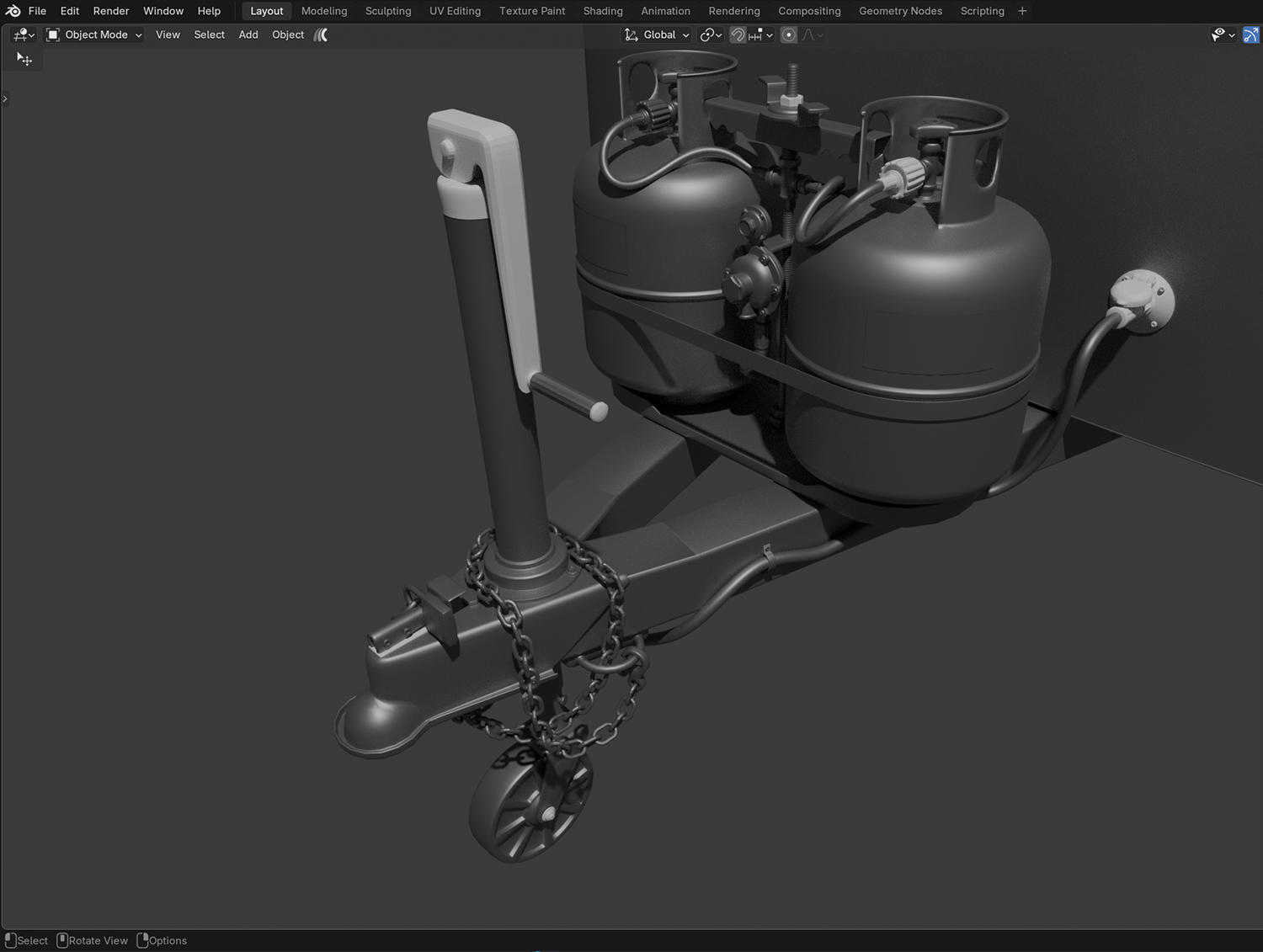
The truth is, I’ve only been here a short while, but I’ve got quite a bit of 3D work under my belt. I used to work with Lightwave and Softimage 3D; it was my hobby, and every now and then I’d get the chance to add a bit of 3D to my usual work as an art director at the advertising agency or for a direct client, but it wasn’t much.
When the pandemic began, I’m not exactly sure why, but I started receiving 3D commissions from contacts in the industry, and things snowballed: ‘Hey, you do 3D stuff, don’t you?’.Around that time, I started looking into Blender. I was really angry about Autodesk’s acquisition and subsequent ‘murder’ of Softimage, and Blender appealed to me partly because I thought no big corporation could ever buy it, let alone shut it down for good.
I’d like to show some of the work I’ve been doing up until exactly four months ago, but I don’t think it’ll be of interest to my fellow BlenderArtists members because it’s basically visualisation work for petrochemical products and more or less industrial machinery. (Bless my former clients and their payments), but there isn’t much glamour in it, and besides, I’m still bound by non-disclosure agreements for a couple more years.
Now that I’ve retired, I’m learning my way around Blender by doing more fun and creative things (like this Airstream caravan, secon image Blender remastering old projects), but, for the moment, I can only share 3D finished images/projects created using programmes other than Blender, and I’m wondering if that would be acceptable on this forum. I haven’t found any information on this in the ‘Rules’ sections, so I’m not sure.
What do you think?
Translated with DeepL.com (free version)
8 Likes
Yes, a mysterious place, beyond time and space
1 Like
when you are at the shader editing steps on your journey, you can render those older models with blender [even if your models are created in other software, it is quite usual, if accounted for the fact in the description of your project].
happy ing!
edit: oooh, you are already the professional you are aspiring [not] to be…
1 Like
I’m wondering why you’re even worried. 
Those models look like they’ve been subdivided, so I’d say you have a better than decent grasp on topology. Given that your working with hard surfaces, repology isn’t something you need to concern yourself with all that much, since it’s usually reserved for paring down the polycount for organic, sculpted models, or objects that are going to be animated to an extreme degree, and need a logical underlying mesh to deform properly.
I guess the only thing you need to learn is the shader editor, and if you’ve used Photoshop, you pretty much know what it does. Think of it as instead of stacking adjustment layers and masks on top of an image, you’re stringing nodes together that perform about the same functions. Nodes are a little more freeform, and offer a little more flexibility, but the foundation is about the same.
edit: I don’t even need to look at your wiremesh to know your topology is clean. From that 3rd shot you edited in, I can tell how good it is by the shading. I can see a subd pinch on the circular cutout along the top of your propane tank, but that’s being nitpicky, and I’m sure you know how to fix it. At the VERY least, you probably know as much as I do about modeling.
4 Likes
Linguistically speaking, an ‘Amateur’ is someone who loves what they do.
Weather or not your are getting paid, the best thing for your creative career is loving making art.
I work 8-12 hours a day (often with blender) and I come home and half the time I start playing with blender. I still love it, even after doing it professionally for 18 years now.
I admire your amateur sprit, @currosawa
7 Likes
Once your NDAs are done, please go ahead and share that stuff. Some of us love nothing more than look at hard surfaces flowing into each other
5 Likes
I have found something.
This was published sometime ago, so it’s public

Also this. I made the 3d shots only. Models were provided by client in .step

5 Likes
So sorry to say this… But I think you might be a pro already… 

Those look awesome.
Can’t wait to see what you do with Blender! Please share.
3 Likes
Hello !
You’re sharing super cool stuff, can’t wait to see more ! Especially when it comes to more personal work ! But the commercial was pretty neat !
Well, I’m not 100% aware of the rules, in general there has to be a relation to blender because sometimes some people jump in and spam non blender content just for the sake of exposure without willing to participate in the forum in the meantime.
But maybe you can create something like a sketchbook where you put your past work, so it’s not added to the art gallery but it’s out there for people to enjoy and discuss !
I think anyway since your goal is to work with blender for now on and be an active member of the forum it’s ok to have some of your old work here even if since it’s called blender artists , stuff is supposed to be done at least a bit with blender, unless it’s traditional stuff…
You can asks @joseph if you want to be sure !
Anyway, looking forward to see more cool things from you !
4 Likes
even the Human Progress thread contains lots of material originally created in Lighwave, then worked on again in blender, so if the description of the piece contains this information, might not be any problem…
happy ing!
2 Likes
Thank you for your time and advice.
It doesn’t really matter; I have to admit that my query was about something to do with vanity – a personal quirk of mine. I don’t like playing the role of the old man telling war stories, and at the end of the day, this is a forum about Blender. I feel a positive connection here, so it’s no problem – we need to look ahead and keep everyone happy. Let’s get blending!
Thanks DeepL
3 Likes